MSME Development (Amendment) Bill 2026: Transforming India's Growth Engine
In a massive push towards
Ease of Doing Business
and strengthening the backbone of India's economy, the Parliament passed the MSME Development (Amendment) Bill, 2026
. This crucial legislation overhauls the existing MSMED Act of 2006 to align with the sector's rapid digital and economic expansion. Considering that MSMEs contribute to nearly 31% of the GDP and form the livelihood for over 40 crore people, this amendment strategically addresses payment bottlenecks, institutionalizes time-bound dispute resolution
, and simplifies compliance to boost domestic competitiveness.
Economic Contribution
31.1% of GDP & 48.58% Exports
Udyam Registration
Free & Voluntary for All MSMEs
Core Objective
Time-Bound Dispute Resolution & Decriminalisation
Key Legislative Reforms & Strategic Focus
The
2026 Amendment
introduces sweeping systemic changes. By pivoting from punitive measures to a pro-business framework, the government aims to facilitate robust formal supply chain integration
.
🏛️ Redefined Classification & Digital Support
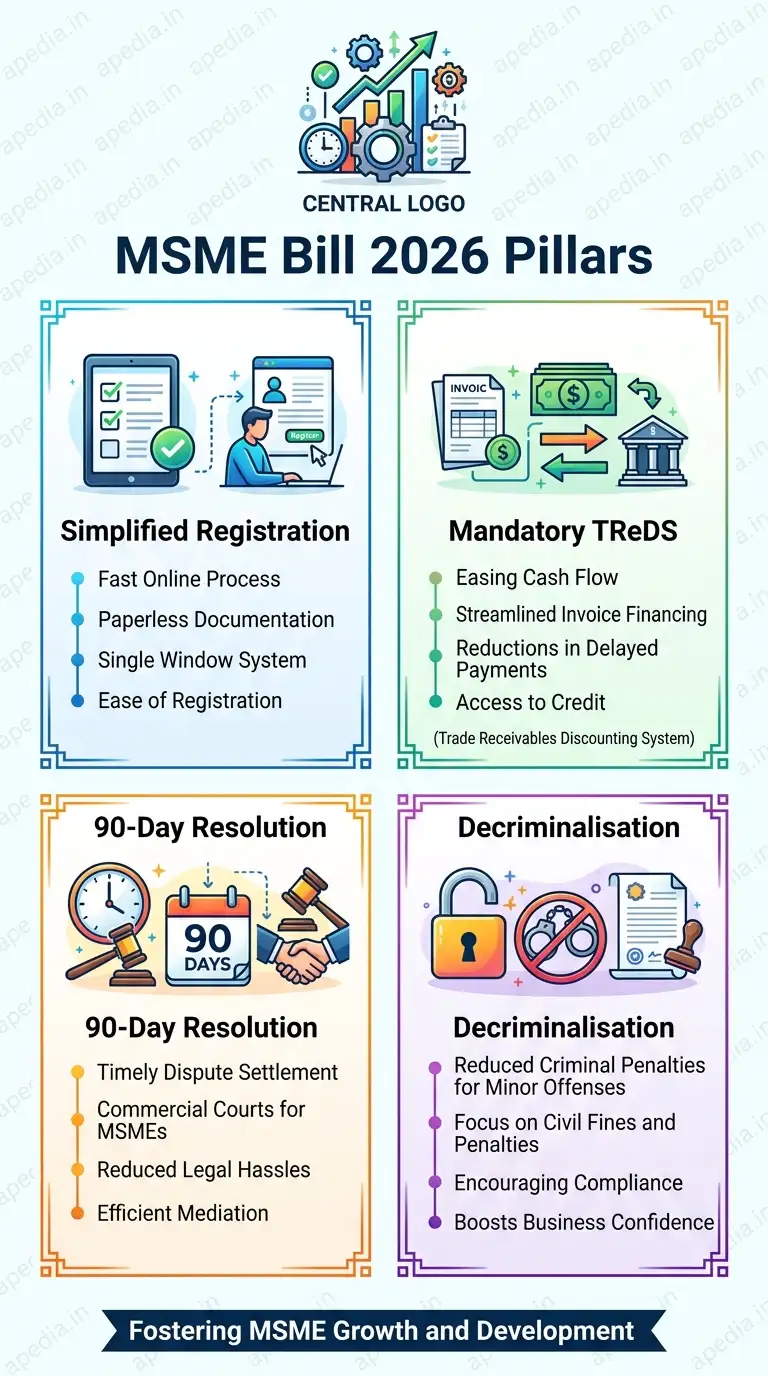
MSMEs are now officially classified based on a dual metric: investment in plant/machinery and turnover. The Udyam platform now offers free, paperless registration, while the Udyam Assist Platform targets the formalization of micro-enterprises lacking GST or active income tax footprint.
💰 TReDS Mandate & Payment Security
To combat chronic liquidity crunches, all
Central Public Sector Enterprises (CPSEs)
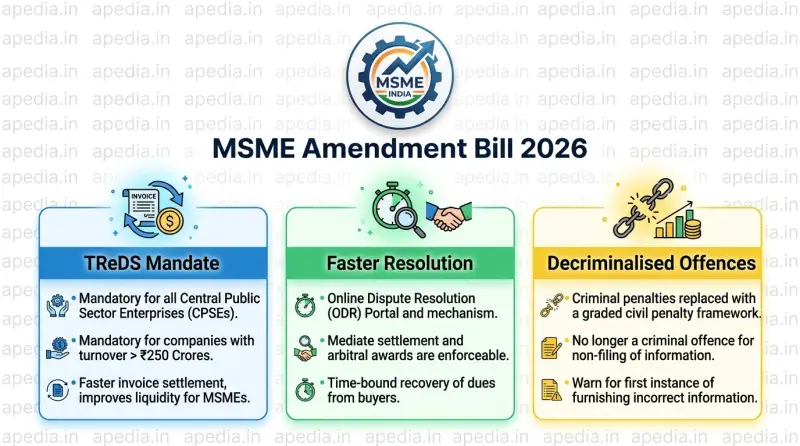
are now legally mandated to settle MSME invoices via the Trade Receivables Discounting System (TReDS). Recovery of settled dues or arbitral awards can now be executed as ‘arrears of land revenue’.🔄 Expedited Dispute Resolution & Decriminalisation
•
90-Day Deadline:
Mediation must be completed within 90 days; if failed, matter goes to arbitration within 30 days.•
Multiple MSE Facilitation Councils (MSEFCs) can be set up by states to clear pendency.
•
Minor offenses (like incorrect info or non-disclosure) are now decriminalized, substituting jail terms with graded warnings and penalties.
If a buyer challenges a Council’s award in court, they must deposit
75% of the awarded amount
. Furthermore, if the appeal remains pending for over six months, the court must direct a minimum 50% payment
to the MSME supplier, safeguarding their working capital.
UPSC CSE Quiz
1. With reference to the Micro, Small and Medium Enterprises Development (Amendment) Bill, 2026, consider the following statements:
1. It restricts the classification of MSMEs strictly to the investment threshold in plant and machinery, dropping the turnover criteria.
2. It mandates all Central Public Sector Enterprises (CPSEs) to settle invoices procured from MSMEs through the TReDS platform.
3. It decriminalises offences such as furnishing incorrect information, replacing convictions with warnings and penalties.
Which of the statements given above is/are correct?
A) 1 and 2 only
B) 2 and 3 only ✓
C) 3 only
D) 1, 2, and 3
Source Information
PIB (Ministry of Micro, Small & Medium Enterprises)