📜 INR vs USD: 1947 - 2026

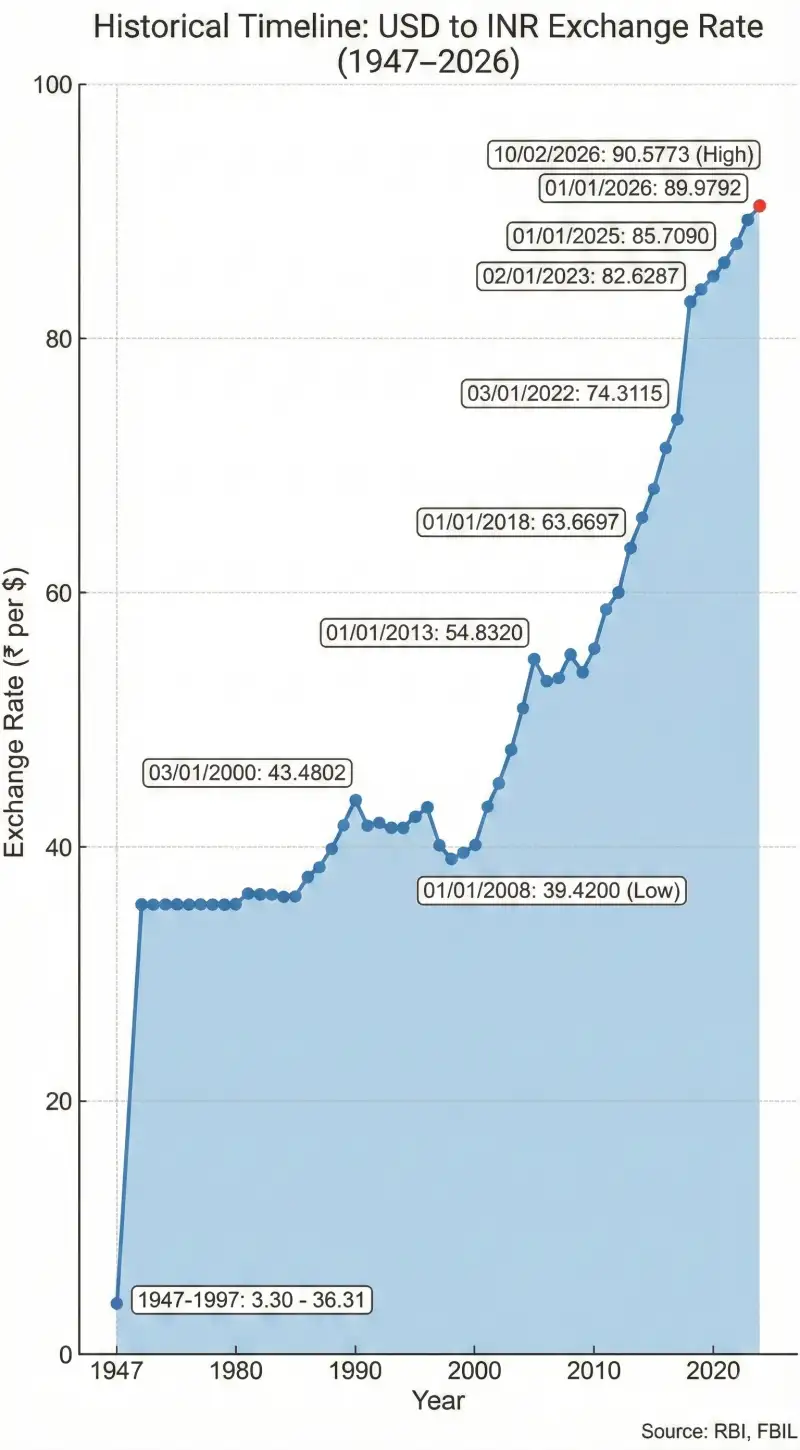
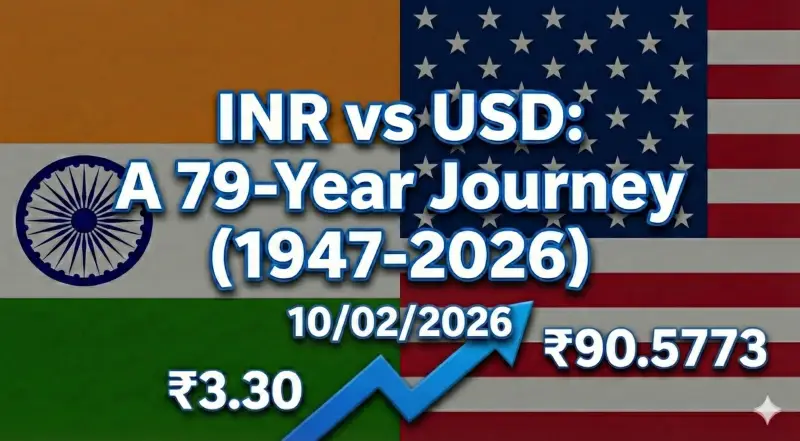
The trajectory of the Indian Rupee (INR) offers a panoramic view of India's economic history. From the early days of a fixed exchange rate regime pegged to the British Pound (approx ₹3.30/$) to the market-determined era post-1993, the currency has witnessed volatility driven by wars (1962, 1965, 1971), the Balance of Payments crisis (1991), and modern global financial shifts, culminating in the ₹90.5773 mark in 2026.

1947
₹3.30
1992
₹25.92
10/02/2026
₹90.577

📊 Exchange Ledger

Period Recorded (INR/USD)
01/01/2026 10/02/2026 Current Year (YTD)
89.9792 90.5773
01/01/2025 31/12/2025 2025 Fiscal
85.7090 89.9198
01/01/2024 31/12/2024 2024 Fiscal
83.1975 85.6232
02/01/2023 29/12/2023 2023 Fiscal
82.6287 83.1164
03/01/2022 30/12/2022 2022 Fiscal
74.3115 82.7862
01/01/2021 31/12/2021 2021 Fiscal
73.0328 74.3025
01/01/2020 31/12/2020 2020 Fiscal
71.3717 73.0536
01/01/2019 31/12/2019 2019 Fiscal
69.7131 71.2740
01/01/2018 31/12/2018 2018 Fiscal
63.6697 69.7923
02/01/2017 29/12/2017 2017 Fiscal
68.0225 63.9273
01/01/2016 30/12/2016 2016 Fiscal
66.1780 67.9547
01/01/2015 31/12/2015 2015 Fiscal
63.3213 66.3260
01/01/2014 31/12/2014 2014 Fiscal
61.9335 63.3315
01/01/2013 31/12/2013 2013 Fiscal
54.8320 61.8970
02/01/2012 31/12/2012 2012 Fiscal
53.2975 54.7773
03/01/2011 30/12/2011 2011 Fiscal
44.6700 53.2660
01/01/2010 31/12/2010 2010 Fiscal
46.6500 44.8100
01/01/2009 31/12/2009 2009 Fiscal
48.7300 46.6800
01/01/2008 31/12/2008 2008 Fiscal (Global Crisis)
39.4200 48.4500
02/01/2007 31/12/2007 2007 Fiscal
44.2000 39.4100
02/01/2006 29/12/2006 2006 Fiscal
45.0500 44.2300
03/01/2005 30/12/2005 2005 Fiscal
43.6100 45.0700
01/01/2004 31/12/2004 2004 Fiscal
45.6100 43.5800
01/01/2003 31/12/2003 2003 Fiscal
47.9900 45.6100
01/01/2002 31/12/2002 2002 Fiscal
48.2400 48.0300
01/01/2001 31/12/2001 2001 Fiscal
46.6600 48.1800
03/01/2000 29/12/2000 2000 Fiscal
43.4802 46.7500
01/01/1999 30/12/1999 1999 Fiscal
42.4701 43.5199
25/08/1998 31/12/1998 1998 (Partial)
42.5007 42.4809
1947 1997 The First 50 Years
3.30 36.31

📝 Why Does INR Depreciate?

I. Structural Determinants
Economic Theory 1. Inflation Differential Theory
According to the Purchasing Power Parity (PPP) theory, a country with a higher inflation rate (India) than its trading partner (USA) will see its currency depreciate. Historically, India averages 5-7% inflation vs 2-3% in the US, naturally eroding the Rupee's value over decades.
Trade Balance 2. Current Account Deficit (CAD)
India consistently imports more than it exports. This creates a "Dollar Deficit." To bridge this gap, India needs to buy dollars, increasing demand for USD and lowering the value of INR.
II. Global & External Headwinds
Energy Security 1. The "Petro-Dollar" Effect
India imports over 85% of its crude oil requirements. Oil is traded globally in USD. Whenever geopolitical tensions (e.g., Middle East conflicts) push oil prices up, India's demand for dollars spikes immediately, weakening the Rupee.
US Fed Policy 2. Capital Flight (FII Outflows)
When the US Federal Reserve hikes interest rates (as seen in 2025-26), global investors pull money out of emerging markets like India to park it in safe US Treasury Bonds. This sudden outflow of dollars crashes the local currency.
III. Socio-Economic Impact
  • Imported Inflation: Expensive dollars make imported goods like edible oil, electronics, and machinery costlier, fueling domestic inflation.
  • Education Cost: Indian students studying abroad face a double whammy—tuition fees and living expenses (rent/food) increase drastically in Rupee terms.
  • External Debt: Companies that borrowed money in dollars (ECBs) have to pay back much more in Rupee terms, straining their balance sheets.
IV. Conclusion & The Way Forward
While short-term volatility is concerning, the RBI actively manages volatility by selling dollars from its Forex Reserves (which stood strong at $600B+ levels). The long-term solution lies in Export Diversification (Make in India), reducing oil dependency (Green Energy transition), and attracting stable FDI (Foreign Direct Investment) rather than volatile FII money.

🏛️ Evolution of Exchange Rate Regimes (GS-3)

A critical chronological timeline for UPSC Mains Answer Writing on Economy.

1947 - 1971 Par Value System
The Rupee was pegged to the British Pound Sterling. The rate was fixed (approx ₹13.33/Pound initially). It followed the Bretton Woods system where most currencies were pegged to the USD or Gold, but India chose the Pound due to historic colonial trade ties.
1975 - 1991 Basket Peg
To avoid shocks from a single currency fluctuation, the Rupee was pegged to a "Basket of Currencies" of India’s major trading partners. The RBI officially determined the daily exchange rate.
1991 - 1993 Transitional Phase (LERMS)
Post-1991 Crisis, India adopted the Dual Exchange Rate system (LERMS). Exporters had to surrender 40% of earnings at a low official rate (for govt imports) and could sell the remaining 60% at a market rate.
1993 - Present Managed Float
India unified the exchange rate. We now follow a Market Determined system where demand and supply decide the rate. However, the RBI intervenes (buys/sells USD) only to reduce volatility, making it a "Managed Float" or "Dirty Float."

🧠 NEER vs REER (Prelims/Mains)

Understanding these terms is vital for analyzing export competitiveness.

NEER (Nominal Effective Exchange Rate)

It is the weighted average value of the Rupee against a basket of currencies of major trading partners.

UPSC Insight: If NEER < 100, the Rupee has depreciated against the basket. NEER does not account for inflation.
REER (Real Effective Exchange Rate)

It is the NEER adjusted for the Inflation Differential between India and its trading partners.

UPSC Insight: REER is the true measure of International Competitiveness. If REER > 100 (Overvalued), our exports become expensive and lose competitiveness.

🚀 Internationalization of Rupee

What is it?
The process of using INR for cross-border transactions (Import/Export) instead of the US Dollar. This reduces India's demand for Dollars and shields the economy from global shocks.
Key Mechanism: Vostro Accounts
Foreign banks open Special Rupee Vostro Accounts (SRVA) with Indian banks. For example, a Russian importer pays Rupees into this account, and Indian exporters are paid from this balance. This mechanism is currently being pushed with countries like Russia, UAE, and Sri Lanka.
Benefits for India (Mains Points)
  • Reduces Exchange Rate Risk for Indian traders.
  • Lowers the Cost of doing business (no conversion fees).
  • Helps save India's precious Forex Reserves.
  • Enhances India's Geo-economic influence globally.
Rupee Journey Graph 1

❓ Frequently Asked Questions (FAQs)

Q1. Was 1 USD really equal to 1 INR in 1947?
No, this is a distinct internet myth. In 1947, India was a British colony/dominion, and the Rupee was pegged to the British Pound. Based on the Pound-Dollar rate of that time, the derived value was approximately ₹3.30 per USD.
Q2. What is the difference between Devaluation and Depreciation?
Devaluation is an official reduction in the value of a currency by the government (happened in 1966 & 1991). Depreciation is when the market forces (supply and demand) reduce the value of the currency (happening now).
Q3. Why doesn't the government just print more dollars?
A country cannot print another country's currency. India can only print Rupees. To get dollars, India must earn them through exports, tourism, or foreign investment.
Q4. How does a weak Rupee help India?
It acts as a stimulus for Exporters. IT companies (TCS, Infosys) and Textile manufacturers earn in dollars. When they convert those dollars to Rupees, they get more money, boosting their profitability and allowing them to employ more people.
Q5. What is the RBI doing to stop the fall?
The RBI uses its Forex Reserves to intervene. When the Rupee falls too sharply, the RBI sells dollars into the market to increase supply and stabilize the price. They do not target a specific rate but try to prevent "wild volatility."
Q6. I am a student planning to study abroad. How does this affect me?
The impact is direct. If your university fee is $50,000, at ₹70/$, it cost ₹35 Lakhs. At ₹90/$, the same fee costs ₹45 Lakhs. You will need to budget for a 20-25% increase in your education loan requirements.
Source Information: RBI & FBIL Database and Historical Archives (Feb 11, 2026)
View Official FBIL Charts