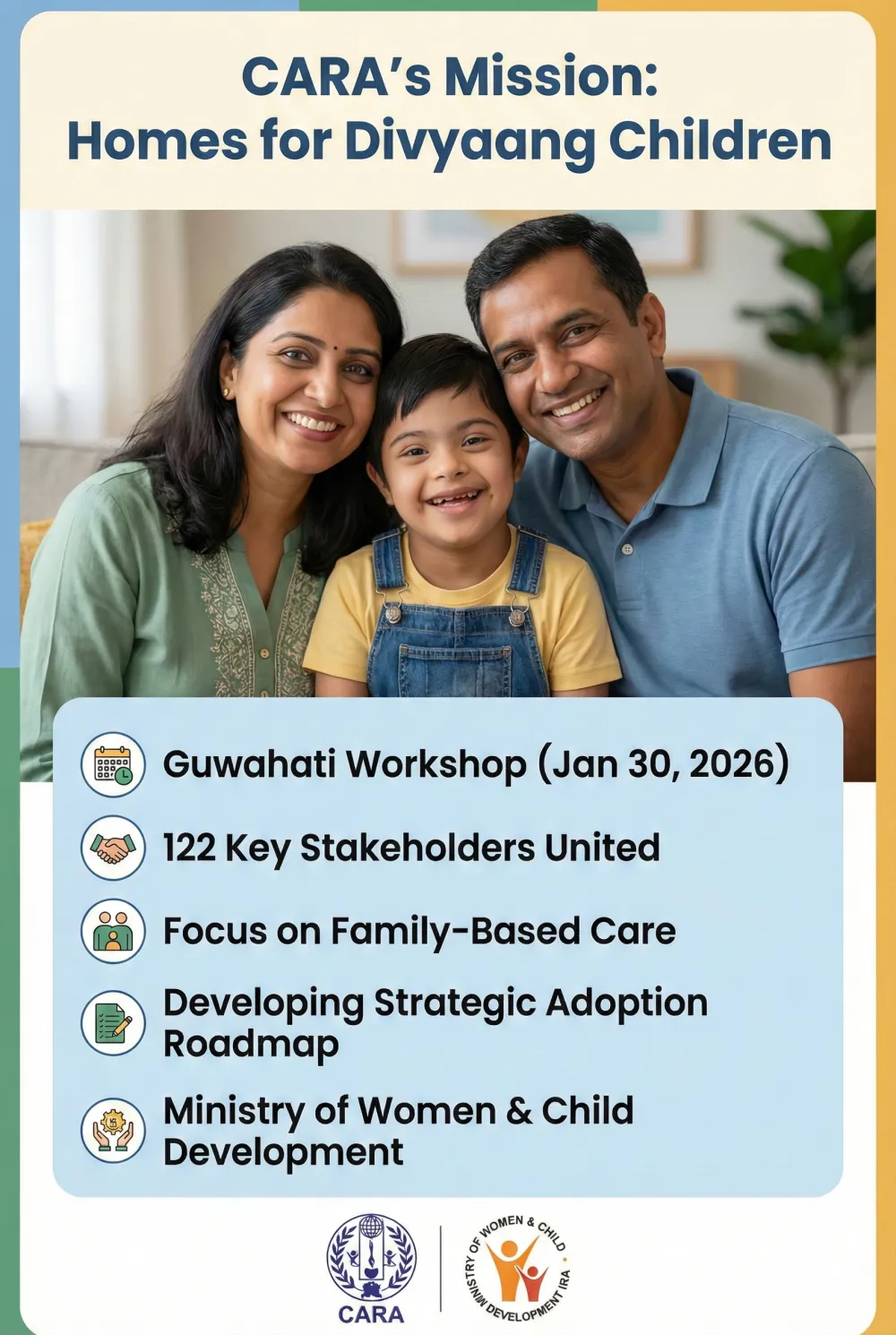
On January 30, 2026, the Central Adoption Resource Authority (CARA), operating under the Ministry of Women and Child Development, took a significant step toward improving the lives of children with special needs. A crucial Regional Consultative Workshop was held in Guwahati, Assam, focusing on "Promoting Non-Institutionalised Rehabilitation of Children with Special Needs (Divyaang Children)." The event underscored the government's pivot toward family-based care rather than permanent institutionalization.
CARA (Ministry of WCD)
Guwahati, Assam
122 Stakeholders
Adoption of Divyaang Children
Strategic Roadmap Development
Stakeholder Convergence
The consultation brought together a diverse group of experts, including representatives from State Adoption Resource Agencies (SARAs), District Child Protection Units (DCPUs), and Chief Medical Officers. This strong turnout highlights a unified institutional commitment to solving complex adoption challenges in the region.
Strategic Deliberations
Participants engaged in structured group discussions covering four critical pillars of the adoption ecosystem:
- Medical Assessment: Standardizing health evaluations for children with special needs.
- Legal Frameworks: Simplifying procedural aspects to expedite adoption.
- Operations: Addressing financial and administrative hurdles.
- Coordination: improving grievance redressal and inter-agency cooperation.
Future Action Plan
The workshop concluded with a firm resolve to draft a comprehensive roadmap aimed at boosting domestic adoption numbers for Divyaang children. The strategy focuses on enhancing the capacity of frontline workers and ensuring Prospective Adoptive Parents are well-informed and supported.
CARA's Commitment
CARA reiterated its dedication to the principle that every child deserves a permanent family environment. The authority emphasized that transparency, child welfare, and the "best interest of the child" remain the guiding lights for all future policy implementations.
Official Press Release: Ministry of Women and Child Development (PIB)