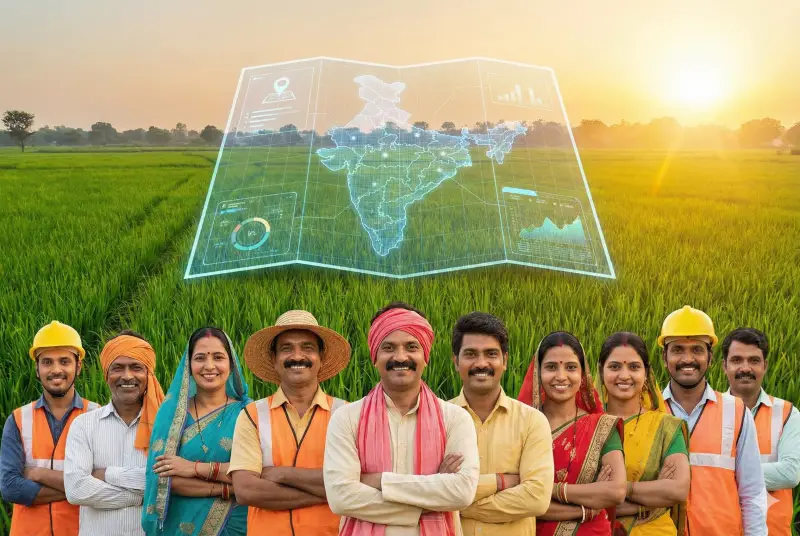
The Government of India has introduced a transformative statutory framework titled the VB-GRAM G Act, 2025 (Viksit Bharat Guarantee for Rozgar and Ajeevika Mission). This new legislation is designed to align India's rural development infrastructure with the ambitious vision of Viksit Bharat @2047. The primary goal is to move beyond simple employment generation towards creating durable assets and sustainable livelihoods.
This mission focuses on empowerment, convergence, and saturation, ensuring that rural households not only receive wage support but also contribute to a modern "National Rural Infrastructure Stack."
VB-GRAM G Act, 2025
125 Days per Financial Year
Rural Households (Adult Volunteers)
AI, Biometrics, GPS, PM Gati Shakti
Ministry of Rural Development
Enhanced Employment Guarantee
Unlike previous schemes that typically offered 100 days, the new Act explicitly guarantees 125 days of wage employment in a financial year to rural households willing to do unskilled manual work. This is intended to provide a stronger safety net and facilitate labor availability during non-peak agricultural seasons.
Four Thematic Domains of Work
Works under this mission are categorized into four specific domains to ensure strategic development:
- Water Security: Water-related conservation and management works.
- Core Rural Infrastructure: Building essential connectivity and facilities.
- Livelihood-Related Infrastructure: Assets that directly support rural income generation.
- Disaster Mitigation: Special works to handle extreme weather events (floods, cyclones, droughts) and climate adaptation.
Digital Ecosystem & AI
The government is modernizing governance through a "Whole of Government" delivery approach. Key technological integrations include:
- Biometric Authentication to prevent identity fraud.
- Real-time MIS Dashboards for transparency.
- Use of Artificial Intelligence (AI) for planning, auditing, and fraud risk mitigation.
- PM Gati Shakti integration for geospatial planning of rural assets.
The scheme operates as a Centrally Sponsored Scheme with the following fund-sharing ratios:
- 90:10 Ratio: For North-Eastern States, Himalayan States, and UTs (Uttarakhand, Himachal Pradesh, J&K).
- 60:40 Ratio: For all other States and Union Territories with a legislature.
Allocations will be determined based on objective parameters set by the Central Government.
"The primary objective of this Act is to align the rural development framework with the national vision of Viksit Bharat @2047... enabling rural households to participate more effectively in the expanded livelihood security framework."
— Shri Kamlesh Paswan, Minister of State for Rural Development.
For the full official text and details, please refer to the Press Information Bureau release:
Click here to read the Official Press Release