
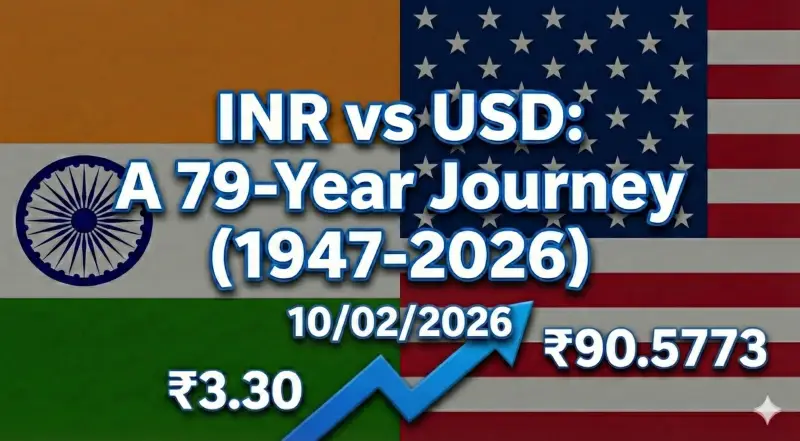
The history of the Indian Rupee is a reflection of India's economic evolution—from a closed economy pegged to the British Pound in 1947 to a liberalized market force today. Starting at approximately ₹3.30 per Dollar at independence, the currency has navigated wars, oil shocks, and global financial crises to breach the ₹90 mark in February 2026.
₹3.30 / $1
Rupee was pegged to the British Pound. The rate against USD was derived from this peg.
₹25.00 / $1
Severe Balance of Payments crisis forced a major devaluation and liberalization.
₹68.00 / $1
Panic selling occurred as the US Fed signaled tapering of bond-buying.
₹90.58 / $1
High US bond yields and global oil demand pushed the Rupee past ₹90.
A detailed look at the exchange rate at the close of major years.
| Year | Reference Date | Value (₹ per $) |
|---|---|---|
| 2026 | Feb 10, 2026 | 90.58 |
| 2025 | Dec 31, 2025 | 89.91 |
| 2024 | Dec 31, 2024 | 85.62 |
| 2023 | Dec 31, 2023 | 83.11 |
| 2022 | Dec 30, 2022 | 82.78 |
| 2021 | Dec 31, 2021 | 74.30 |
| 2020 | Dec 31, 2020 | 73.05 |
| 2019 | Dec 31, 2019 | 71.27 |
| 2018 | Dec 31, 2018 | 69.79 |
| 2017 | Dec 29, 2017 | 63.92 |
| 2016 | Dec 30, 2016 | 67.95 |
| 2015 | Dec 31, 2015 | 66.32 |
| 2014 | Dec 31, 2014 | 63.33 |
| 2013 | Dec 31, 2013 | 61.89 |
| 2012 | Dec 31, 2012 | 54.77 |
| 2011 | Dec 30, 2011 | 53.26 |
| 2010 | Dec 31, 2010 | 44.81 |
| 2009 | Dec 31, 2009 | 46.68 |
| 2008 | Dec 31, 2008 | 48.45 |
| 2007 | Dec 31, 2007 | 39.41 |
| 2000 | Dec 29, 2000 | 46.75 |
| 1998 | Dec 31, 1998 | 42.48 |
| 1991 | (Devaluation) | 25.00 |
| 1980 | (Approx) | 7.86 |
| 1966 | (Devaluation) | 7.50 |
| 1947 | Independence | 3.30 |
The depreciation is not merely a sign of weakness but a result of structural economic factors over the last 79 years.
- Import Dependence: India imports over 85% of its crude oil requirements. When oil prices rise, India needs more Dollars to pay for it, weakening the Rupee.
- Inflation Differentials: Historically, India's inflation rate has been higher than the US. Currencies of countries with higher inflation tend to depreciate over the long term.
- Global Capital Flows: In 2026, high interest rates in the US attracted foreign investors away from emerging markets like India, putting pressure on the currency.
A weaker Rupee leads to "Imported Inflation." Essentials like petrol, diesel, edible oils, and electronics (smartphones/laptops) become more expensive. However, it benefits Indian Exporters, particularly in the IT and Pharma sectors, who earn in Dollars.
Source: RBI Database & Historical Forex Archives
Date: 11 FEB 2026