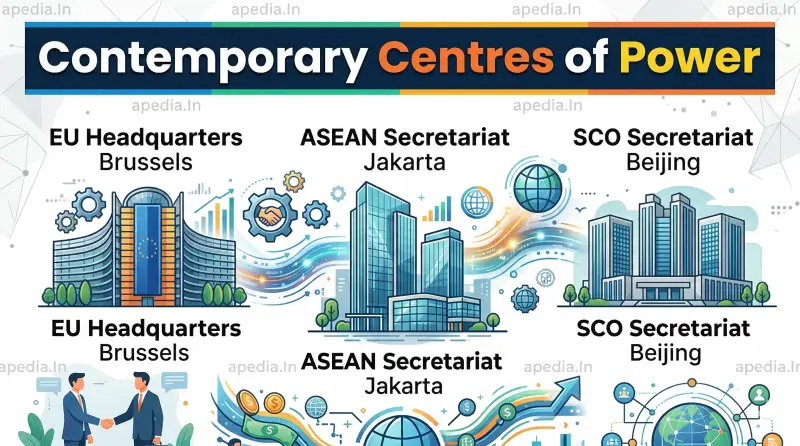
🏛️ Contemporary Centres of Power
🇪🇺 Module 1: The European Union (EU)
After the end of the bipolar structure of world politics, alternative centres of political and economic power emerged to limit America's dominance. In Europe, the process of integration was aided by the Cold War and massive financial help from America, known as the Marshall Plan.
Evolution of the EU
- Early Steps: Under the Marshall Plan, the Organisation for European Economic Cooperation (OEEC) was established in 1948. This was followed by the Council of Europe in 1949 for political cooperation, and the European Economic Community (EEC) in 1957.
- Formation: The collapse of the Soviet bloc put Europe on a fast track, leading to the establishment of the European Union in 1992 through the Treaty of Maastricht.
- Influence: The EU has evolved from an economic union into a highly political one, acting more like a nation-state with its own flag, anthem, founding date, and a common currency called the euro. Its GDP is projected to be approximately $19.35 trillion by 2024, giving it massive economic and diplomatic influence.
- Limitations: Member states often have their own foreign and defense policies that are at odds with each other (e.g., Britain's role in the Iraq invasion vs. France and Germany's opposition), and there is deep-seated 'Euro-skepticism' in parts of Europe.
📝 Concept Check 1
1. What was the massive financial aid extended by America to revive Europe's economy called?
The Marshall Plan.
2. In which year was the European Union formally established?
1992.
3. What is the common currency of the European Union called?
The euro.
4. Which country exited the EU following a referendum in 2016?
Britain (Brexit).
🌏 Module 2: Association of South East Asian Nations (ASEAN)
To avoid the historical enmities and the pressure of the Cold War, Southeast Asian nations established their own alternative centre of power.
The ASEAN Approach
- Founding: ASEAN was established in 1967 by five countries—Indonesia, Malaysia, the Philippines, Singapore, and Thailand—by signing the Bangkok Declaration. Today, it has ten members.
- The ASEAN Way: Unlike the EU, ASEAN prefers an informal, non-confrontationist, and cooperative form of interaction, strongly respecting national sovereignty.
- The Three Pillars: In 2003, ASEAN agreed to establish an ASEAN Community comprising the Security Community, the Economic Community, and the Socio-Cultural Community.
- Security and Economy: The ASEAN Regional Forum (ARF), established in 1994, handles security and foreign policy coordination. Economically, ASEAN focuses on creating a Free Trade Area (FTA) and is the fastest-growing economy in the region.
🐉 Module 3: The Rise of the Chinese Economy
China's economic success since 1978 has drastically altered world politics, with projections suggesting it could overtake the US as the world's largest economy by 2040.
From Isolation to Open Door
- Early Phase: After the 1949 communist revolution under Mao, China adopted the Soviet model, severing links with the capitalist world and building a state-owned heavy industries sector.
- The Turnaround: In 1972, China ended its isolation by establishing relations with the US. In 1973, Premier Zhou Enlai proposed the 'four modernisations'.
- The Open Door Policy: In 1978, leader Deng Xiaoping announced the 'open door' policy to generate higher productivity through foreign capital and technology. Instead of 'shock therapy', China opened up step-by-step: privatizing agriculture in 1982 and industry in 1998.
- India-China Relations: Despite the brief 'Hindi-Chini bhai-bhai' era, relations soured over the Chinese takeover of Tibet in 1950 and the 1962 border conflict regarding Arunachal Pradesh and Aksai Chin. Relations slowly improved after Rajiv Gandhi's visit in 1988, shifting focus toward immense economic trade and strategic dialogue.
📝 Concept Check 2
1. Which five nations were the founding members of ASEAN in 1967?
Indonesia, Malaysia, the Philippines, Singapore, and Thailand.
2. Who announced the 'open door' policy in China in 1978?
Deng Xiaoping.
3. When did China privatize agriculture and industry, respectively?
Agriculture in 1982, and industry in 1998.
4. The 1962 border conflict between India and China was principally over which two regions?
Arunachal Pradesh and the Aksai Chin region of Ladakh.