🛡️ Security in the Contemporary World
⚔️ Module 1: Traditional Notions of Security
At its most basic level, security implies freedom from threats. However, in political science, security relates only to extremely dangerous threats that could endanger "core values" that would be damaged beyond repair if left unaddressed.
External and Internal Threats
- External Threats: In the traditional conception of security, the greatest danger to a country is military threats from another country. Military action endangers the core values of sovereignty, independence, and territorial integrity.
- State Responses: When threatened with war, a government essentially has three choices: surrender, prevent the disaster (deterrence), or defend itself if war breaks out.
- Balance of Power & Alliances: To prevent attacks, countries build up their military power and form alliances (coalitions of states coordinating their actions to deter or defend against military attacks).
- Internal Threats: Traditional security also concerns internal peace and order. After the Second World War, newly independent nations, particularly in Asia and Africa, faced immense internal challenges from separatist movements wanting to form independent countries, alongside external threats from neighbors.
📝 Concept Check 1
1. What are the "core values" a state seeks to protect from external military threats?
Sovereignty, independence, and territorial integrity.
2. What are the three basic choices a government has when facing war?
Surrender, prevent/deter, or defend itself.
3. What is a coalition of states that coordinate their actions to deter or defend against military attack called?
An alliance.
🌍 Module 2: Non-Traditional Security & New Threats
Non-traditional notions of security move beyond military threats to include a wider range of dangers affecting human existence. They question *what* is being secured: the state or the individual?
Human and Global Security
- Human Security: This concept focuses on the protection of people more than the protection of states. Proponents argue that citizens need protection not just from foreign armies, but from hunger, disease, natural disasters, and internal violence.
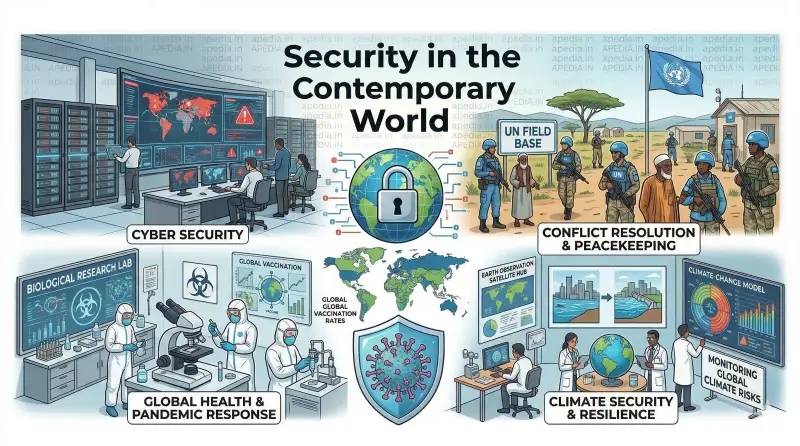
- Global Security: This emerged in response to threats like global warming, international terrorism, and health epidemics (like HIV-AIDS, bird flu, COVID-19). Because these issues cross borders, no single country can resolve them alone.
New Sources of Threats
- Terrorism: Political violence that deliberately targets civilians indiscriminately to terrorize the public and pressure governments.
- Poverty and Inequality: Global poverty remains a massive driver of insecurity, especially with stark disparities between the rich nations of the Northern Hemisphere and the poorer nations of the South.
- Migration and Displacement: Poverty and armed conflicts lead to mass displacements. It is important to distinguish between refugees (fleeing war, natural disasters, or persecution) and migrants (voluntarily leaving for better economic opportunities). Internally displaced people flee their homes but remain within national borders.
📝 Concept Check 2
1. What is the primary focus of "human security"?
The protection of individuals and people, rather than just the state.
2. How does terrorism primarily achieve its political goals?
By deliberately targeting civilians indiscriminately to create widespread terror.
3. What is the difference between a refugee and a migrant?
Refugees flee from war, persecution, or disasters; migrants leave voluntarily for better economic prospects.
🤝 Module 3: Cooperative Security and India's Strategy
Dealing with both traditional and non-traditional threats increasingly requires international cooperation. Military force is often useless against poverty, migration, or disease.
Traditional Security Cooperation
- Disarmament: Requires states to give up certain weapons. For example, the 1972 Biological Weapons Convention (BWC) and 1992 Chemical Weapons Convention (CWC) banned the production and possession of these weapons.
- Arms Control: Regulates the acquisition or development of weapons, such as the Anti-Ballistic Missile (ABM) Treaty of 1972 and the Nuclear Non-Proliferation Treaty (NPT) of 1968.
- Confidence Building: A process where countries share ideas and information with rivals to avoid misunderstandings and accidental wars.
India's Four-Pronged Security Strategy
- 1. Strengthening Military Capabilities: Because India faces conflicts with neighbors like Pakistan and China, it has invested in military strength, including conducting nuclear tests in 1998 to safeguard national security.
- 2. Strengthening International Norms: India actively supports international institutions, championed the Non-Aligned Movement (NAM), pushed for universal disarmament, and argued for a more equitable global economic order.
- 3. Meeting Internal Security Challenges: India has sought to manage internal conflicts (such as in Nagaland, Mizoram, Punjab, and Kashmir) through democratic political accommodations and preserving national unity.
- 4. Economic Development: A core component of India's security is developing its economy to eradicate mass poverty and lift citizens out of misery.