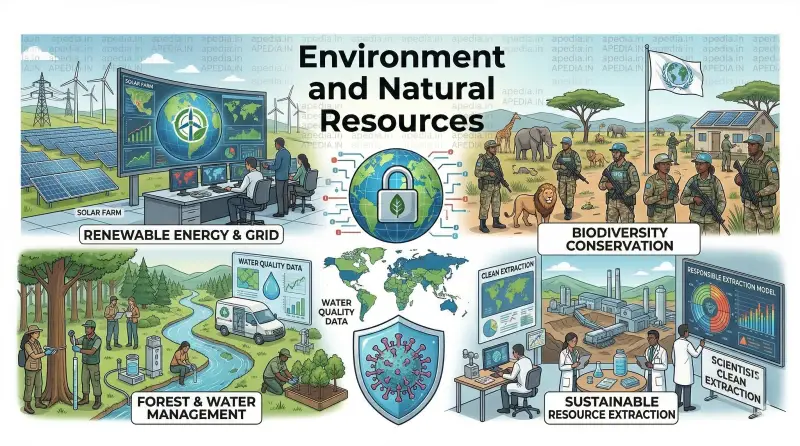
🌍 Environment and Natural Resources
🌱 Module 1: Environmental Concerns & The Earth Summit
Environmental issues like the depletion of agricultural land, water scarcity, deforestation, and the ozone hole have profound political consequences, bringing them into the realm of 'world politics'.
The Rise of Global Environmentalism
- Early Warnings: The political character of environmental degradation grew in the 1960s. In 1972, the Club of Rome published Limits to Growth, highlighting resource depletion against a booming population. The United Nations Environment Programme (UNEP) soon began coordinating international responses.
- The 1992 Earth Summit: The UN Conference on Environment and Development in Rio de Janeiro (the Earth Summit) consolidated these issues globally. It highlighted a divide: the 'global North' (developed countries) focused on ozone depletion and global warming, while the 'global South' (developing countries) prioritized the link between economic development and environmental management.
- Agenda 21 & Sustainable Development: The summit produced 'Agenda 21', a list of development practices aimed at achieving 'sustainable development'—combining economic growth with ecological responsibility.
📝 Concept Check 1
1. What influential book was published by the Club of Rome in 1972?
Limits to Growth.
2. Where was the 1992 Earth Summit held?
Rio de Janeiro, Brazil.
3. What was the list of recommended development practices from the Rio Summit called?
Agenda 21.
🌐 Module 2: Global Commons & Differentiated Responsibilities
Some resources are not owned by anyone but are shared by a community, known as 'commons'. At a global level, these present unique political challenges.
Managing Shared Spaces
- The Global Commons: Areas outside sovereign jurisdiction requiring international governance are called global commons. These include the earth's atmosphere, Antarctica, the ocean floor, and outer space. Key agreements include the 1959 Antarctic Treaty and the 1987 Montreal Protocol.
- Common but Differentiated Responsibilities: The global South successfully argued that since developed nations caused most of the historical ecological damage during their industrialization, they should bear a greater responsibility for fixing it. Developing nations, still industrializing, should not face the same strict restrictions.
- The Kyoto Protocol (1997): An agreement setting targets for industrialized countries to cut greenhouse gas emissions. Based on the UNFCCC principles, developing nations like India and China were initially exempted from these requirements due to their low historical emissions.
🛢️ Module 3: Resource Geopolitics & Indigenous Rights
Global politics is deeply intertwined with the struggle to access strategic resources and the impact this has on marginalized communities.
The Scramble for Resources
- Oil Politics: Oil remains the most crucial resource in global strategy. The Gulf region in West Asia accounts for about 30% of global production and holds 64% of known reserves, making it a focal point of geopolitical struggles and interventions.
- Water Wars: Shared river resources can lead to severe conflicts between upstream and downstream states over dam construction or pollution, with commentators predicting future "water wars".
- Environmental Movements: Around the world, powerful movements resist environmental destruction. This includes anti-mining campaigns (like against the WMC in the Philippines) and anti-dam/pro-river movements (like the Narmada Bachao Andolan in India).
- Indigenous Peoples: Defined as descendants of original inhabitants whose lands were overtaken by other cultures, they face severe threats from the loss of their lands and economic base due to developmental projects. In India, they are often referred to as Scheduled Tribes (about 8% of the population).
📝 Concept Check 2
1. What are the earth's atmosphere, Antarctica, and outer space collectively known as?
The global commons.
2. Why were India and China initially exempt from the Kyoto Protocol?
Because their historical greenhouse gas emissions were relatively low.
3. Which region holds about 64% of the planet's known oil reserves?
West Asia (specifically the Gulf region).
4. What is the prominent anti-dam movement in India mentioned in the text?
Narmada Bachao Andolan.