🌍 Globalisation
🌐 Module 1: The Concept and Causes of Globalisation
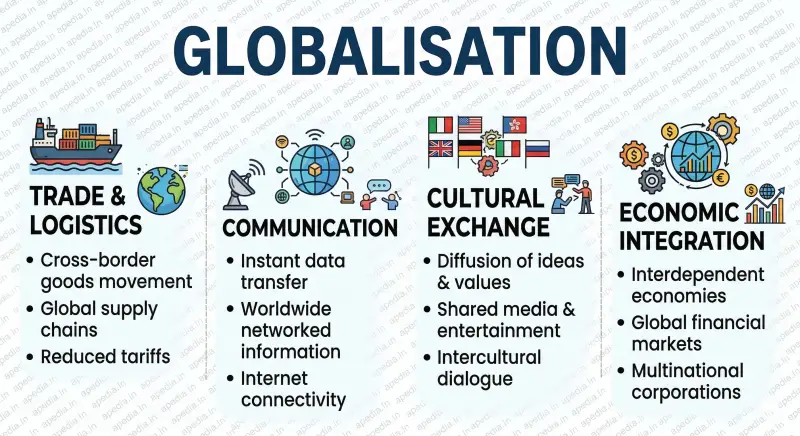
Globalisation is a multi-dimensional concept with political, economic, and cultural manifestations. It fundamentally deals with flows—ideas, capital, commodities, and people moving across the world.
Worldwide Interconnectedness
- The Core Element: The crucial element of globalisation is the 'worldwide interconnectedness' that is created and sustained as a consequence of these constant flows. Events in one part of the world (like a tsunami or bird flu) impact other parts.
- The Role of Technology: While globalisation has historical roots, the scale and speed of contemporary flows are unique. Technology (telegraph, telephone, microchip, internet) remains a critical element that has revolutionized global communication and movement.
- Uneven Impact: Globalisation affects some societies more than others and some parts of societies more than others; it is not purely an economic phenomenon and has both positive and negative consequences.
📝 Concept Check 1
1. What does the concept of globalisation fundamentally deal with?
Flows of ideas, capital, commodities, and people.
2. What is the crucial element sustained by these flows?
Worldwide interconnectedness.
3. What critical element accounts for the unique scale and speed of contemporary globalisation?
Technology.
⚖️ Module 2: Political and Economic Consequences
Globalisation sparks intense debate regarding its impact on the traditional sovereignty of states and the distribution of economic wealth.
State Capacity and Economy
- The Minimalist State: Politically, the old 'welfare state' is giving way to a more minimalist state that focuses on core functions like law, order, and security, while withdrawing from welfare functions. The market becomes the prime determinant of social priorities.
- Boost in State Power: Conversely, state capacity can also receive a boost due to enhanced technologies available to collect information about citizens, allowing the state to rule better.
- Economic Globalisation: This involves international institutions like the IMF and WTO, and greater flows of trade and capital. Advocates argue it generates greater economic growth and well-being.
- Critics and Safety Nets: Critics argue economic globalisation disproportionately benefits a small section while impoverishing others, calling for 'social safety nets' to protect the economically weak. Some even describe it as the "re-colonisation" of the world.
📝 Concept Check 2
1. Under globalisation, the welfare state is largely giving way to what?
A minimalist state.
2. What institutions are prominently involved in determining global economic policies?
The IMF and the WTO.
3. What do critics demand to minimize the negative economic effects on the weak?
Institutional safeguards or 'social safety nets'.
🎭 Module 3: Cultural Impact and Resistance
Globalisation also significantly affects our homes, what we eat, drink, wear, and think, leading to complex cultural dynamics and global resistance movements.
Culture and the Indian Experience
- Homogenisation vs. Heterogenisation: The fear that globalisation imposes Western culture (the "McDonaldisation" of the world) is called cultural homogenisation. However, it can also lead to cultural heterogenisation, where each culture becomes more distinctive, or creates unique combinations (like a khadi kurta over blue jeans).
- India's Journey: Following the colonial experience, post-independence India adopted 'protectionism' to build domestic industries. In 1991, responding to a financial crisis, India embarked on a programme of economic reforms and de-regulation.
- Global Resistance: Resistance takes many forms. The World Social Forum (WSF) brings together activists opposed to neo-liberal globalisation, with its first meeting in Brazil in 2001 and its fourth in Mumbai in 2004. In 1999, massive protests occurred at the WTO meeting in Seattle.
- Resistance in India: Left-wing groups and trade unions protest economic liberalization and the entry of multinationals. The political right objects to cultural influences like foreign TV channels, Valentine's Day, and western dress. There has also been strong opposition to the patenting of plants like Neem by foreign firms.