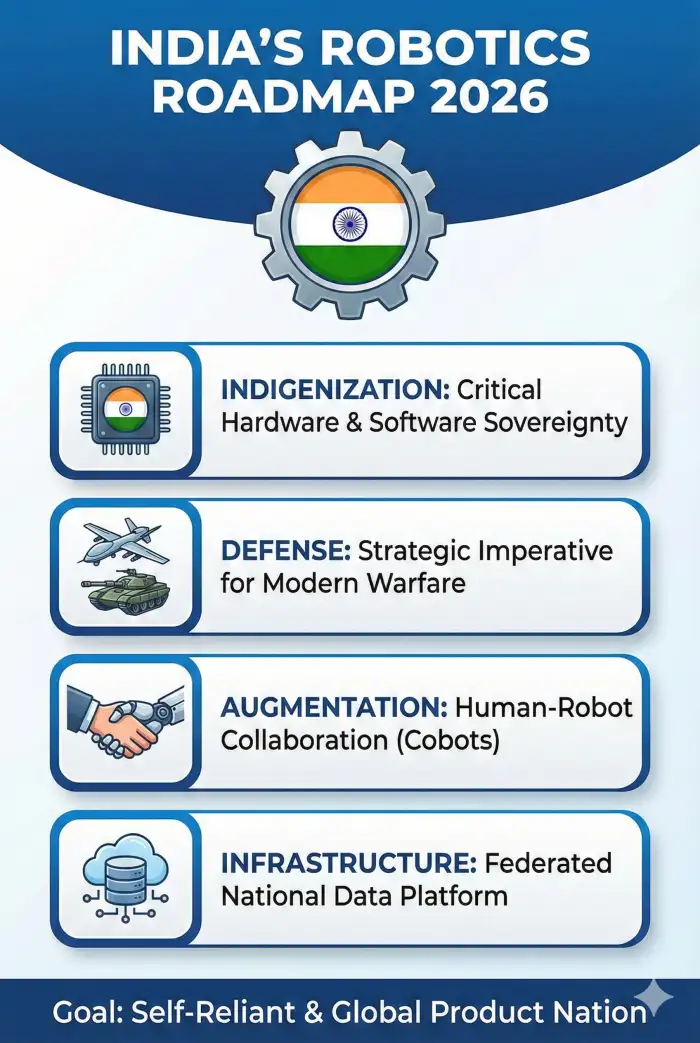
On February 3, 2026, a high-level meeting of the Technology Advisory Group (TAG) was convened under the chairmanship of Prof. Ajay Kumar Sood, the Principal Scientific Adviser (PSA) to the Government of India. The primary agenda was to define a strategic roadmap for the robotics ecosystem in India. The discussion focused on shifting from mere assembly to indigenization and leveraging robotics as a tool for "augmentation" of human labor rather than replacement.
Prof. Ajay Kumar Sood (PSA)
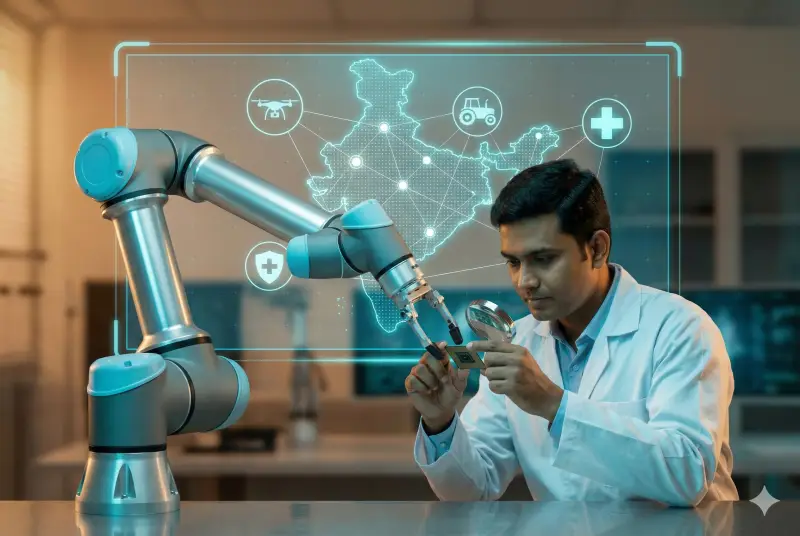
Strategic Roadmap for Robotics & Physical AI
Ministry of Electronics & IT (MeitY)
Defense, Healthcare, Agriculture, Manufacturing
1. Vision for Indigenization
Prof. Sood emphasized that India must become self-reliant in robotics. The goal is to move towards "Software Sovereignty" and indigenize critical design tools, a sentiment echoed by DRDO Chairman Dr. Sameer Kamat.
2. Defense as a Priority
Lt Gen N.S. Raja Subramani highlighted that integrating robotics into national defense is no longer optional but a strategic imperative for modern warfare, calling for unmanned and dual-use platforms.
3. The National Strategy Framework
MeitY Secretary Shri S. Krishnan noted that the existing IndiaAI Mission and Semiconductor Mission serve as foundational pillars for a future dedicated Robotics Mission.
4. Academic & Industry Inputs
- IIT Madras: Stressed the need for a national "Tactile Intelligence" initiative (Touch technology in robots).
- ARTPARK (IISc): Focused on moving research from labs to market-ready solutions.
- Startups: Founders from GreyOrange and General Autonomy called for Production Linked Incentives (PLI) and "Grand Challenges" to boost domestic manufacturing.
The group identified several critical gaps that make India vulnerable:
- Hardware Deficit: Lack of domestic manufacturing for actuators, sensors, chipsets, and precision gears.
- Standards Gap: Need for a unified regulatory framework and testing labs to ensure Indian robots meet global safety norms (ISO/CE) for export.
- Data Infrastructure: A consensus was reached on building a Federated National Data Infrastructure to support robotics use cases.
"Robotics should be viewed as a force multiplier for national missions... and a cornerstone of high-value manufacturing." — Prof. Ajay Kumar Sood, Principal Scientific Adviser to GoI.
For the full official text, please refer to the Press Information Bureau release:
Click here to read the Official Press Release