News Economy

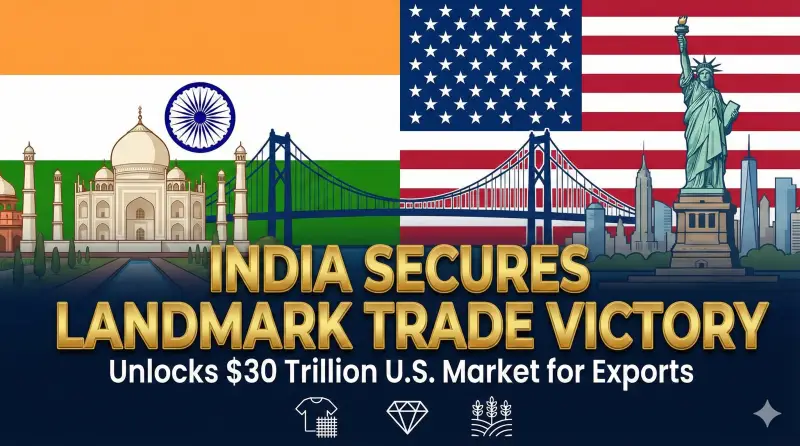
India Achieves Landmark Trade Victory: Unlocks $30-Trillion U.S. Market

Topic: India-US Bilateral Trade Agreement

#IndiaUS #TradeAgreement #ExportBoost #ZeroDuty #UPSC
🚀 Introduction: A Historic Milestone

The India–U.S. Bilateral Trade Agreement marks a major milestone in India’s global trade engagement. By securing preferential access to the massive $30 trillion U.S. market, the deal offers comprehensive tariff rationalisation and zero-duty access across large product categories. Crucially, it includes a calibrated framework to safeguard India’s farmers, MSMEs, and domestic industries.

📊 Key Highlights & Benefits
Tariff Reduction
50% ➔ 18%
On key exports like textiles & machinery.
Zero Duty Access
$1.36 Billion
Agri exports (Tea, Coffee, Spices) get 0% duty.
Reciprocal Tariffs
Major Cuts
$30.94 Bn exports see duty drop to 18%.
Market Size Unlocked
$30 Trillion
Access to vast US consumer base.
🏭 Sectoral Gains & Opportunities

The agreement creates a clear tariff differential favoring India over competitors like China and Vietnam.

  • Textiles & Apparel: Silk gets 0% duty. Tariffs on garments dropped to 18%. Boosts job creation.
  • Gems & Jewellery: 0% duty on diamonds & platinum ($29 Bn market). General tariff cut to 18%.
  • Agriculture: Zero duty for spices, tea, coffee, mangoes, etc. Sensitive sectors (Dairy, Meat, Cereals) fully protected.
  • Technology & Digital: Enhanced access to semiconductors and high-tech inputs for Digital India.

📢 Strategic Advantage This deal gives India a competitive edge with lower tariffs compared to China (35%) and Vietnam (20%). It balances export growth with robust protection for domestic farmers and MSMEs.

Source Data
PIB Headquarters
Date: 09 FEB 2026

Frequently Asked Questions

Q1. What is the new tariff rate for key Indian exports like textiles?
Tariffs have been reduced from 50% to 18% for many sectors, with Silk getting 0% duty.
Q2. Are Indian farmers protected under this agreement?
Yes, highly sensitive sectors like dairy, meat, poultry, and cereals remain fully protected under the Exemption category.
Q3. How does this benefit the digital sector?
It facilitates access to advanced semiconductor chips and server components, supporting the Digital India initiative.
0%

Up Next