🌍 The End of Bipolarity
☭ Module 1: The Soviet System and its Decline
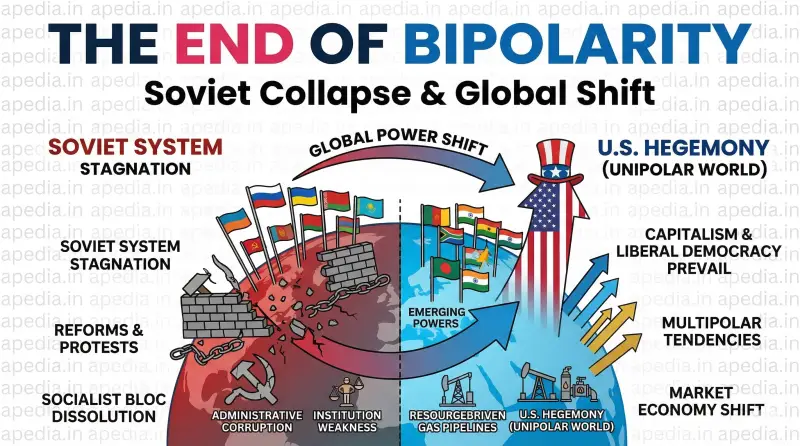
The Union of Soviet Socialist Republics (USSR) emerged after the 1917 socialist revolution in Russia. It was a massive attempt to abolish private property and design an egalitarian society based on socialism.
Features and Stagnation
- The System: The Soviet political system was centered completely around the Communist Party, with no opposition allowed. The economy was state-planned and controlled. Post-WWII, the USSR led the "Second World" (or socialist bloc), held together by the Warsaw Pact military alliance.
- Early Success: It developed a complex communications network, vast energy resources, and a domestic consumer industry that ensured a minimum standard of living and subsidized basic necessities (health, education).
- Stagnation: Over time, the system became highly bureaucratic and authoritarian. The economy faltered because the USSR spent a huge portion of its resources maintaining its nuclear and military arsenals and satellite states. Technologically, it fell behind the capitalist West, and ordinary citizens suffered from severe consumer shortages.
- Gorbachev's Reforms: Mikhail Gorbachev became General Secretary in 1985 and initiated reforms (perestroika and glasnost) to democratize the system and catch up with the West. However, loosening the system sparked uncontrollable nationalist urges and protests.
📝 Concept Check 1
1. What major historical event in 1917 led to the formation of the USSR?
The socialist revolution in Russia.
2. What was the military alliance of the Soviet bloc called?
The Warsaw Pact.
3. Why did the Soviet economy largely stagnate?
Massive spending on nuclear/military arsenals and maintaining satellite states.
4. Who initiated major democratic and economic reforms in the USSR in 1985?
Mikhail Gorbachev.
📉 Module 2: Disintegration and Consequences
The fall of the Berlin Wall in November 1989 marked the beginning of the end. As communist regimes collapsed across Eastern Europe, a crisis escalated within the USSR itself.
The Collapse
- The 1991 Coup: Communist Party hardliners, opposed to Gorbachev's reforms, staged a coup in 1991. Boris Yeltsin emerged as a national hero by opposing it.
- Disbandment: In December 1991, Russia, Ukraine, and Belarus declared the Soviet Union disbanded and formed the Commonwealth of Independent States (CIS). Russia was accepted as the successor state, taking over the UN Security Council seat and nuclear arsenal.
- Causes: Disintegration was caused by institutional weakness, economic stagnation, administrative corruption, and a massive rise in nationalism and desire for sovereignty (especially in Russia and the Baltic states).
- Global Consequences: The Cold War arms race ended. The world order shifted, leaving the US as the sole superpower (a unipolar world), and liberal democracy and capitalism became the dominant global systems.
⚡ Module 3: Shock Therapy and Tensions
The transition from an authoritarian socialist system to a democratic capitalist one in Russia, Central Asia, and East Europe was guided by the World Bank and IMF. This painful model was known as 'Shock Therapy'.
Impact and Conflicts
- Economic Ruin: Shock therapy required total privatization and a switch to free trade. It resulted in "the largest garage sale in history," where state industries were sold at throwaway prices. The Russian currency (ruble) plummeted, inflation wiped out savings, and a mafia emerged.
- Conflicts: Post-Soviet states experienced severe instability. Chechnya and Dagestan in Russia had violent secessionist movements. Tajikistan suffered a 10-year civil war, and Yugoslavia broke apart brutally into independent countries like Croatia and Bosnia.
- Revival: Most economies started reviving around 2000, primarily due to the export of natural resources like oil, natural gas, and minerals.
- India's Relations: India maintains strong relations with post-communist countries, especially Russia. They share a vision of a multipolar world order and collaborate heavily on military hardware, space, nuclear energy, and counter-terrorism. Bollywood and Indian culture remain highly popular in the region.
📝 Concept Check 2
1. What was the transition model to capitalism guided by the World Bank and IMF called?
Shock Therapy.
2. What event was described as "the largest garage sale in history"?
The undervaluation and selling off of Russian state-controlled industries at throwaway prices.
3. Which Russian republics experienced violent secessionist movements?
Chechnya and Dagestan.
4. What is the primary reason post-Soviet economies began reviving in 2000?
The export of natural resources like oil and natural gas.