🏛️ National Conference: Reaffirming Commitment

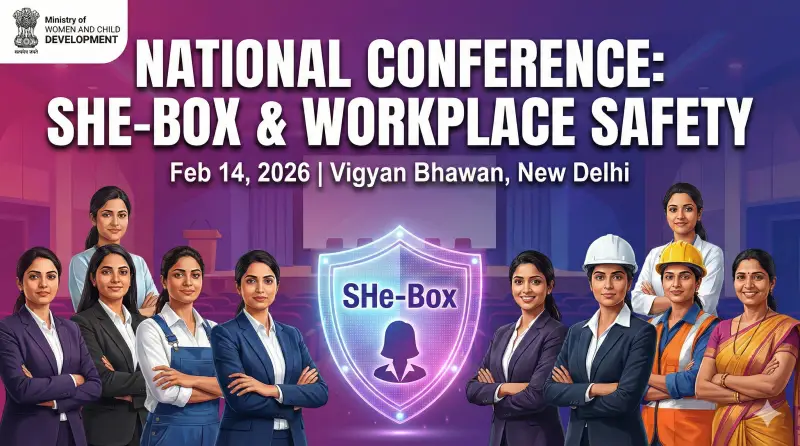
The Ministry of Women and Child Development (MWCD) is set to organize a landmark ‘National Conference on Safety of Women at Workplace (SHe-Box)’ on February 14, 2026, at Vigyan Bhawan, New Delhi. The event underscores the government's resolve to create safe, dignified, and harassment-free workplaces for women across all sectors.

1,500+ Participants
100+ Organizations
Feb 14 Date (2026)

Union Minister Smt. Annpurna Devi will deliver the keynote address and administer the 'National Workplace Safety Pledge'.

💻 Decoding the SHe-Box Portal

Launched on August 29, 2024, the SHe-Box (Sexual Harassment electronic Box) is a centralized platform designed to streamline the implementation of the PoSH Act. It acts as a single-window solution.

🚪
Single Window Access
A unified digital platform for women to securely register complaints related to workplace sexual harassment.
🔄
Direct Routing
Complaints are automatically forwarded to the concerned Internal Committee (IC) or Local Committee (LC).
⏱️
Real-time Tracking
Enhances transparency by allowing complainants to track the status of their grievances in real-time.
📚
Resource Hub
Enables workplaces to upload compliance details, annual reports, committee info, and training initiatives.

📋 Conference Highlights & Agenda

The conference agenda focuses on bridging gaps in implementation, with specific attention to the unorganized sector.

Session/Activity Objective/Details
National Roundtable Focus on strengthening PoSH compliance in the Unorganized Sector.
International Roundtable Discussion with UN agencies on global best practices for workplace safety.
New Launches SHe-Box Logo, PoSH Training Video, Voluntary Compliance Checklist.
Capacity Building Access to PoSH training on iGOT Karmayogi for every citizen.

📚 UPSC Corner: Prelims & Mains

Prelims Practice Questions

Q1. With reference to the 'SHe-Box' portal, consider the following statements:
  1. It was launched by the Ministry of Labour and Employment.
  2. It facilitates the registration of complaints related to sexual harassment at the workplace for both government and private sector employees.
  3. It automatically forwards complaints to the concerned Internal Committee (IC) or Local Committee (LC).

Which of the statements given above is/are correct?

  • A) 1 only
  • B) 2 and 3 only
  • C) 1 and 3 only
  • D) 1, 2 and 3
Answer: B (Launched by Ministry of Women and Child Development)
Q2. The 'Vishaka Guidelines', which laid the foundation for the PoSH Act, 2013, were issued by the Supreme Court in which year?
  • A) 1992
  • B) 1997
  • C) 2005
  • D) 2012
Answer: B

Mains Practice Questions & Model Answers

Q1. "Despite the enactment of the PoSH Act, 2013, the implementation remains a challenge, particularly in the unorganized sector." Discuss. How can digital interventions like SHe-Box address these gaps? (250 Words)
Model Answer Synopsis
Introduction The PoSH Act, 2013 aims to provide safe environments for women, but its reach is limited in the unorganized sector (construction, domestic work) due to lack of formal structures like HR departments.
Challenges Low awareness, fear of job loss, absence of Internal Committees (ICs) in small establishments, and difficulty in accessing Local Committees (LCs).
Role of SHe-Box 1. Accessibility: Allows women in remote or informal jobs to file complaints via mobile without visiting offices.
2. Direct Routing: Automatically routes complaints to the District Magistrate or Local Committee (LC), bypassing immediate employers who might suppress the issue.
3. Monitoring: Centralized data helps the government identify districts with poor implementation and intervene.
Conclusion While SHe-Box is a robust tool, its success depends on digital literacy and grassroots awareness campaigns to ensure the unorganized sector workforce can actually use it.
Q2. Evaluate the significance of Internal Committees (ICs) and Local Committees (LCs) in ensuring a safe workplace environment for women. (150 Words)
Model Answer Synopsis
Internal Committees (ICs) Mandated for workplaces with 10+ employees. They serve as the first line of defense, offering an in-house, quick redressal mechanism (Civil Court powers) and creating a deterrent effect against harassment.
Local Committees (LCs) Crucial for the unorganized sector and workplaces with fewer than 10 employees. They also handle complaints against the employer/head of the institution, ensuring impartial justice where ICs might be compromised.
Conclusion ICs and LCs decentralize justice. However, their effectiveness relies on regular training (as promoted by iGOT Karmayogi) and strict adherence to constitution norms (e.g., external member requirement) to avoid bias.
Source Information: PIB Release ID: 2227349 (Feb 13, 2026)
Ministry of Women and Child Development

Watch Webcast