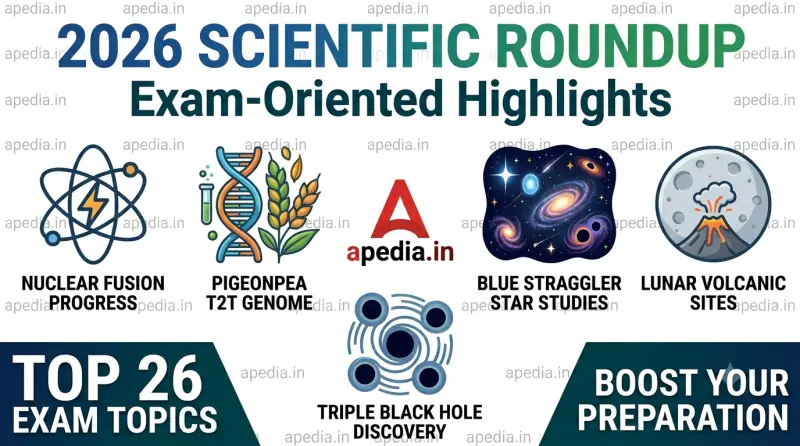
2026 Scientific Milestones: Propelling India and the World into a New Era
The year 2026 has witnessed unprecedented advancements in global and Indian
Science & Technology
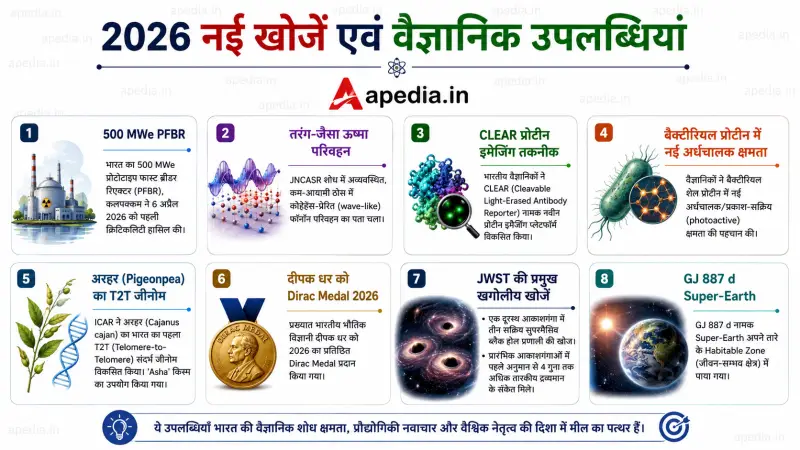
. From India’s Kalpakkam 500 MW PFBR
achieving its historical first criticality to the discovery of wave-like heat transport in disordered solids by JNCASR, the scientific landscape is rapidly evolving. Internationally, the James Webb Space Telescope (JWST)
uncovered a triple supermassive black hole system, while biotechnological leaps
like India's first T2T reference genome for pigeonpea highlight critical agricultural innovations on a global scale.
Nuclear Energy
500 MW PFBR Criticality
Space & Astronomy
JWST Triple Black Hole
Agri-Biotech
T2T Pigeonpea Genome
Key Innovations & Strategic Focus Areas
The discoveries of 2026 cover a broad spectrum of research domains, heavily emphasizing
deep space exploration
, genomic sequencing
, and theoretical physics.
🔭 Space & Astronomy
Astronomers made massive strides, identifying a
Blue Straggler-Brown Dwarf
binary system (TIC 327546480). NASA tested the HPSC processor (500x more powerful than current chips), and Artemis-I safety vests demonstrated a 50% reduction in space radiation exposure.🧬 Biotechnology & Health
Indian researchers developed the CLEAR protein imaging technique and an ultra-large nanobody library at IIT Roorkee. Furthermore, scientists discovered self-replicating Polymerase Ribozyme, bolstering the RNA-World hypothesis.
🔬 Physics & Environment
•
Indian physicist Deepak Dhar was honored with the
Dirac Medal 2026
.•
New semiconductor capabilities were discovered in bacterial shell proteins.
•
An abnormal excess of ozone was detected over the Northern
Bay of Bengal
.
These breakthroughs collectively reinforce the vital importance of scientific
Research & Development
, showcasing India as a Global Leader
in nuclear energy, astronomy, and agricultural genomics.
UPSC CSE Quiz
1. With reference to the recent agricultural and biological advancements in India, consider the following statements:
1. ICAR has successfully developed India's first T2T reference genome for pigeonpea using the 'Asha' variety.
2. The CLEAR technique was recently developed by Indian scientists specifically for deep space galaxy imaging.
3. A new ultra-large nanobody library was developed by IIT Roorkee.
Which of the statements given above is/are correct?
A) 1 and 2 only
B) 1 and 3 only ✓
C) 2 and 3 only
D) 1, 2, and 3
Source Information
Department of Science & Technology / Current Affairs