Level of Governance: National
Composition:
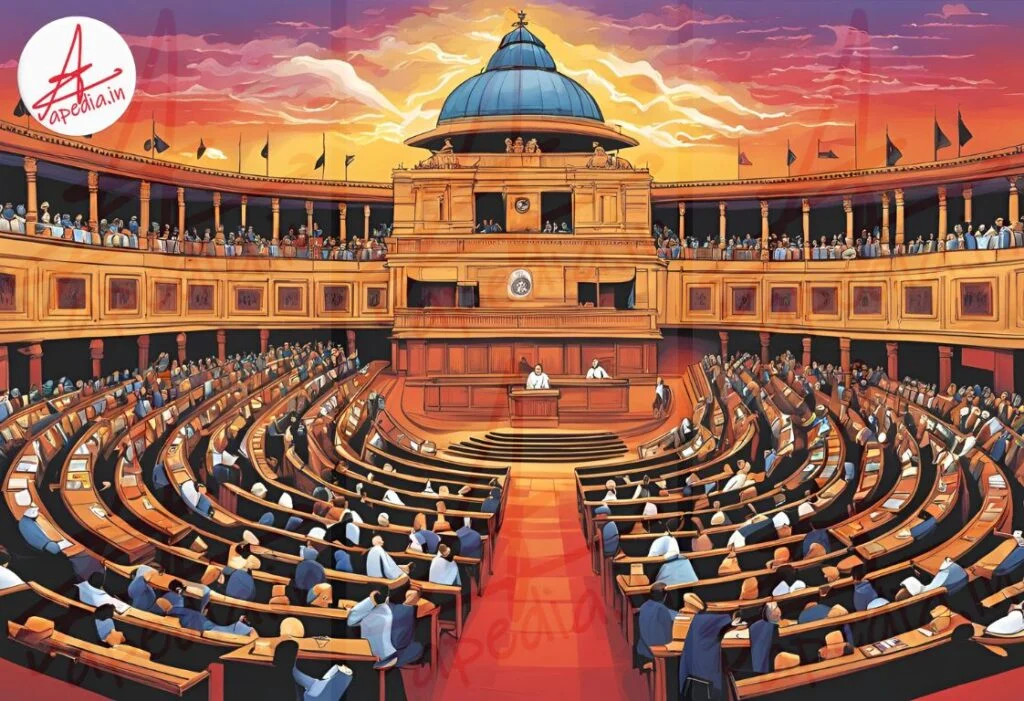
- Lok Sabha (House of the People): The lower house, where members are directly elected by the people.
- Rajya Sabha (Council of States): The upper house, representing states and union territories. Members are elected by the elected members of State Legislative Assemblies and Electoral College for Union Territories, while some are nominated by the President.
Powers:
- Legislation: Parliament holds the authority to enact laws that apply to the entire country.
- Constitutional Amendments: It possesses the exclusive power to amend the Constitution, thereby altering the country’s fundamental legal framework.
- Financial Control: Parliament has control over the Union government’s finances, including the approval of the Union Budget and taxation.
- Government Oversight: It monitors the executive branch's functioning, ensuring accountability. It can remove the Union government through a no-confidence motion.
Members: Known as Members of Parliament (MPs).
Election: MPs are elected through a direct vote by citizens in their respective constituencies.
Level of Governance: State
Composition:
- Unicameral or Bicameral: Most Indian states have a unicameral legislature with only a Legislative Assembly, but some states have a bicameral system, including a Legislative Council.
Powers:
- Legislation: The Assembly can create laws that apply within the state’s boundaries.
- Financial Control: The Assembly oversees the state government’s finances, including the state budget and taxation within the state.
- Government Oversight: Similar to Parliament, the Assembly holds the state government accountable and can remove it through a no-confidence motion.
Members: Known as Members of the Legislative Assembly (MLAs).
Election: MLAs are directly elected by voters in their respective state constituencies.
| Feature | Parliament | State Legislative Assembly |
|---|---|---|
| Level of Governance | National | State |
| Composition | Bicameral (Lok Sabha and Rajya Sabha) | Usually unicameral |
| Powers | Supreme law-making body, can amend the Constitution | Limited to state matters |
| Members | Members of Parliament (MPs) | Members of Legislative Assembly (MLAs) |
| Election | Direct election by the people of constituencies | Direct election by the people of state constituencies |
Parliament and State Legislative Assemblies have some areas of overlap:
| Feature | Description |
|---|---|
| Legislation | Both Parliament and State Legislative Assemblies have legislative powers. However, in certain cases, Parliament can override state laws, especially when national interest is involved. |
| Finance | Each body controls the financial matters of its respective government. |
| Oversight | Both are responsible for ensuring their respective governments' accountability and proper functioning. |
Supremacy: Parliament holds supremacy as the highest law-making body in India, with State Legislative Assemblies being subordinate.
Cooperation: Both bodies must often cooperate, especially on issues that affect both national and state levels.
Conflict: Conflicts may arise, particularly when state laws or policies clash with national interests or when there is a divergence in priorities between the central and state governments.
While both Parliament and State Legislative Assemblies serve as critical components of India's legislative framework, their jurisdictions and powers are distinct. Parliament, as the supreme national law-making body, plays a broader role, while State Legislative Assemblies focus on regional governance. Together, they ensure the effective functioning of the federal structure of governance in India.