
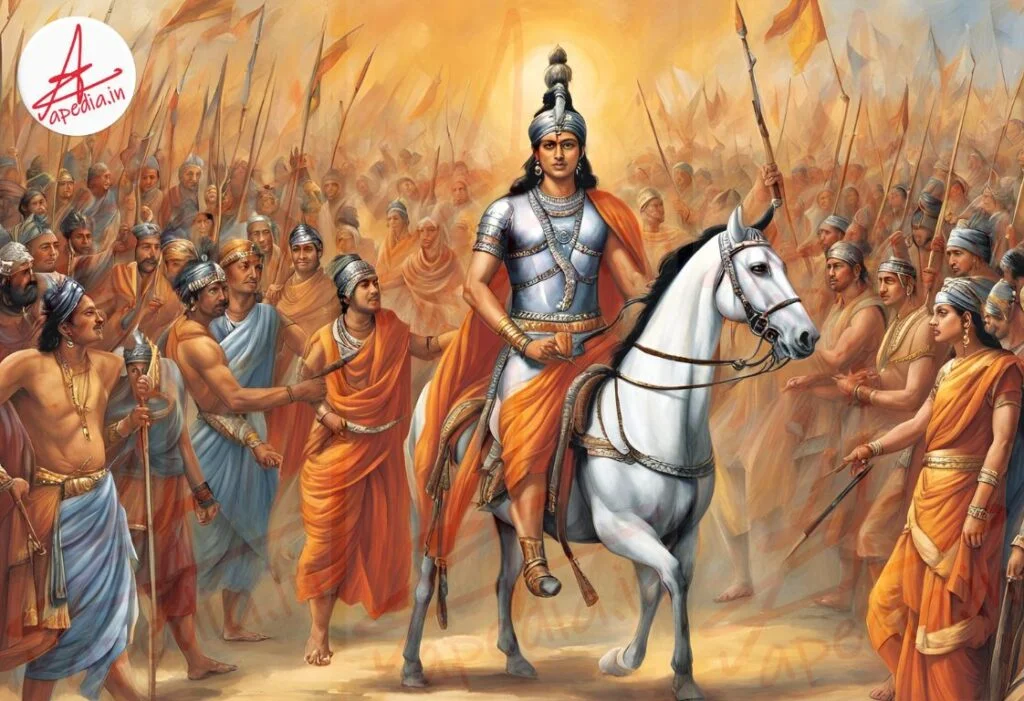
Ashoka Maurya
304 BCE, Pataliputra (modern-day Patna, India)
Bindusara
Chandragupta Maurya
273-232 BCE
Mauryan
Pataliputra
Largest extent of the Mauryan Empire, covering most of the Indian subcontinent and parts of present-day Afghanistan, Bangladesh, and Iran
Kalinga War (261 BCE)
Converted to Buddhism after witnessing the horrors of the Kalinga War
Ashoka spread Buddhism throughout his empire and beyond, including Sri Lanka, Central Asia, and Southeast Asia
14 major edicts inscribed on rocks, discussing governance, social justice, religious tolerance, and non-violence
7 edicts, shorter messages focusing on moral and ethical guidance
Ashoka Chakra (24-spoked wheel) now featured in the Indian national flag
Initially followed Hinduism, converted to Buddhism; later influenced by Jainism
Built stupas and monuments, including the Great Stupa at Sanchi
Promoted welfare measures like healthcare, roads, public wells, and planting trees
Established relations with Greek rulers like Antiochus II, Ptolemy II, and others
Spread of Buddhism, moral governance, welfare policies; influenced later Indian rulers and leaders
232 BCE, Pataliputra
Uncertainty about successors, leading to the eventual decline of the Mauryan Empire
Ashoka’s edicts are still visible across India; considered a model ruler in Indian history
Dharma Chakra Pravartan
Ashoka adopted the Buddhist philosophy and undertook efforts to promote Buddhism across his empire and beyond. He built stupas, monasteries, and pillar inscriptions to disseminate the teachings of the Buddha, spreading ideas of religious tolerance and compassion.
Rock Edicts
Ashoka’s policies were outlined in his famous rock edicts, which were engraved on large stone surfaces. These inscriptions detailed his principles of governance, animal welfare, social justice, and religious freedom.
Pillar Edicts
Shorter but significant messages, the pillar edicts, focused on moral and ethical guidance for his people. These inscriptions were spread throughout his empire, serving as reminders of virtues like non-violence, charity, and ethical behavior.
Welfare Measures
Ashoka’s concern for the welfare of his subjects led him to implement measures like building hospitals, planting trees along roads, constructing wells, roads, and rest houses for travelers. His rule promoted social welfare and public good.
Diplomatic Relations
Ashoka established diplomatic relations with several foreign powers, including Greece, Syria, and Egypt, which helped facilitate cultural exchange and goodwill between his empire and the Hellenistic world.
Buddhism’s Global Spread
Ashoka’s efforts were instrumental in the spread of Buddhism to Sri Lanka, Southeast Asia, Central Asia, and beyond, transforming it into a major world religion.
Mauryan Empire’s Insights
The edicts inscribed on rocks and pillars offer invaluable details about social, political, and religious conditions during his reign, making them critical resources for historians.
Cultural and Ethical Influence
Ashoka’s promotion of ethical governance, tolerance, and welfare became central to Indian governance and shaped later rulers' approaches to leadership.
- Ashoka’s conversion to Buddhism shaped his governance, pivoting from militaristic expansion to compassionate rule.
- His edicts provide deep insight into the Mauryan Empire’s governance and culture.
- Ashoka’s efforts to spread Buddhism had a profound impact on both Indian society and the broader world, marking him as one of history’s greatest leaders.