
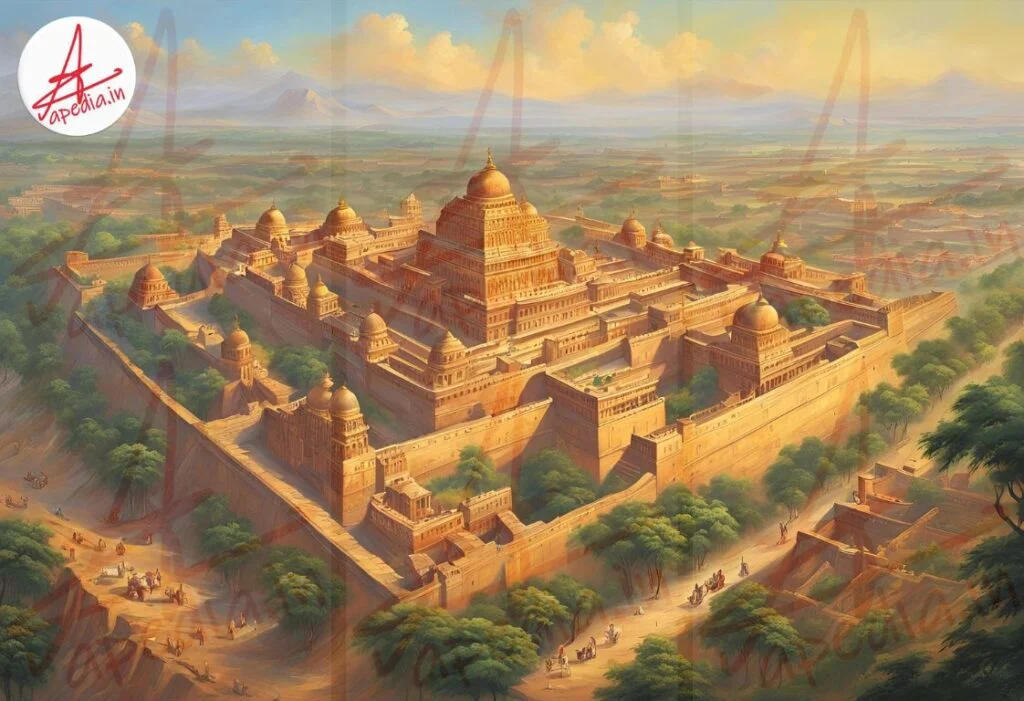
- Chandragupta Maurya (Founder)
- Bindusara (Expansionist Ruler)
- Ashoka (Promoter of Buddhism)
- Unification of India
- Flourishing of art, literature, and philosophy
- Development of trade routes
The Mauryan Empire was founded in 322 BCE by Chandragupta Maurya, a visionary leader and military strategist. He overthrew the Nanda Dynasty with the guidance of his mentor and political adviser, Chanakya (Kautilya), the author of Arthashastra, an ancient treatise on statecraft, economic policy, and military strategy.
Chandragupta's early reign was marked by his military conquests, notably the defeat of Seleucus Nicator, a successor of Alexander the Great, around 305 BCE. This victory expanded the Mauryan territory into regions of modern-day Pakistan and Afghanistan, solidifying its western frontiers and establishing diplomatic relations with the Hellenistic world.
After consolidating his power, Chandragupta embarked on a mission to unify the Indian subcontinent. His son, Bindusara, succeeded him and continued the expansion of the empire, extending its influence to the southern parts of India. Bindusara's reign, though less documented than his father’s or son's, was critical in maintaining the vast territory inherited from Chandragupta.
The reign of Ashoka the Great (273 BCE - 232 BCE) marked the zenith of the Mauryan Empire. Ashoka initially pursued a path of military conquest, but the Kalinga War in 261 BCE proved to be a turning point. His remorse from the war led to a spiritual awakening, and he embraced Buddhism, promoting the principles of ahimsa (non-violence) and dharma (moral duty).
- Compassion and welfare for all living beings
- Fair treatment of subjects
- Religious tolerance
- Establishment of medical facilities for humans and animals alike
The Mauryan Empire’s cultural contributions were vast. Under Ashoka, Buddhism flourished, leading to the construction of stupas, monasteries, and pillars with intricate carvings. The famous Lion Capital of Ashoka at Sarnath is celebrated for its craftsmanship and remains the national emblem of modern India.
The Mauryan Empire’s administrative structure was advanced for its time. The central bureaucracy, established under Ashoka, maintained control over vast regions through a well-organized system of governance. The empire was divided into provinces, each governed by a royal prince or official, ensuring effective administration.
After Ashoka’s death, successive rulers failed to maintain the centralized power that had held the vast empire together. Internal strife and external invasions weakened the empire, leading to its fragmentation. In 185 BCE, the last Mauryan ruler, Brihadratha, was assassinated, marking the end of the Mauryan Empire.
The legacy of the Mauryan Empire, particularly under Ashoka’s reign, has had a profound influence on Indian civilization. The unification of India under a single polity, the spread of Buddhism, and advancements in art and architecture have left an indelible mark on the subcontinent.
The Mauryan Empire stands as a cornerstone in Indian history. Its achievements in unifying the subcontinent, promoting peace and cultural growth, and developing a sophisticated administrative system make it one of the greatest empires of its time. The reign of Ashoka, in particular, highlights a ruler’s transformation from conquest to benevolence, showcasing the enduring impact of moral governance.