
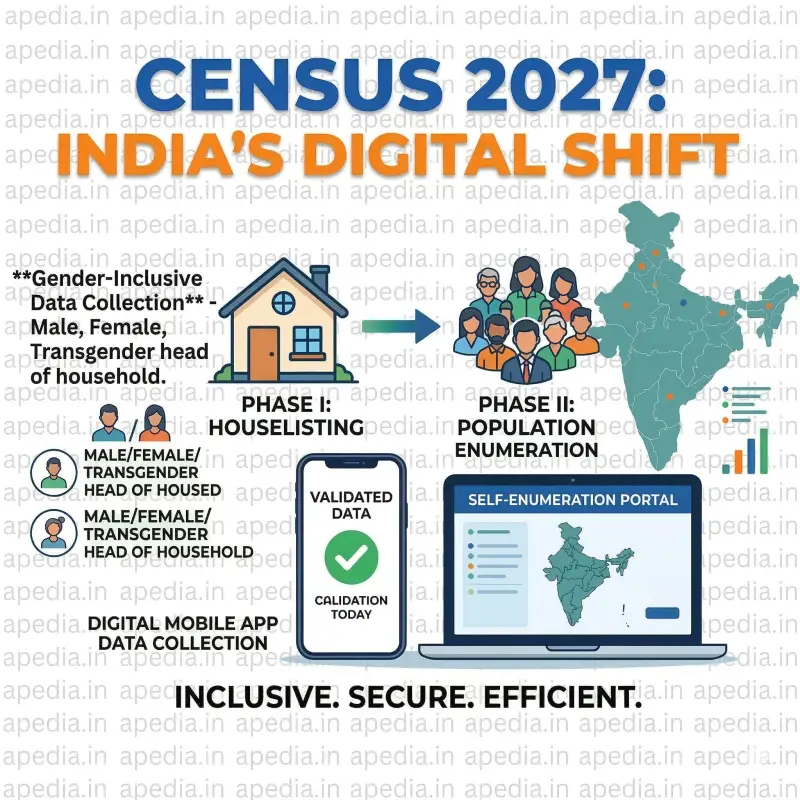
💧 Decoding the Census 2027 Strategy
The Ministry of Home Affairs has outlined a comprehensive operational framework for Census 2027, marking a significant leap toward a digital and inclusive demographic exercise. The upcoming census will be executed in two distinct phases, starting with a meticulous Houselisting and Housing Census to capture living conditions, household amenities, and the gender identity of household heads—notably formalizing Male, Female, and Transgender categories. A landmark shift in this iteration is the integration of technology: while traditional house-to-house visits remain mandatory to ensure zero exclusion, citizens now have an additional option to utilize a self-enumeration portal. To safeguard this massive data operation, the government has deployed stringent validation rules within their mobile applications, backed by physical enumerator confirmations and multi-level data security protocols from collection to server storage.
💧 Key Initiatives & Strategic Focus
The operational framework for Census 2027 balances complete physical coverage with modern digital convenience.
- Self-enumeration portal features built-in FAQs, tooltips, and digital validation checks.
- Field enumerators physically confirm self-submitted data before final system entry.
- Supervisors monitor and cross-check the app-collected data for consistency.
📚 Prelims Quiz Corner
1. It introduces a self-enumeration portal that completely replaces traditional house-to-house field visits for urban respondents.
2. The Houselisting phase explicitly collects data on three categories for the sex of the head of the household: Male, Female, and Transgender.
Which of the statements given above is/are correct?
- A) 1 only
- B) 2 only
- C) Both 1 and 2
- D) Neither 1 nor 2