📡 Delhi Declaration & Bharat 6G Alliance
In a significant stride towards the future of telecommunications, the Minister of State for Communications and Rural Development, Dr. Pemmasani Chandra Sekhar, highlighted the outcomes of the Bharat 6G Symposium 2025 in a written reply to the Rajya Sabha.
The Core Consensus
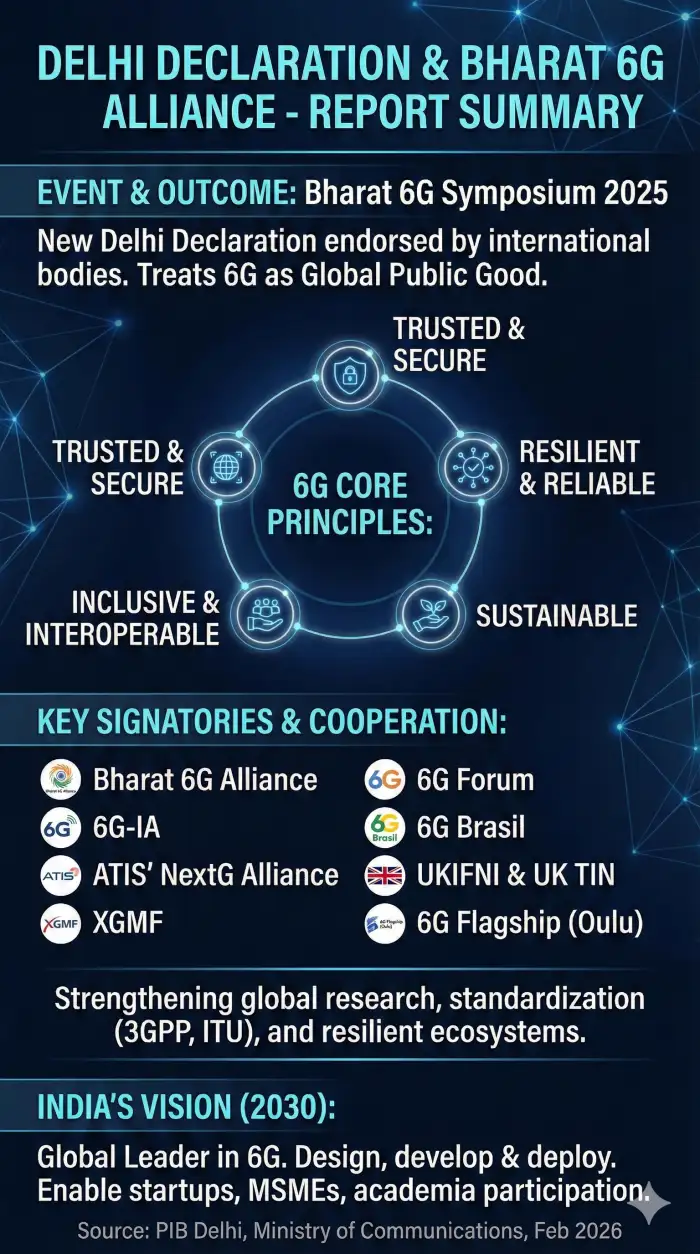
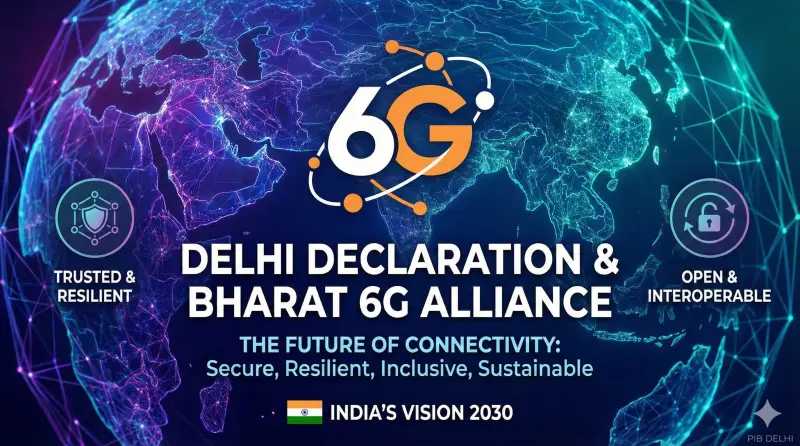
The "New Delhi Declaration" established a collective stance treating 6G as a global public good. International bodies endorsed core principles ensuring future networks are Trusted, Resilient, Open, and Inclusive.
⚖️ The 6G Core Principles
The international consensus rests on the following pillars for future networks:
Security & Reliability
Trusted, Secure, Resilient
Networks must be designed to withstand systemic shocks and ensure data privacy and security by default.
Accessibility
Inclusive & Affordable
6G technology must bridge the digital divide, ensuring high-quality connectivity is accessible to all demographics, not just the elite.
Architecture
Open & Interoperable
Moving away from proprietary "walled gardens," future networks will promote interoperability to foster innovation and competition.
Environment
Sustainable
Emphasis on energy efficiency and reducing the carbon footprint of digital infrastructure.
🌍 The Global Coalition (Signatories)
The declaration brought together leading global and regional 6G alliances, research platforms, and industry forums:
Bharat 6G Alliance (India)
6G Smart Networks & Services (6G-IA)
ATIS’ NextG Alliance (USA)
XG Mobile Promotion Forum (XGMF)
6G Forum
6G Brasil
UK - India Future Networks Initiative
UK Telecoms Innovation Network
6G Flagship, University of Oulu
Nature of Cooperation: Alignment on global standardization (3GPP, ITU), strengthening research collaboration, and promoting deeper participation of Startups, MSMEs, and Academia.
🚀 Bharat 6G Vision Document
Released: March 2023
The Government of India released the vision document with a clear roadmap to design, develop, and deploy 6G network technologies.
The 2030 Objective
To position India as a global leader in 6G technology by 2030, providing ubiquitous, intelligent, and secure connectivity for a high-quality living experience.
Download Resource
📄 Click here to view the Bharat 6G Vision Document
❓ Prelims Practice Questions
- The "New Delhi Declaration" recently seen in the news is related to which technology?
A) Artificial Intelligence Governance
B) 6G Telecommunications
C) Green Hydrogen Standards
D) Space Debris Management
Answer: B - Which of the following is NOT a core principle endorsed in the New Delhi Declaration for 6G?
A) Trusted and Secure
B) Exclusive and Proprietary
C) Open and Interoperable
D) Sustainable
Answer: B (The principle is "Inclusive," not Exclusive) - The Bharat 6G Vision Document aims to position India as a global leader in 6G technology by which year?
A) 2027
B) 2030
C) 2035
D) 2047
Answer: B - Who is the current Minister of State for Communications who provided this information in Rajya Sabha?
A) Dr. S. Jaishankar
B) Shri Ashwini Vaishnaw
C) Dr. Pemmasani Chandra Sekhar
D) Shri Jyotiraditya Scindia
Answer: C - Which international university's flagship program is a signatory to the declaration?
A) MIT Media Lab
B) University of Oxford
C) University of Oulu (6G Flagship)
D) Stanford University
Answer: C
Source Information: Press Information Bureau (PIB) Release ID: 2227133 (Feb 12, 2026)