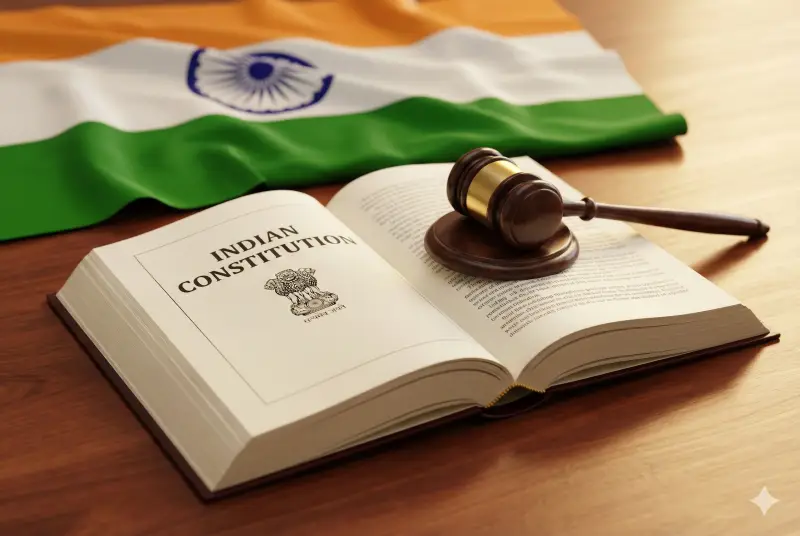
Part II of the Constitution of India, covering Articles 5 to 11, lays the legal framework for citizenship at the time of the Constitution's commencement (January 26, 1950). Unlike other parts of the Constitution, these articles do not deal with the permanent law of citizenship but rather identify who became a citizen on that specific date. For all subsequent matters, Article 11 empowers the Parliament to enact laws, leading to the Citizenship Act, 1955, and its subsequent amendments.
Part II
Citizenship at Commencement
19th July, 1948
Parliament (Art. 11)
🏠 Article 5: Citizenship by Domicile
At the commencement of the Constitution, any person who had their domicile in the territory of India and fulfilled ANY ONE of the following three conditions was declared a citizen:
- (a) Who was born in the territory of India; OR
- (b) Either of whose parents was born in the territory of India; OR
- (c) Who has been ordinarily resident in the territory of India for not less than five years immediately preceding such commencement.
🚂 Article 6: Rights of Migrants from Pakistan
A person who migrated to India from the territory now included in Pakistan shall be deemed a citizen if:
- Ancestry: They, or either of their parents, or any of their grandparents were born in "India" as defined in the Government of India Act, 1935 (undivided India); AND
- Two Categories of Migrants:
- (i) Before July 19, 1948: The person has been ordinarily resident in India since the date of their migration.
- (ii) On or After July 19, 1948: The person has been registered as a citizen by an officer appointed by the Government.
Note: For registration under category (ii), the person must have resided in India for at least six months immediately preceding the application.
🚫 Article 7: Rights of Migrants to Pakistan
This article overrides Articles 5 and 6 regarding those who left India:
- Any person who migrated from India to Pakistan after March 1, 1947, is NOT deemed a citizen of India.
- Exception (Returnees): This disqualification does not apply to a person who returned to India under a permit for resettlement or permanent return. In such cases, they are deemed to have migrated to India after July 19, 1948 (requiring 6 months residence and registration).
🌍 Article 8: Persons of Indian Origin Residing Outside India
This provision covers Indians living abroad (e.g., for employment or education):
- Eligibility: Any person who (or whose parents/grandparents) was born in undivided India (as defined in 1935 Act) and is ordinarily residing in any country outside India.
- Process: They are deemed citizens if they have been registered as a citizen by the diplomatic or consular representative of India in that country, upon application.
⚖️ General Provisions (Articles 9-11)
Article 9: Loss of Citizenship (Single Citizenship Rule)
No person shall be a citizen of India by virtue of Article 5, or deemed a citizen under Article 6 or 8, if they have voluntarily acquired the citizenship of any foreign State.
Article 10: Continuance of Rights
Every person who is deemed a citizen under these provisions continues to be a citizen, subject to the provisions of any law made by Parliament.
Article 11: Parliament to Regulate Citizenship by Law
This is the most dynamic article in Part II. It declares that nothing in the foregoing provisions restricts the power of Parliament to make any provision regarding:
- The acquisition of citizenship.
- The termination of citizenship.
- All other matters relating to citizenship.
📢 Major Legal Updates (Under Article 11 Power):
Using the power granted by Article 11, Parliament enacted the Citizenship Act, 1955. This Act has been amended multiple times to reflect changing needs:
- 1986 Amendment: Restricted citizenship by birth (jus soli) to cases where at least one parent is an Indian citizen.
- 2003 Amendment: Introduced the concept of "illegal migrant" and Overseas Citizens of India (OCI).
- 2019 Amendment (CAA): Provided a path to citizenship for persecuted minorities from Afghanistan, Bangladesh, and Pakistan who entered India before Dec 31, 2014.
This content is based on the text of the Constitution of India, Part II (Articles 5-11).
🔗 Official Legislative Department Link