💧 IRNSS-1F Achieves Decade-Long Milestone
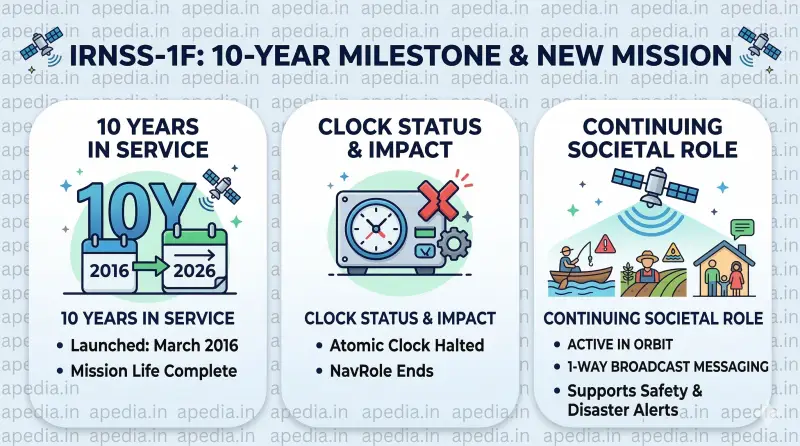
The Indian Space Research Organisation (ISRO) has announced a significant milestone for India's independent regional navigation satellite system. The IRNSS-1F satellite, a crucial operational component of the NavIC constellation launched in March 2016, successfully completed its designated 10-year mission life on March 10, 2026. For UPSC aspirants studying space technology, understanding the life cycle, component vulnerabilities (like atomic clocks), and the resilient post-mission utility of these navigational assets is critical for analyzing India's space self-reliance.
10 Years
Mission Life
March 2016
Launch Date
March 2026
Clock Halted
💧 Key Initiatives & Strategic Focus
Despite critical hardware limitations after a decade in space, the satellite remains a valuable asset for societal applications.
🛰️ End of Primary Navigation Role
On March 13, 2026, the procured on-board atomic clock ceased functioning. Because highly precise timekeeping is the foundation of satellite-based positioning, its primary navigation role has concluded.
📡 Continued Broadcast Services
ISRO has confirmed the satellite is not being decommissioned. It will remain active in orbit to provide one-way broadcast messaging services, ensuring continued societal utility.
🔄 Impact on Space Strategy
Understanding this transition is vital for India's strategic space planning:
- Highlights the durability and extended utility of ISRO's satellite engineering.
- Ensures continuous support for critical alerts like disaster warnings and safety messages for fishermen.
- Emphasizes the ongoing need for launching next-generation (NVS series) satellites equipped with indigenous atomic clocks to maintain a robust NavIC constellation.
📚 Prelims Quiz Corner
1. With reference to the IRNSS-1F satellite, consider the following statements:
It successfully completed its designated 10-year mission life in March 2026.
Following the failure of its onboard atomic clock, the satellite has been completely decommissioned and de-orbited.
Which of the statements given above is/are correct?
It successfully completed its designated 10-year mission life in March 2026.
Following the failure of its onboard atomic clock, the satellite has been completely decommissioned and de-orbited.
Which of the statements given above is/are correct?
- A) 1 only
- B) 2 only
- C) Both 1 and 2
- D) Neither 1 nor 2
✓ Answer: A
Source Reference
Indian Space Research Organisation (ISRO) | ID: N/A | March 13, 2026