🏭 Secondary Activities: Manufacturing and Processing
⚙️ Module 1: The Essence of Manufacturing
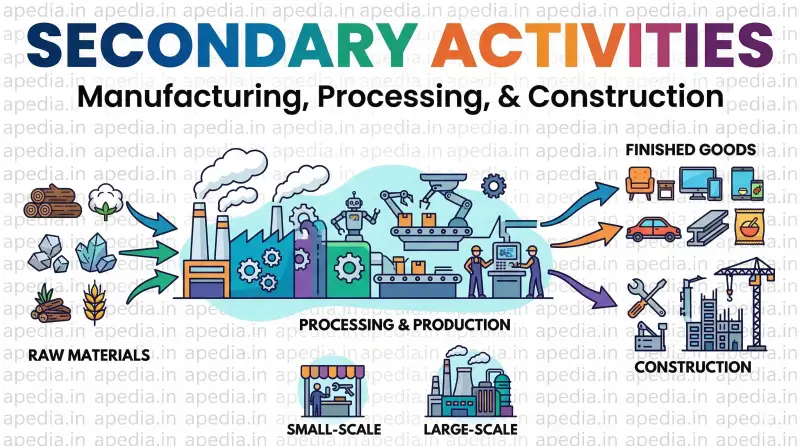
Secondary activities are vital to the economy because they add value to natural resources by transforming raw materials into more useful and valuable products. For instance, iron ore directly from a mine has limited utility, but when converted into steel, it becomes highly valuable for constructing machines and infrastructure.
Characteristics of Modern Large-Scale Manufacturing
- Specialization and Division of Labour: Unlike the traditional 'craft' method where one artisan makes a complete product (which is costly and slow), modern mass production relies on each worker repeatedly performing a single, specific task to increase efficiency and output.
- Mechanization and Automation: Extensive use of gadgets and machines to accomplish tasks. Automation is the advanced stage where computer-controlled systems allow machines to 'think' and operate without direct human intervention.
- Technological Innovation: Continuous Research and Development (R&D) is crucial for quality control, eliminating waste, and combating pollution.
- Uneven Geographic Distribution: Modern manufacturing is highly concentrated. Though it generates massive wealth, major industrial hubs cover less than 10% of the earth's land area.
📝 Concept Check 1
1. What is the primary function of secondary activities?
To add value to natural resources by transforming them into finished goods.
2. What production method involves a worker repeatedly performing a single task?
Mass production (Division of labour)
3. What is the advanced stage of mechanization where machines operate without human thinking?
Automation
4. Approximately what percentage of the world's land area is covered by modern manufacturing hubs?
Less than 10 percent
📍 Module 2: Factors Influencing Industrial Location
Industries aim to maximize profits by minimizing production costs. Thus, their location is strategically chosen based on several geographical and economic factors.
Key Determinants
- Access to Market: The most crucial factor. A market means people with a demand for goods and the purchasing power to buy them. Developed regions like Europe and North America offer massive global markets.
- Access to Raw Materials: Industries using cheap, bulky, weight-losing materials (like sugar or iron and steel) or perishable items (like dairy) must locate close to their raw material sources.
- Access to Energy and Transportation: Power-intensive industries (like aluminum smelting) locate near energy sources. Fast, efficient transportation is essential to move raw materials in and finished goods out.
- Agglomeration Economies: The savings and benefits that industries derive from clustering together, sharing links, infrastructure, and services.
Footloose Industries: Unlike traditional factories, footloose industries are not tied to specific raw materials. They rely on component parts, produce small quantities, employ few people, and are generally non-polluting. Their primary requirement is good road network accessibility.
📊 Module 3: Classification of Manufacturing Industries
Industries are incredibly diverse and can be classified based on their size, raw materials, output, and ownership structure.
Major Classifications
- By Size: 1. Household/Cottage: Smallest unit, artisans use local materials at home for local consumption. 2. Small Scale: Uses power-driven machines and semi-skilled labor in a workshop outside the home. 3. Large Scale: Assembly-line production, massive capital, advanced technology.
- By Raw Material: Agro-based (food processing, cotton); Mineral-based (iron/steel, cement); Chemical-based (petrochemicals, plastics); Forest-based (paper, timber); Animal-based (leather, wool).
- By Output: Basic Industries (products used as raw materials for other industries, e.g., steel); Consumer Goods (products consumed directly by people, e.g., biscuits, soap).
- By Ownership: Public Sector (government-owned); Private Sector (individually owned); Joint Sector (managed jointly by private and public entities).
- High-Technology Industry: The newest generation of manufacturing. It relies heavily on intensive R&D, robotics, and CAD. The workforce is dominated by professional "white-collar" workers. Regionally concentrated, self-sustained high-tech hubs are called Technopolies (e.g., Silicon Valley).
📝 Concept Check 2
1. Which industry type produces items that are used as raw materials by other industries?
Basic Industries
2. Are footloose industries tied to bulky, weight-losing raw materials?
No, they depend on lightweight component parts.
3. What term describes a regionally concentrated, highly specialized high-tech industrial hub?
Technopole
4. Industries owned and managed by the government are classified under which sector?
Public Sector