🌍 Citizenship
🤝 Module 1: Introduction and Equal Membership
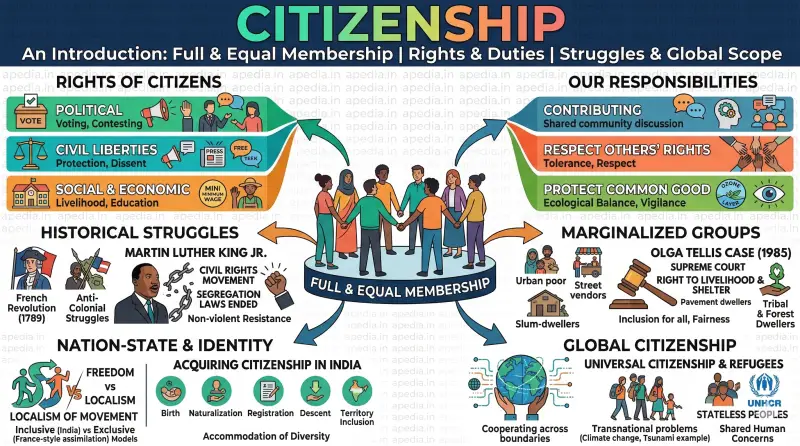
Citizenship has been defined as full and equal membership of a political community. In today's world, states provide a collective political identity and certain rights to their members, such as the right to vote, freedom of speech, and socio-economic rights like minimum wages. However, citizenship is not just about the relationship between the state and the individual; it also involves moral and legal obligations among citizens, including contributing to the shared life of the community.
Struggles for Full Membership
- Historical Context: Many rights were won after intense struggles, such as the French Revolution in 1789, anti-colonial movements in Asia and Africa, and the long fight against the white minority rule in South Africa.
- Freedom of Movement: A crucial right for citizens is the freedom to move and work anywhere within their country. However, when jobs and resources are limited, tensions often arise between local residents and 'outsiders' (migrant workers), sometimes leading to demands to restrict jobs to local populations.
- Martin Luther King Jr.: In the 1950s, he led the Civil Rights Movement in the USA against "Segregation Laws" that denied black people equal civil and political rights. He argued that segregation was a "social leprosy" that created artificial boundaries, advocating for peaceful and non-violent resistance to achieve equality.
📝 Concept Check 1
1. How is citizenship primarily defined?
As full and equal membership of a political community
2. What laws did Martin Luther King Jr. fight against in the USA?
Segregation Laws
3. What kind of resistance did Martin Luther King Jr. advocate?
Peaceful and non-violent resistance
4. What is a common cause of tension regarding the freedom of movement within a country?
Competition for limited jobs and resources between locals and migrant 'outsiders'
⚖️ Module 2: Equal Rights and the Marginalized
Does full membership mean that all citizens, regardless of their wealth, should be guaranteed a minimum standard of living? British sociologist T.H. Marshall stated in his book Citizenship and Social Class that citizenship endows individuals with civil, political, and social rights, helping to counter the divisive effects of class hierarchy.
Challenges of the Urban Poor and Tribals
- The Urban Poor: Slum-dwellers and street vendors make a massive contribution to the economy but often live in insecure conditions. They struggle to exercise basic rights like voting because they lack a fixed address.
- The Olga Tellis Case (1985): A landmark Supreme Court judgment involving pavement dwellers in Bombay. The Court ruled that Article 21 of the Constitution (right to life) included the right to livelihood, stating that if pavement dwellers are evicted, they must be provided alternative accommodation.
- Tribal and Forest Dwellers: Commercial interests, population pressures, and tourism threaten the natural resources these communities depend on for their livelihood. Governments face the challenge of protecting these marginalized groups without halting national development. Equal citizenship implies that policies must take the different needs of various groups into account, rather than applying uniform rules blindly.
🌐 Module 3: Citizen, Nation, and Global Citizenship
The concept of the nation-state evolved to provide citizens with a shared political identity, often expressed through symbols like flags and anthems.
National Identity and Universal Challenges
- Inclusive vs. Exclusive States: While states like France are secular, they expect citizens to assimilate into the national culture in public (leading to controversies like banning turbans or headscarves in schools). India adopted a highly inclusive notion, accommodating diverse religions, languages, and tribes. In India, citizenship can be acquired by birth, descent, registration, naturalization, or inclusion of territory.
- Universal Citizenship & Refugees: The ideal of universal citizenship faces challenges from the existence of stateless people, illegal migrants, and refugees displaced by war or famine. Despite the UN High Commissioner for Refugees attempting to help, many states restrict entry due to humanitarian limits or security risks.
- Global Citizenship: Today's interconnected world (via the internet and global media) has fostered shared sympathies across borders, as seen during the 2004 tsunami or global health crises. Supporters argue that a concept of "global citizenship" might make it easier to solve transnational problems and protect stateless people when national governments fail to do so.
📝 Concept Check 2
1. According to T.H. Marshall, what are the three kinds of rights involved in citizenship?
Civil, political, and social rights
2. In the 1985 Olga Tellis case, the Supreme Court linked the right to life with which other right?
The right to livelihood
3. Name the five ways citizenship can be acquired in India.
Birth, descent, registration, naturalization, or inclusion of territory
4. What concept suggests strengthening links with people across national boundaries to solve transnational problems?
Global Citizenship