🕊️ Secularism
🔍 Module 1: What is Secularism?
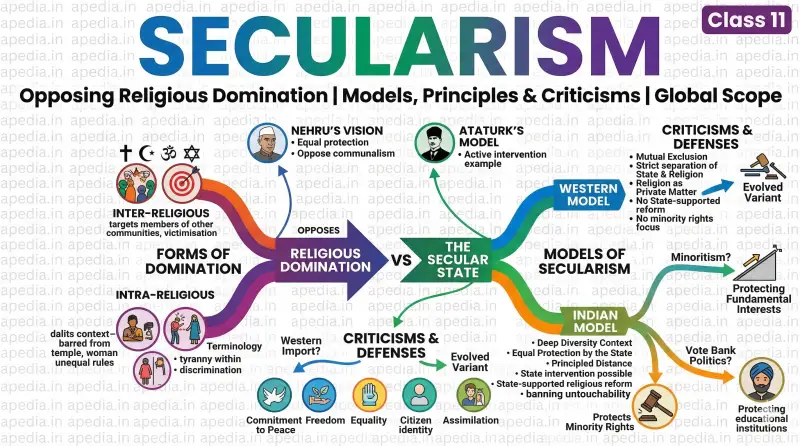
Despite the constitutional promise of freedom and dignity, discrimination based on religion continues to exist. Secularism is a normative doctrine that seeks to create a society devoid of religious domination, promoting freedom within religions and equality between them.
Two Forms of Religious Domination
- Inter-religious Domination: This occurs when members of one religious community are targeted and victimised on account of their religious identity by another group. Examples include the 1984 massacre of Sikhs, the displacement of Hindu Kashmiri pandits, and the 2002 post-Godhra riots in Gujarat.
- Intra-religious Domination: This refers to discrimination and oppression occurring within a single religion. Examples include dalits being barred from entering Hindu temples, or the unequal treatment of women in various religious traditions. Secularism actively opposes this internal tyranny as well.
📝 Concept Check 1
1. What is the primary goal of the doctrine of secularism?
To oppose all forms of institutionalised religious domination
2. Women being denied entry into certain places of worship is an example of what?
Intra-religious domination
3. What is a state governed directly by a priestly order called?
A theocratic state
4. Is the mere separation of religion and state sufficient for a state to be truly secular?
No, it must also be committed to principles like peace, religious freedom, and equality
🏛️ Module 2: The Secular State and The Western Model
To prevent religious conflict, the state must not be run by the heads of any particular religion (which is called a theocratic state, like the Taliban-controlled state or medieval Papal states). Furthermore, a secular state must have no formal, legal alliance with any religion.
The Western Model of Secularism
- Mutual Exclusion: Inspired mainly by the American model, this conception understands secularism as strict mutual exclusion: the state will not intervene in the affairs of religion, and religion will not interfere in the state.
- Private Matter: Religion is considered a strictly private matter. The state cannot aid any religious institution, nor can it hinder the activities of religious communities (unless they break the law).
- No State-Supported Reform: Because of this strict separation, the mainstream western model has no place for the idea of state-supported religious reform, nor does it focus heavily on community-based minority rights.
🇮🇳 Module 3: The Indian Model of Secularism and its Criticisms
Indian secularism is fundamentally different from Western secularism because it arose in a context of deep, pre-existing religious diversity. Jawaharlal Nehru, the philosopher of Indian secularism, believed in "equal protection by the State to all religions" and a complete opposition to communalism.
Distinctive Features of Indian Secularism
- Focus on Minority Rights: It deals not only with the religious freedom of individuals but also protects the rights of minority communities to exist and maintain their own educational institutions.
- State-Supported Religious Reform: Because it opposes intra-religious domination, the Indian state can intervene in religion to bring about social reform (e.g., banning untouchability and child marriage).
- Principled Distance: The Indian state adopts a sophisticated policy of "principled distance," allowing it to either disengage with religion or positively engage (like providing assistance to minority schools) to promote peace and equality.
Criticisms Addressed
- Western Import? India evolved its own variant based on peaceful coexistence, not just church-state separation.
- Minoritism? Minority rights are justified because they protect fundamental interests, much like providing a ramp for the physically challenged is not a "special privilege" but a necessity for equal access.
- Vote Bank Politics? Seeking votes is part of democracy; it only becomes harmful when it artificially constructs a monolithic identity, prioritizing short-term gains over genuine development.
📝 Concept Check 2
1. What does the American model of secularism strictly enforce?
Mutual exclusion of state and religion
2. Who is considered the philosopher of Indian secularism?
Jawaharlal Nehru
3. Banning untouchability is an example of what feature of Indian secularism?
State-supported religious reform
4. What concept allows the Indian state to engage or disengage with religion based on democratic values?
Principled distance