🚀 Startup India 2026: 2 Lakh+ Ventures
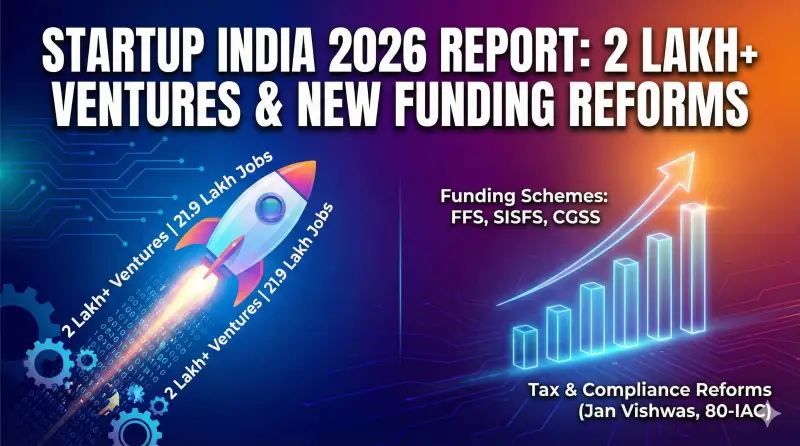
The Ministry of Commerce & Industry has released the latest scorecard for the Startup India Initiative (as of Dec 31, 2025). The ecosystem has witnessed exponential growth, solidifying India's position as a global startup hub.
2.07 Lakh
Recognized Startups
21.9 Lakh
Direct Jobs
₹25K Cr+
FFS Investment
💰 Flagship Funding Schemes
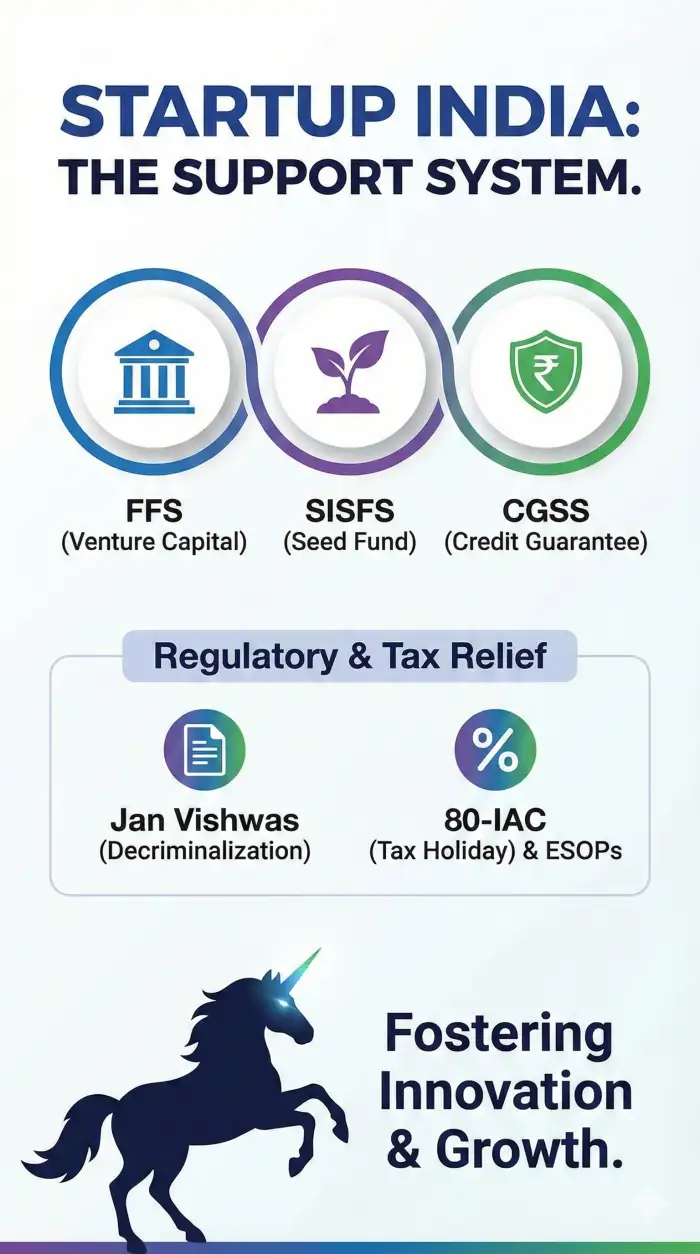
The Government supports startups through three primary financial pillars covering seed stage to growth capital.
Fund of Funds (FFS)
• Managed by: SIDBI
• Mechanism: Invests in SEBI-registered AIFs.
• Impact: ₹25,547 Cr invested in 1,371 startups.
• Mechanism: Invests in SEBI-registered AIFs.
• Impact: ₹25,547 Cr invested in 1,371 startups.
Seed Fund (SISFS)
• Launch: April 2021
• Mechanism: Grants/Convertible Debentures via incubators.
• Impact: ₹590 Cr approved for 3,271 startups.
• Mechanism: Grants/Convertible Debentures via incubators.
• Impact: ₹590 Cr approved for 3,271 startups.
Credit Guarantee (CGSS)
• Managed by: NCGTC
• Mechanism: Collateral-free loans.
• Impact: ₹808 Cr guaranteed for 334 loans.
• Mechanism: Collateral-free loans.
• Impact: ₹808 Cr guaranteed for 334 loans.
⚖️ Regulatory & Tax Reforms (Ease of Doing Business)
To foster entrepreneurship, significant relaxations have been introduced under the Companies Act, 2013 and Income Tax Act.
- Board Meetings Startups are exempted from quarterly meetings. They only need to hold 2 meetings in a calendar year (one every 6 months).
- Sweat Equity Increase Startups can issue sweat equity up to 50% of paid-up share capital (General limit is 25%).
- Tax Holiday (80-IAC) Profit-linked deductions available for 3 consecutive years out of 10 years.
- ESOP Taxation TDS on ESOPs is deferred, easing the immediate tax burden on employees.
- Deposit Rules Startups can accept deposits from members without any limit on the amount (General limit is 35% of capital).
📚 UPSC Corner: Prelims Quiz
1. Which institution operationalizes the 'Fund of Funds for Startups' (FFS)?
Answer: B
2. Section 80-IAC of the Income Tax Act, 1961 relates to:
Answer: C
3. Under the Startup India Seed Fund Scheme (SISFS), financial assistance is provided through:
Answer: B
4. What is the relaxation regarding Board Meetings for startups under the Companies Act, 2013?
Answer: C
5. Startups are allowed to issue Sweat Equity shares up to what percentage of their paid-up share capital?
Answer: C
6. The Credit Guarantee Scheme for Startups (CGSS) is operationalized by:
Answer: B
7. Regarding deposits, startups can accept deposits from members:
Answer: C
8. Which department recognizes entities as 'Startups' in India?
Answer: B
9. The 'Jan Vishwas' Act mentioned in the context of startups aims to:
Answer: B
10. A convertible note of Rs 25 lakh or more received by a startup is:
Answer: B
📝 Mains Practice Questions & Model Answers
Q1. "The Startup India initiative has successfully created a culture of entrepreneurship, but access to capital remains a hurdle." Discuss the role of government schemes like FFS and SISFS in addressing the funding winter. (GS-3: Economy) - 250 Words
Model Answer Synopsis
Introduction
With over 2 lakh recognized startups generating 21.9 lakh jobs, the ecosystem has matured. However, global economic headwinds often cause 'funding winters'. Government intervention acts as a stabilizer.
Role of Funding Schemes
1. Seed Funding (SISFS): Bridges the critical gap at the 'Idea to Prototype' stage where private VCs are risk-averse. ₹590 Cr support proves vital for proof-of-concept.
2. Catalyzing Capital (FFS): The Fund of Funds does not invest directly but backs AIFs. This has a multiplier effect—₹25,547 Cr invested creates confidence in private investors to co-invest.
3. Debt Accessibility (CGSS): By providing credit guarantees, it encourages banks to lend to startups without collateral, shifting reliance from equity dilution to debt financing.
2. Catalyzing Capital (FFS): The Fund of Funds does not invest directly but backs AIFs. This has a multiplier effect—₹25,547 Cr invested creates confidence in private investors to co-invest.
3. Debt Accessibility (CGSS): By providing credit guarantees, it encourages banks to lend to startups without collateral, shifting reliance from equity dilution to debt financing.
Conclusion
While these schemes provide a safety net, long-term sustainability requires deep-tech innovation and reduced regulatory friction (Jan Vishwas Act) to attract global patient capital.
Q2. Analyze the regulatory reforms undertaken by the Government to ease the compliance burden for startups in India. How do these measures promote 'Ease of Doing Business'? (GS-2: Governance) - 150 Words
Model Answer Synopsis
Regulatory easing
Reforms have shifted from "Command and Control" to "Trust-based Governance."
Key Measures & Impact
1. Companies Act Exemptions: Reduced board meetings (2/year) and Cash Flow statement exemptions lower administrative costs.
2. Talent Retention: Liberalized ESOP taxation (deferment) and increased Sweat Equity limits (50%) help cash-strapped startups attract top talent.
3. Decriminalization: The Jan Vishwas Act removes jail terms for minor technical defaults, reducing the fear of failure among entrepreneurs.
4. GST Simplification: Automated registration and risk-based refunds improve working capital flow.
2. Talent Retention: Liberalized ESOP taxation (deferment) and increased Sweat Equity limits (50%) help cash-strapped startups attract top talent.
3. Decriminalization: The Jan Vishwas Act removes jail terms for minor technical defaults, reducing the fear of failure among entrepreneurs.
4. GST Simplification: Automated registration and risk-based refunds improve working capital flow.
Source Information: PIB Release ID: 2227597 (Feb 13, 2026)
Ministry of Commerce & Industry
Ministry of Commerce & Industry