🚢 Project Overview: Decongesting Kolkata
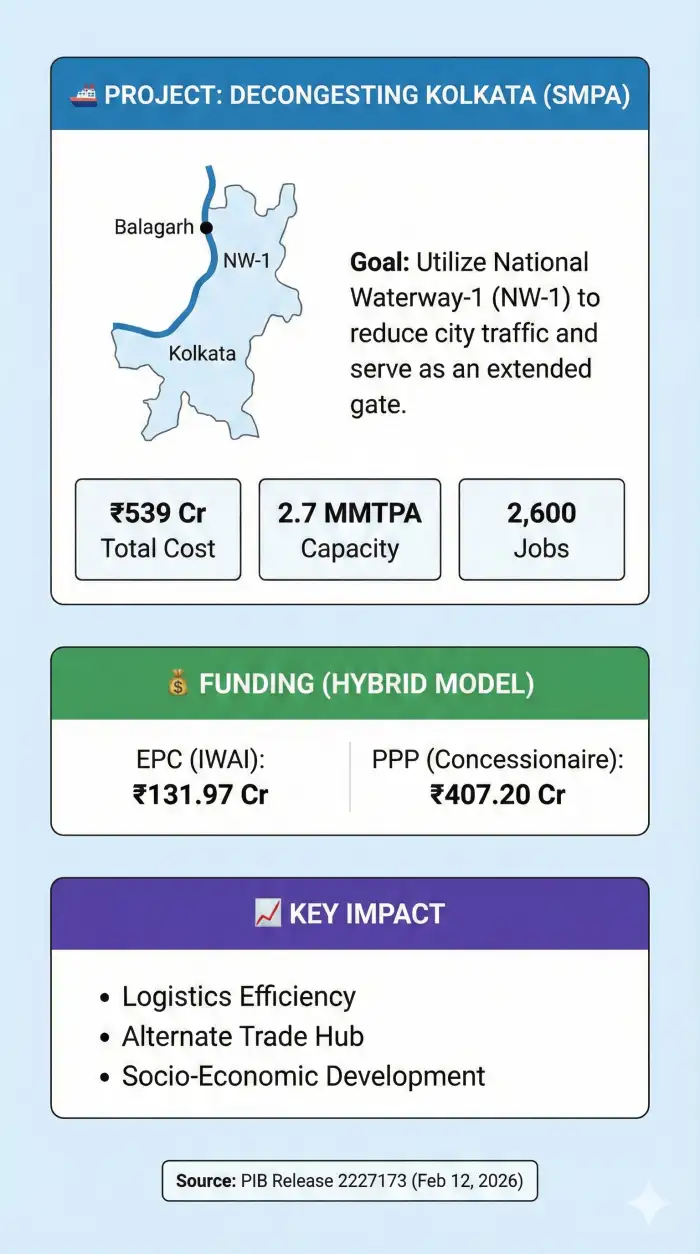
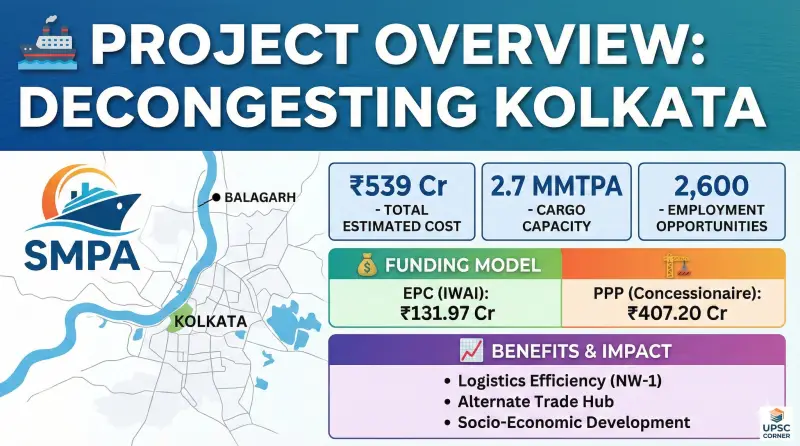
To tackle anticipated traffic growth and reduce the burden of intra-city cargo movement, the Syama Prasad Mookerjee Port Authority (SMPA) is developing a dedicated terminal at Balagarh (approx. 85 km from Kolkata). The project aims to utilize National Waterway-1 (NW-1) for cargo transport, serving as an extended gate for Kolkata Port.
💰 Funding & Implementation Model
The project follows a hybrid model splitting responsibilities between government authorities and private concessionaires.
| Component | Cost (₹ Crore) | Funding/Implementation |
|---|---|---|
| EPC (Engineering Procurement Construction) | 131.97 | Funded by Inland Waterways Authority of India (IWAI). Includes basic infrastructure like roads. |
| PPP (Public Private Partnership) | 407.20 | Financed and implemented by the selected Concessionaire. Includes jetties and handling facilities. |
| Total | 539.17 | - |
🏗️ Timeline & Current Status
- Environmental Clearance: Received on 24.01.2025.
- Road Construction Tender: Opened on 02.02.2026.
- ROB Work Order: Issued on 09.01.2026.
- EPC Completion Target: 31.03.2028 (excluding dredging).
- PPP Completion Target: Within 3 years from the award of concession.
Note: Dredging activities will be undertaken by IWAI immediately before the commencement of jetty construction by PPP operators.
📈 Benefits & Impact
- Logistics Efficiency: By shifting cargo to inland waterways (NW-1), the project reduces reliance on congested city roads.
- Alternate Hub: Balagarh will serve as an alternate trade hub, lowering overall logistics costs.
- Socio-Economic Development: Expected to generate ~2,600 direct and indirect jobs, benefiting the local population.
📚 UPSC Corner: Prelims & Mains Focus
Prelims Practice
Q1. The 'Balagarh Project', recently seen in the news, is conceived as an 'Extended Gate' for which major port?
- A) Paradip Port Authority
- B) Syama Prasad Mookerjee Port Authority (Kolkata)
- C) Haldia Dock Complex
- D) Visakhapatnam Port Authority
Answer: B (Syama Prasad Mookerjee Port Authority)
Q2. Consider the following statements regarding the Balagarh Terminal Project:
- It is located on National Waterway-1 (Ganga-Bhagirathi-Hooghly).
- The project is funded entirely by the Inland Waterways Authority of India (IWAI).
- It aims to decongest Kolkata city roads by shifting cargo to waterways.
Which of the statements given above are correct?
- A) 1 and 2 only
- B) 2 and 3 only
- C) 1 and 3 only
- D) 1, 2 and 3
Answer: C (Statement 2 is incorrect as the project uses a Hybrid model with significant PPP funding).
Mains Practice & Model Answer
Q. "Decongesting major city ports is crucial for urban planning and trade efficiency." Discuss the significance of the Balagarh Terminal project in this context and analyze how Inland Waterways can reduce logistics costs in India. (250 Words)
📝 Model Answer Approach
Introduction
India’s logistics cost currently stands at approx. 13-14% of GDP, significantly higher than the global average of 8%. The Balagarh Terminal Project, acting as an extended gate for Kolkata Port via National Waterway-1 (NW-1), represents a strategic intervention to lower these costs and decongest urban infrastructure.
Body: Significance of Balagarh Terminal
- Urban Decongestion: Kolkata Port acts as a city-port where cargo movement often chokes city traffic. Balagarh (85km away) will intercept cargo upstream, bypassing the city limits.
- Extended Gate Concept: It functions as a satellite terminal, increasing the cargo catchment area for Kolkata Port without adding pressure to existing jetties.
- Multi-modal Connectivity: By integrating with NW-1, it facilitates the smooth movement of bulk cargo (like stone aggregates and coal) directly to the hinterland.
Body: Role of Inland Waterways in Logistics
- Cost Efficiency: Freight movement via water is the cheapest mode.
- Waterways: ~₹1.06 per ton-km
- Rail: ~₹1.41 per ton-km
- Road: ~₹2.58 per ton-km
- Environmental Impact: IWT (Inland Water Transport) has the lowest carbon footprint and is fuel-efficient (1 liter of fuel moves 105 ton-km by water vs 24 ton-km by road).
- Strategic Accessibility: Connects landlocked states (e.g., Bihar, UP) and North East India (via Indo-Bangladesh Protocol Route) to international trade routes.
Conclusion
The Balagarh project aligns with the PM Gati Shakti National Master Plan by promoting multi-modal connectivity. Prioritizing such inland waterway projects is essential to reduce logistics costs to single digits, thereby enhancing the competitiveness of Indian exports in the global market.
Ministry of Ports, Shipping and Waterways