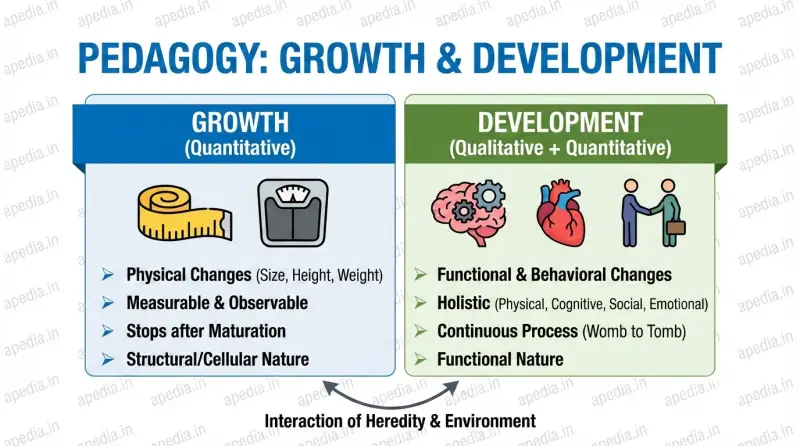
🌱 Concept: Growth vs. Development
Growth refers to physical, quantitative changes (height, weight) that stop after maturation. Development is a broader, continuous process involving both quantitative and qualitative changes (functional, behavioral) from "Womb to Tomb".
Quantitative
Nature of Growth
Qualitative
Nature of Development
Continuous
Lifelong Process
🧠 Domains & Principles
Development is multidimensional, interlinked, and influenced by the interaction of Heredity and Environment.
🧩 Domains of Development
- Physical: Bodily changes, Motor skills (Gross & Fine).
- Cognitive: Thinking, reasoning, language, memory.
- Social/Emotional: Interactions, relationships, managing feelings.
📐 Key Principles
- Cephalocaudal: Head to Toe development.
- Proximodistal: Center to Periphery (Spine to fingers).
- Spiral: Development advances and consolidates, it is not linear.
🧬 Factors
Development is the product of Heredity (Nature) × Environment (Nurture). It follows the principle of General to Specific responses.
👶 Stages of Development
Key characteristics of the major developmental stages relevant for teaching exams.
- 🍼 Infancy (Birth–2 yrs): Rapid physical growth, sensory exploration, language begins.
- 🧸 Early Childhood (2–6 yrs): Known as "Toy Age". Language explosion, pre-gang age, curiosity, imitative behavior.
- 🎒 Later Childhood (6–12 yrs): Known as "Gang Age". Logical thinking (concrete), social skills active, slow physical growth.
- ⚡ Adolescence (12–18 yrs): Period of "Storm & Stress". Puberty, identity crisis, abstract thinking.
📚 Quiz Corner
1. The "Cephalocaudal" principle of development states that development proceeds from:
Answer: B
2. Which stage is referred to as the period of "Storm and Stress"?
Answer: C
Source Information: DSSSB PRT Pedagogy Preparation Series
Link to Study Material
Child Development & Pedagogy