⚖️ Core Concepts: The Heinz Dilemma
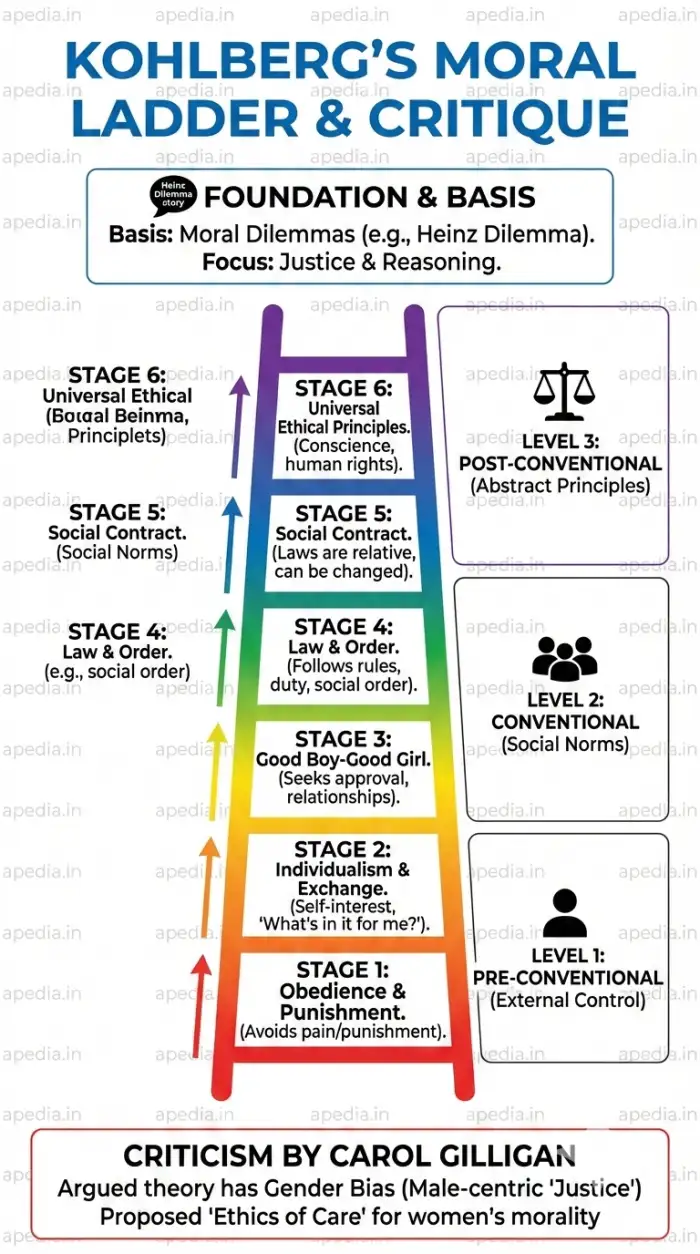
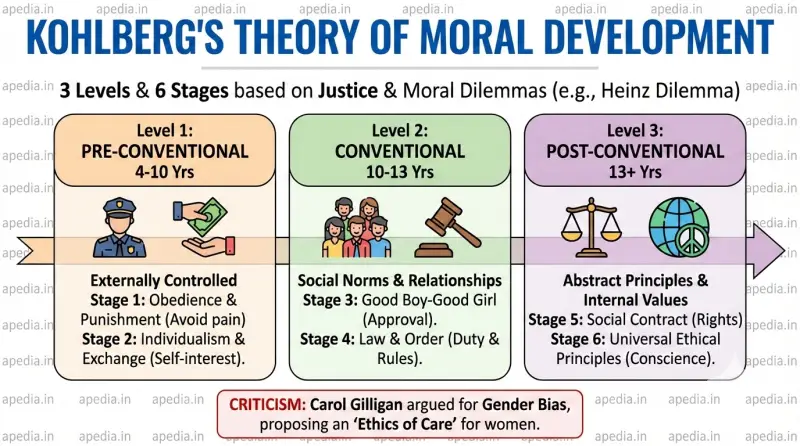
Lawrence Kohlberg expanded on Piaget's work to create a theory of Moral Development. He used stories like the famous Heinz Dilemma (should a man steal a drug to save his dying wife?) to assess how people justify their moral decisions.
3
Levels of Morality
6
Distinct Stages
Justice
Core Value
🪜 The 3 Levels & 6 Stages
Kohlberg believed moral development follows a specific sequence, though not everyone reaches the highest stage.
Level 1: Pre-Conventional (4-10 yrs)
Morality is externally controlled (by authority/consequences).
- Stage 1: Obedience & Punishment: "I won't do it because I'll get punished."
- Stage 2: Individualism & Exchange: "What's in it for me?" (Tit-for-Tat).
Level 2: Conventional (10-13 yrs)
Morality is tied to personal and social relationships.
- Stage 3: Good Boy-Good Girl: Seeking approval and maintaining good relationships.
- Stage 4: Law & Order: Obeying laws to maintain social order (Duty).
Level 3: Post-Conventional (13+ yrs)
Morality is defined by abstract principles and justice.
- Stage 5: Social Contract: Laws are social contracts that can be changed if they are unjust.
- Stage 6: Universal Ethical Principles: Follows self-chosen ethical principles (e.g., Human Rights) even if they violate laws.
⚠️ Criticism: Carol Gilligan
Kohlberg's theory was heavily criticized by his student, Carol Gilligan.
- Gender Bias: She argued Kohlberg's theory was based on male norms (Justice perspective).
- Care Perspective: Gilligan proposed that women often make moral decisions based on an "Ethic of Care" and relationships, rather than abstract justice.
📚 Quiz Corner
1. A child obeys rules only to avoid punishment. Which stage of Kohlberg's theory is this?
Answer: A
2. Who criticized Kohlberg for gender bias in his theory of moral development?
Answer: C
Source Information: DSSSB PRT Pedagogy Preparation Series
Link to Study Material
Educational Psychology