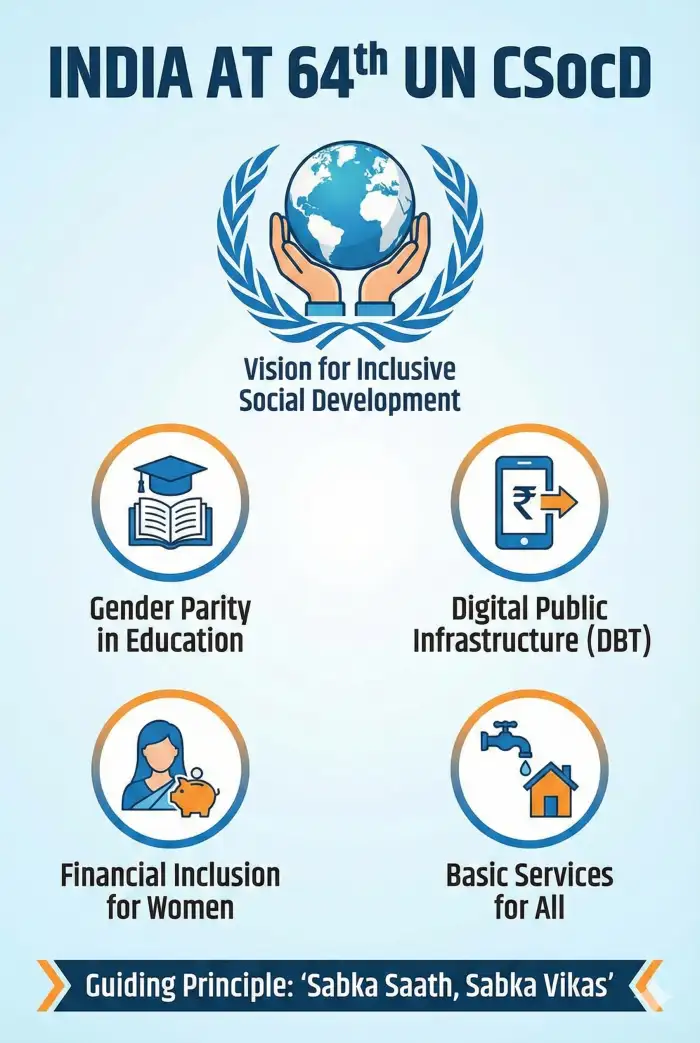
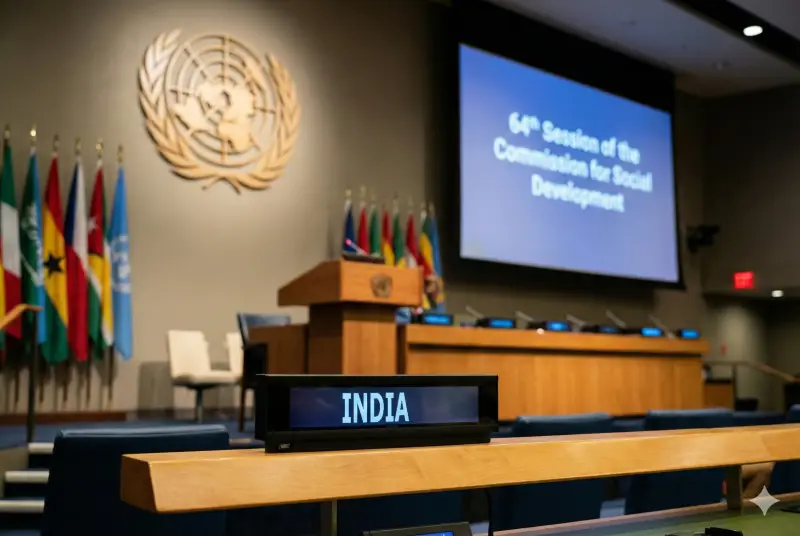
India reaffirmed its global commitment to equitable growth at the 64th Session of the Commission for Social Development (CSocD) held at the UN Headquarters in New York. Leading the Indian delegation, Minister of State for Women and Child Development, Smt. Savitri Thakur, delivered the National Statement. She articulated India's strategy for advancing social justice through inclusive policies, deeply rooted in the constitutional framework and the long-term national vision of "Viksit Bharat 2047".
64th Session of the Commission for Social Development
UN Headquarters, New York
Smt. Savitri Thakur (MoS, WCD)
"Sabka Saath, Sabka Vikas"
Ambassador Khrystyna Hayovyshyn (Ukraine)
Education & Gender Parity
The Minister highlighted that India has achieved significant parity between girls' and boys' participation in education. This success is attributed to improved school infrastructure and the establishment of residential schools in remote and tribal areas.
Basic Services & Protection
India adopted a "whole-of-society" approach to scale up basic amenities. Key milestones include:
- Universal access to piped drinking water and clean cooking energy.
- Development of nationwide protection mechanisms for women and children, including dedicated helplines.
- Health and nutrition programs that now cover over 100 million beneficiaries.
Financial Inclusion
The delegation emphasized the transformative impact of opening hundreds of millions of bank accounts, where women have emerged as the primary beneficiaries of credit schemes and entrepreneurship opportunities.
India showcased its successful model of using Digital Public Infrastructure and Direct Benefit Transfers (DBT). These technological interventions have enhanced accountability and efficiency in public service delivery, ensuring benefits reach the last mile without leakage.
The statement reiterated India's support for vulnerable groups through expanded social security schemes targeting:
- The Elderly
- Persons with Disabilities (PwD)
- Unorganized Sector Workers
- Transgender Persons
"Social justice and social protection in India are rooted in constitutional guarantees and aligned with the country’s long-term vision of Viksit Bharat 2047... reflecting a whole-of-government approach to ensure that no one is left behind." — Smt. Savitri Thakur, Minister of State for Women and Child Development.
For the full official text of the intervention, please refer to the Press Information Bureau release:
Click here to read the Official Press Release