💧 2025 Hurricane Glider Coordination: A Tech Retrospective
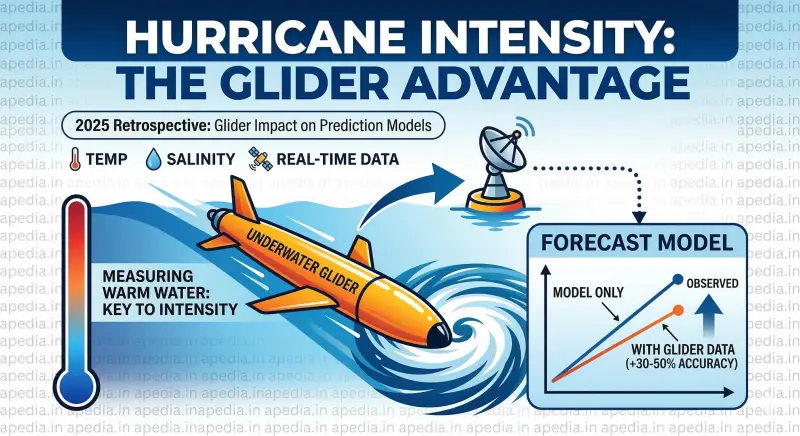
Understanding the role of cutting-edge technology in disaster management is key for UPSC aspirants. Underwater gliders have emerged as critical tools for gathering vital subsurface ocean data to enhance hurricane intensity forecasting, complementing existing methods that track a storm's movement. The IOOS-led Hurricane Glider Collaboration successfully marked its eighth coordinated field campaign in 2025, deploying a significant fleet across major ocean basins to capture real-time environmental data that improved predictive models. These autonomous vehicles measure crucial parameters like temperature and salinity, feeding into complex simulations to refine our understanding of hurricane behavior.
💧 Technological Impact & Global Synergy
The campaign demonstrated significant advancements in both autonomous data collection and strategic global cooperation, enhancing forecasting capabilities and showcasing international scientific collaboration.
- International partners, supported by the Global Ocean Observing System (GOOS) Co-Design Programme, expanded glider flights into coastal waters of Bermuda, Dominican Republic, Bahamas, Mexico, Barbados, Trinidad and Tobago, and Guyana.
- The U.S. National Academies Understanding Gulf Ocean Systems (UGOS) Program supported gliders and floats from the U.S. and Mexico.
- Gliders are a crucial element of NOAA's Coordinated Hurricane Atmosphere-Ocean Sampling (CHAOS) Experiment, which collocates measurements across the air-sea interface during storms using multi-platform approaches.
📚 Prelims Quiz Corner
1. They are primarily used to track the path or 'track' of a hurricane.
2. They collect subsurface ocean data such as water temperature, salinity, and pressure, which is vital for forecasting hurricane 'intensity'.
3. The data gathered is used only in purely illustrative scientific research and does not feed into operational forecasting models.
Which of the statements given above is/are correct?
- A) 1 and 2 only
- B) 2 only
- C) 2 and 3 only
- D) 1, 2, and 3