🌿 Biodiversity and Conservation
🌍 Module 1: Understanding Biodiversity
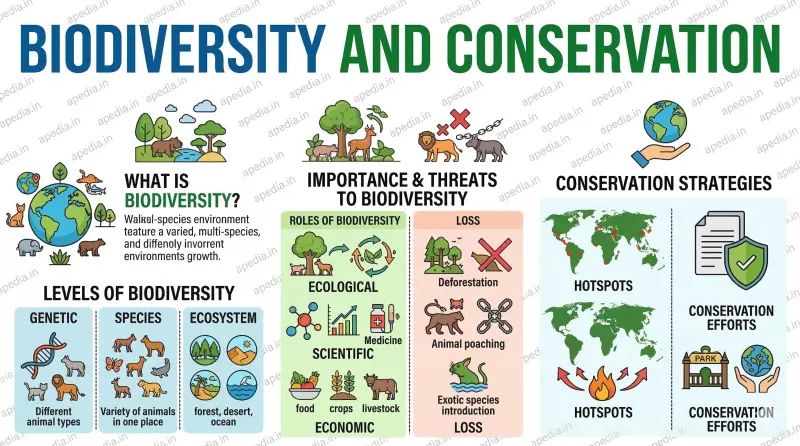
Biodiversity is a combination of two words: "Bio" meaning life, and "diversity" meaning variety. It refers to the number and variety of organisms found within a specific geographic region. It is a system in constant evolution, and the richest biodiversity is consistently found in the tropical regions, progressively decreasing as one moves towards the poles.
Levels of Biodiversity
- Genetic Diversity: This refers to the variation of genes within a particular species. It is the reason why individuals of the same species (like humans) have different physical characteristics. This diversity is essential for the healthy breeding and adaptation of a population.
- Species Diversity: This relates to the variety and number of different species present in a defined area. It is measured by the richness, abundance, and types of species.
- Ecosystem Diversity: This involves the broad differences between ecosystem types (like forests, deserts, and wetlands) and the diversity of habitats and ecological processes occurring within them.
📝 Concept Check 1
1. Which region of the Earth consistently has the richest biodiversity?
The Tropics
2. What level of biodiversity refers to the variation of genes within a single species?
Genetic Diversity
3. What does "Bio" mean in the term Biodiversity?
Life
4. How is species diversity usually measured?
By species richness and abundance
📉 Module 2: Roles and Loss of Biodiversity
All forms of life are closely interlinked. Biodiversity plays three major roles: Ecological (capturing energy, recycling nutrients, regulating climate), Economic (providing food, crops, livestock, and medicines), and Scientific (helping us understand how life evolves and functions).
The Decline of Biological Wealth
Despite its importance, biodiversity is facing a rapid decline due to human activities. The primary causes include habitat destruction, over-logging, pollution, poaching of wild animals, and the introduction of exotic (non-native) species that disrupt local ecosystems.
- Endangered Species: Species that are in immediate danger of extinction. The International Union for Conservation of Nature (IUCN) maintains a Red List of these species.
- Vulnerable Species: Species that are likely to become endangered if the current threatening factors continue to operate.
- Rare Species: Species with naturally small populations, usually confined to limited geographical areas, making them highly susceptible to disturbances.
📝 Concept Check 2
1. Which organization categorizes threatened species into lists like "Endangered"?
IUCN
2. What role of biodiversity involves providing food and medicine?
Economic Role
3. What do we call non-native species that threaten local ecosystems?
Exotic species
4. Which species are likely to become endangered if threats continue?
Vulnerable Species
🛡️ Module 3: Conservation Strategies
Conservation is essential to ensure that development is sustainable and harmonious with other life forms. This requires global cooperation, protective legislation, and the active involvement of local communities.
Key Conservation Concepts
- Mega Diversity Centres: A group of specific countries, mostly located in the tropical region, that possess an exceptionally large share of the world's species diversity (e.g., India, Brazil, Mexico, Indonesia).
- Biodiversity Hotspots: Regions identified by the IUCN that are extremely rich in species diversity but are highly vulnerable to habitat loss. They are largely defined by their unique vegetation.
- Legislative Action: The Government of India passed the Wild Life (Protection) Act, 1972 to protect ecosystems by establishing national parks, sanctuaries, and biosphere reserves. Globally, the 1992 Earth Summit in Rio de Janeiro was a major milestone for international conservation agreements.