🙏 Devotional Paths: Bhakti and Sufi Movements
🌺 Module 1: The Cultural Mosaic and Tamil Bhakti
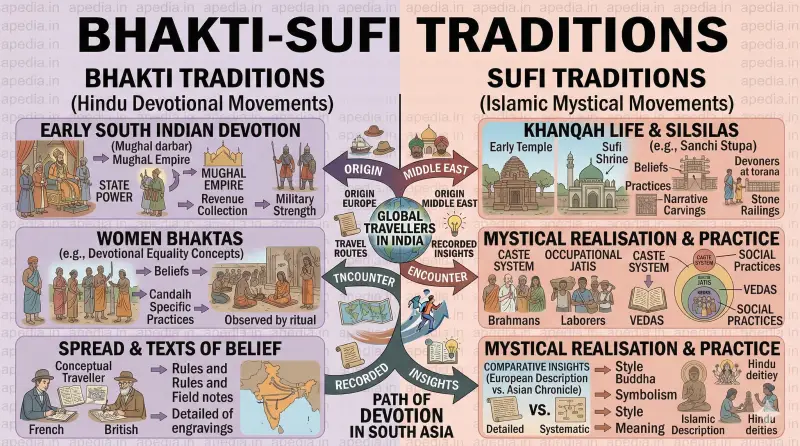
Spanning from the 8th to the 18th century, the Indian subcontinent experienced a dynamic intermingling of diverse religious practices, leading to the phenomenal growth of passionate devotional (Bhakti) movements.
Religious Integration and the Southern Saints
- A Blend of Traditions: The sociologist Robert Redfield conceptualized this cultural blending by describing how everyday agrarian societies maintained their indigenous, local beliefs ("little traditions") while simultaneously adopting the orthodox rituals dictated by dominant priests ("great traditions"). A classic example of this synthesis is the absorption of a local Odia deity into the broader Puranic pantheon as Lord Jagannatha (a manifestation of Vishnu) in Puri.
- The Alvars and Nayanars: Originating around the 6th century in Tamil Nadu, a powerful wave of devotion was spearheaded by the Alvars (who worshipped Vishnu) and the Nayanars (who revered Shiva). These itinerant poet-saints composed ecstatic hymns in the vernacular Tamil language, fostering an inclusive movement that welcomed marginalized communities, including artisans and those deemed "untouchable" by orthodox elites.
- Elevating Vernacular Texts: The profound spiritual poetry of the Alvars was compiled into a grand anthology known as the Nalayira Divyaprabandham. Devotees revered this compilation so highly that they frequently equated its spiritual authority with that of the ancient Sanskrit Vedas.
- Defying Patriarchy and Gaining Patronage: Female saints such as Andal (an Alvar who envisioned herself as Vishnu's bride) and Karaikkal Ammaiyar (a fierce Nayanar devotee) actively challenged strict patriarchal confines through their radical compositions. Recognizing the immense popular appeal of these movements, ambitious Chola monarchs (9th–13th centuries) heavily patronized the Shaiva tradition, constructing spectacular stone temples at Thanjavur and Chidambaram to publicly align their royal power with divine authority.
📝 Concept Check 1
1. Which sociologist introduced the framework of "great" and "little" traditions to explain religious integration?
Robert Redfield.
2. The prominent regional deity of Puri in Odisha was assimilated into the Puranic tradition as which major god?
Lord Vishnu (worshipped there as Jagannatha).
3. Which monumental anthology is popularly revered as the "Tamil Veda"?
The Nalayira Divyaprabandham.
4. Which prominent female Alvar composed passionate poetry viewing herself as the beloved of Lord Vishnu?
Andal.
📿 Module 2: The Virashaiva Revolution in Karnataka
During the 12th century, a revolutionary religious wave swept through Karnataka, posing a direct and formidable challenge to the established Brahmanical hierarchy and its rigid social codes.
Basavanna and the Rise of the Lingayats
- Origins of the Movement: This radical sect was spearheaded by Basavanna (1106–1168), a Brahmana who served as a minister within the Kalachuri court. His devoted followers became known as Virashaivas (meaning "heroes of Shiva") or Lingayats (meaning "wearers of the linga").
- Distinctive Devotion: Lingayats exclusively worship Shiva in his abstract form as a linga. Devotees characteristically wear a miniature linga housed within a silver casket, draped over their left shoulder. They also hold wandering holy men, known as jangama, in the highest spiritual regard.
- Defying Mortuary Norms: The community vehemently rejects the orthodox concept of reincarnation. They believe that a true devotee achieves permanent union with Shiva upon death and will not be reborn into the material world. Consequently, they completely discard the practice of cremation, opting instead for ceremonial burial.
- A Push for Social Equity: The Virashaivas vigorously attacked the discriminatory caste system and the Brahmanical concept of social "pollution." In stark defiance of the conservative Dharmashastras, they actively endorsed progressive practices like adult marriage and the remarriage of widows. The movement's philosophy was popularized through short, accessible Kannada poems known as vachanas (literally, "sayings").
📝 Concept Check 2
1. Who was the founding figure of the 12th-century Virashaiva movement in Karnataka?
Basavanna.
2. How does the Lingayat community diverge from orthodox Hindu traditions regarding the disposal of the dead?
They practice ceremonial burial rather than cremation, believing the soul unites directly with Shiva.
3. What is the specific title given to the wandering ascetics who are deeply respected by Lingayats?
Jangama.
4. What is the term for the brief Kannada poems or "sayings" through which the Lingayats spread their teachings?
Vachanas.
🕌 Module 3: Islamic Traditions and the Sufi Mystics
The establishment of Islamic authority in the subcontinent facilitated a unique cultural synthesis, where universal Islamic principles merged seamlessly with regional customs, deeply nurturing the mystical Sufi traditions.
Syncretism, Hospices, and the Chishti Order
- Cultural Blending: While all Muslims adhered to the five foundational pillars of Islam (monotheism, prayer, charity, fasting, and pilgrimage), regional practices flourished. For example, the Khojah community composed devotional hymns in indigenous languages known as ginan, while Arab merchants settling in Kerala assimilated local customs like speaking Malayalam and adopting matrilocal family structures. Under Islamic governance, non-Muslim populations were categorized as zimmi (protected subjects) upon the payment of the jizya tax.
- The Rise of Tasawwuf (Sufism): Reacting against the increasing wealth and materialism of the early Caliphates, Sufi mystics embraced asceticism and intense spiritual devotion. They congregated in hospices known as khanqahs, operating under the guidance of a master teacher (variously called a shaikh, pir, or murshid). Spiritual authority was passed down through a silsila—an unbroken chain of transmission tracing back to the Prophet Muhammad.
- The Chishti Impact: Of all the Sufi lineages, the Chishti silsila proved the most successful in the subcontinent because its leaders adeptly absorbed local Indian traditions. The Delhi hospice of the revered Shaikh Nizamuddin Auliya emerged as a vibrant, egalitarian center of daily social and spiritual life.
- Devotion through Music: A core Sufi practice involved undertaking a pilgrimage (ziyarat) to the tomb-shrine (dargah) of a venerated saint, particularly on the anniversary of his passing (urs). These gatherings frequently featured ecstatic music and dance (sama) to induce spiritual trance. The renowned poet Amir Khusrau, a dedicated follower of Nizamuddin Auliya, significantly enriched this tradition by introducing the qaul, a specific hymn that initiates a qawwali performance.
📝 Concept Check 3
1. Within medieval Islamic administration, what did the classification 'zimmi' signify?
It referred to "protected" non-Muslim populations who were subject to the jizya tax.
2. What is the specific Arabic term for the communal hospice where Sufi mystics gathered and lived?
Khanqah.
3. What term is used to describe the devotional pilgrimage to a Sufi saint's resting place?
Ziyarat.
4. Which legendary poet and disciple of Nizamuddin Auliya formulated the 'qaul' for qawwali music?
Amir Khusrau.
🌟 Module 4: New Devotional Paths in Northern India
Across Northern India, charismatic poet-saints rose to prominence by fiercely critiquing rigid religious dogmas and promoting a direct, unmediated spiritual bond with the divine.
The Legacies of Kabir, Guru Nanak, and Mirabai
- The Weaver Mystic (Kabir): Thriving in the 14th–15th centuries, Kabir composed piercing verses that survive today in collections like the Kabir Bijak and the Adi Granth Sahib. Writing in the accessible sant bhasha dialect, he masterfully employed ulatbansi (paradoxical, "upside-down" sayings) to articulate the inexpressible nature of God. Blending Islamic vocabulary (Allah, Khuda) with Hindu Vedantic terms (nirakar, alakh), he was an uncompromising critic of polytheism and idol worship.
- The First Sikh Guru (Baba Guru Nanak): Born into a Hindu mercantile family in 1469, Guru Nanak championed nirguna bhakti (the worship of a formless, abstract Divine). He vehemently dismissed outward religious displays like ritual bathing, animal sacrifices, and orthodox scriptural recitations. Instead, he prescribed constant meditation on the Divine Name, utilizing sacred hymns (shabad) accompanied by the strumming of a rabab. In the early 17th century, the fifth Sikh leader, Guru Arjan, formally compiled his teachings—alongside those of Kabir and Baba Farid—into the authoritative Adi Granth Sahib.
- The Rebel Princess (Mirabai): A 16th-century royal from Mewar, Mirabai boldly rejected her aristocratic marital duties, declaring her ultimate, romantic devotion solely to Lord Krishna. Her defiance of societal expectations extended to her choice of spiritual mentor: tradition asserts she accepted Raidas, a socially marginalized leather worker, as her guru. Her deeply passionate, rule-breaking bhajans continue to resonate powerfully, especially among oppressed communities.
📝 Concept Check 4
1. In the context of Kabir's poetry, what does the literary technique 'ulatbansi' entail?
The use of "upside-down" or paradoxical verses meant to invert everyday logic to explain ultimate truths.
2. Did Baba Guru Nanak's theology center on saguna (with form) or nirguna (without form) bhakti?
He strongly advocated for nirguna bhakti.
3. Which historical figure was responsible for compiling the sacred Adi Granth Sahib?
Guru Arjan (the fifth Sikh Guru).
4. According to popular tradition, which socially marginalized artisan served as the spiritual guide for Princess Mirabai?
Raidas (a leather worker).