🌾 The Agrarian Engine: Peasants, Zamindars, and the Mughal State
📜 Module 1: The Backbone of the Empire: Agrarian Society
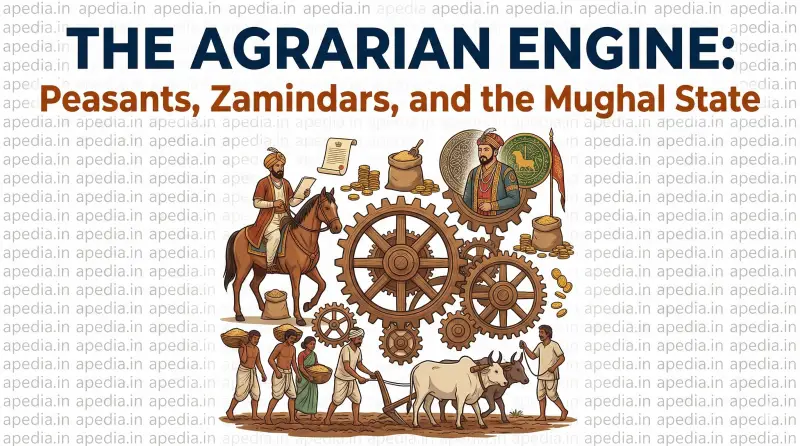
During the 16th and 17th centuries, an overwhelming 85 percent of India's population resided in rural villages, toiling in agricultural production. The immense wealth and power of the Mughal state were almost entirely built upon the revenues extracted from this agrarian base.
Documenting the Fields and the Cultivators
- The Master Record (Ain-i Akbari): Our most detailed understanding of this era stems from the Ain-i Akbari. Authored by Abu'l Fazl, the brilliant court historian of Emperor Akbar, this monumental text meticulously cataloged everything from crop yields and revenue statistics to the structural organization of the empire.
- The Two Tiers of Peasantry: Persian administrative records referred to farmers using terms like kisan, asami, or raiyat. They were fundamentally divided into two groups: the khud-kashta (permanent village residents who owned the land they worked) and the pahi-kashta (migrant or non-resident laborers who cultivated land on a temporary contractual basis, often driven to move by famine or the promise of better economic terms).
- Watering the Empire: While the annual monsoon was the lifeblood of Indian agriculture, the state actively invested in artificial irrigation to boost yields. A prime example is the nahr-i bihisht (canal of paradise) in Punjab, which was extensively repaired and expanded during the reign of Shah Jahan.
- The Push for "Perfect Crops": To maximize tax revenue, the Mughal state heavily incentivized the cultivation of lucrative cash crops, officially termed jins-i kamil (perfect crops), such as sugarcane and cotton. Furthermore, global trade networks introduced transformative "New World" crops to the subcontinent during this era, including potatoes, tomatoes, maize, and chillies.
📝 Concept Check 1
1. Who compiled the exhaustive administrative manual known as the Ain-i Akbari?
Abu'l Fazl.
2. What specific term was used for a migrant or non-resident farmer working on a contractual basis?
Pahi-kashta.
3. What is the English translation of the Persian administrative term 'jins-i kamil'?
Perfect crops (referencing high-value cash crops like cotton and sugarcane).
4. Identify two "New World" crops that became integrated into Indian agriculture during the 17th century.
Tomatoes, potatoes, maize, chillies, papaya, or pineapple.
🏘️ Module 2: The Village Ecosystem: Councils and Craftsmen
The typical Mughal-era village operated as a highly structured, semi-autonomous social unit. It functioned through a delicate balance between the cultivators, the local artisan class, and a governing council.
Local Authority and the Artisan Economy
- The Panchayat and the Muqaddam: Village governance was handled by the panchayat, an assembly composed of respected elders representing the village's various dominant castes (notably excluding menial castes). This council was led by a headman, known as the muqaddam or mandal. He was generally chosen by community consensus but required official ratification from the local zamindar.
- The Village Accountant: Every village relied on a patwari, an essential official who meticulously maintained land records, tracked agricultural output, and managed the financial accounts of the panchayat.
- Enforcing Social Order: Beyond settling disputes, a critical function of the panchayat was to police social behavior and ensure strict adherence to caste boundaries. The council wielded the power to impose harsh fines or, in extreme cases of defiance, permanently expel individuals from the village.
- The Artisan Workforce: Artisans—such as carpenters, potters, and blacksmiths—could make up to 25 percent of a village's households. In exchange for their specialized services, they were compensated through a customary system of negotiated harvest shares (a practice that later British colonial officials termed the jajmani system) or through the allocation of small plots of tax-free land.
📝 Concept Check 2
1. What title was given to the headman of the village panchayat?
Muqaddam (or Mandal).
2. What was the primary responsibility of the village patwari?
To act as the accountant, maintaining village records and managing panchayat funds.
3. What was a major social policing function of the panchayat?
To enforce social norms and ensure that strict caste boundaries were respected.
4. What term did later British administrators use to describe the customary system of compensating artisans with harvest shares?
The jajmani system.
🌲 Module 3: Women's Labor and the Forest Frontier
Beyond the neatly demarcated agricultural fields, the Mughal economy was heavily dependent on the intense labor of rural women and the rich resources extracted from the vast, densely forested regions of the subcontinent.
Gender Roles and the "Jangli" Populations
- The Crucial Role of Women: Peasant women were indispensable to agrarian production. They worked alongside men in the fields—sowing, weeding, and harvesting—while also managing domestic crafts like pottery making and yarn spinning. Due to shockingly high maternal mortality rates, there was a chronic demographic shortage of women in many rural areas, which led to the widespread practice of paying a "bride-price" to a woman's family, rather than the family providing a dowry.
- The Forest Dwellers: Massive tracts of Central India and Jharkhand were covered in deep forest. Mughal texts referred to the inhabitants of these regions as jangli—a term applied to people who sustained themselves through hunting, gathering forest produce, and practicing shifting (slash-and-burn) agriculture.
- The Commercial Forest: The state viewed the forests as a lucrative resource. Forest tribes were frequently forced to provide tribute (peshkash) to the emperor, most crucially in the form of captured wild elephants for the Mughal military. Furthermore, forest commodities like gum lac, beeswax, and honey were highly valued in commercial trade.
- Tribal State Formation: As interaction with the settled agrarian world increased, some tribal chieftains evolved into powerful zamindars or even independent kings. A notable example is the Ahom kingdom in Assam, which built a formidable, centralized state heavily reliant on a system of forced labor known as paiks, while maintaining a strict monopoly over elephant capturing.
📝 Concept Check 3
1. Why did the practice of paying a "bride-price" emerge in many rural peasant communities instead of a dowry system?
Due to a demographic shortage of women caused by high maternal mortality rates in childbirth.
2. In Mughal terminology, what did the word "jangli" specifically refer to?
Populations whose livelihoods depended on hunting, gathering, and shifting agriculture in the forests.
3. What highly prized animal was regularly demanded from forest tribes as state tribute (peshkash)?
Elephants.
4. Which emerging tribal kingdom in Assam built its state power using a system of forced labor called 'paiks'?
The Ahom kings.
💰 Module 4: Zamindars, Revenue, and the Silver Influx
The lifeblood of the Mughal Empire was land revenue. The state managed this massive wealth extraction through a sophisticated bureaucratic apparatus and a powerful class of rural intermediaries known as zamindars.
The Revenue Machine and Global Economics
- The Power of the Zamindar: Zamindars were the landed elite. Unlike peasants, they did not directly till the soil; instead, they held a hereditary property right over their estates known as milkiyat. Acting as the crucial link between the village and the state, they collected agricultural taxes, retaining a fixed percentage as their compensation. To enforce their will, they maintained private fortresses (qilachas) and personal armed militias.
- The Art of Assessment: The imperial revenue department (the diwan) operated a meticulous, two-stage process. First, they calculated the jama (the officially assessed amount of tax owed). Second, they recorded the hasil (the actual amount successfully collected). The local official responsible for maximizing this collection, preferably in cash, was the amil-guzar.
- The Silver River: The 16th and 17th centuries witnessed an explosion in global maritime trade. To purchase highly coveted Indian exports like spices, silk, and cotton, European merchants flooded the subcontinent with massive quantities of silver newly mined from the Americas.
- Monetary Stability: This unprecedented influx of bullion allowed the Mughal state to mint millions of high-purity silver coins known as the rupya. This stable, universally accepted currency facilitated the state's demand that peasants pay their land revenue in cash, deeply monetizing the entire imperial economy.
📝 Concept Check 4
1. What was the specific term for the hereditary property rights held by the powerful zamindar class?
Milkiyat.
2. In the Mughal revenue system, what is the distinction between 'jama' and 'hasil'?
Jama is the assessed amount owed; Hasil is the actual amount successfully collected.
3. What was the title of the local Mughal official tasked with collecting the land revenue?
The amil-guzar.
4. What precious metal poured into India as a result of expanding global trade, fundamentally stabilizing the Mughal economy?
Silver.