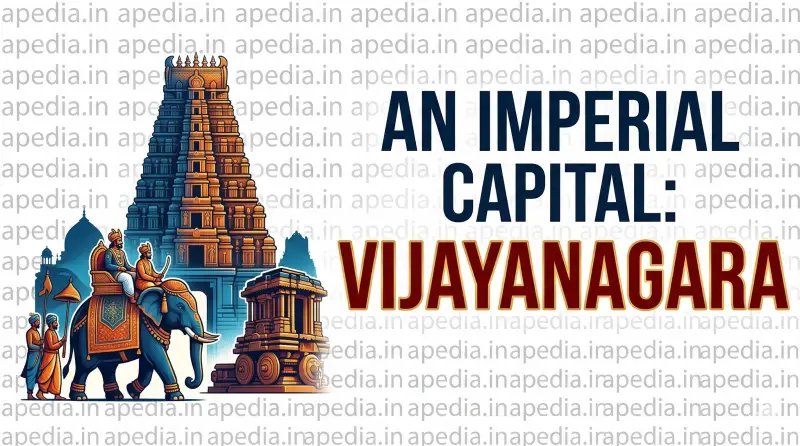
🏰 The Imperial Capital: Vijayanagara
🗺️ Module 1: Discovery and Political History
The term "Vijayanagara" translates to the "City of Victory," representing both a sprawling medieval empire and its bustling epicenter. Today, the remnants of this once-great capital are recognized globally as the ruins of Hampi. From the 1300s to the 1500s, this empire held undisputed sway over the southern Indian peninsula.
Foundations and Downfall
- Uncovering Hampi: In 1800, the forgotten ruins of Hampi were formally documented by Colonel Colin Mackenzie, an antiquarian and engineer working for the English East India Company, who drafted the area's first geographical survey.
- Dynastic Succession: The empire itself was established much earlier, in 1336, by two brothers named Harihara and Bukka, who belonged to the Sangama dynasty. Over the centuries, control shifted through successive lineages: the Saluvas, the Tuluvas, and the Aravidu dynasty.
- The Golden Age: The empire achieved its absolute zenith under the brilliant Tuluva monarch, Krishnadeva Raya. His reign was defined by aggressive territorial expansion (such as seizing the fertile Raichur doab) and the commissioning of breathtaking temple architecture.
- The Catastrophe of Talikota: Prosperity shattered following Krishnadeva Raya's death. In 1565, the ambitious chief minister Rama Raya steered the Vijayanagara army into the catastrophic Battle of Talikota (also known as Rakshasi-Tangadi). A powerful coalition of Deccan Sultanates—comprising Golconda, Ahmadnagar, and Bijapur—decisively crushed the imperial forces, leading to the brutal sacking and ultimate abandonment of the capital.
📝 Concept Check 1
1. Which East India Company official prepared the first survey map of the Hampi ruins in 1800?
Colonel Colin Mackenzie.
2. Which two brothers are credited with founding the Vijayanagara Empire?
Harihara and Bukka.
3. Under which famous Tuluva king did the empire reach its maximum territorial and cultural peak?
Krishnadeva Raya.
4. Which 1565 battle resulted in the destruction and abandonment of the capital city?
The Battle of Talikota (Rakshasi-Tangadi).
💧 Module 2: Administration and Water Resources
The sovereigns of Vijayanagara, who adopted the majestic title of Rayas, governed their vast territories through a highly effective military-administrative framework. They also proved to be master engineers, transforming a harsh, rocky environment into a thriving metropolis.
Governance and Hydrology
- The Amara-Nayaka System: A cornerstone of imperial administration was the amara-nayaka system, a political structure likely adapted from the Delhi Sultanate's iqta model. The Raya delegated regional governance to military chiefs known as amara-nayakas. These commanders collected local revenues, utilizing a portion to maintain specialized contingents of war elephants and cavalry for the crown, and presented an annual royal tribute.
- Geographic Core: The capital was geographically anchored within the natural, bowl-like basin of the Tungabhadra river, surrounded by striking, boulder-strewn granite hills.
- Mastering the Arid Landscape: Because the surrounding peninsula was incredibly dry, advanced water management was a matter of survival. Engineers constructed massive earthen embankments across streams to capture runoff, creating vital reservoirs like the Kamalapuram tank, which supplied the royal center and irrigated adjacent farmlands.
- The Hiriya Canal: Another engineering marvel was the Hiriya canal. It siphoned water from a large dam built across the Tungabhadra River to hydrate the fertile agricultural corridor that separated the urban core from the sacred center.
📝 Concept Check 2
1. What royal title was used by the monarchs of the Vijayanagara Empire?
Rayas.
2. What was the title given to the military commanders who governed territories and collected taxes for the king?
Amara-nayakas.
3. The natural basin of which major river defined the geography of the capital?
The Tungabhadra river.
4. Which significant waterwork drew water from a Tungabhadra dam to irrigate the city's cultivated valleys?
The Hiriya canal.
🧱 Module 3: Fortifications and The Royal Centre
Renowned for its colossal scale and heavily fortified defenses, Vijayanagara frequently left visiting foreign dignitaries in awe. Its innovative urban planning seamlessly integrated military defense with civilian sustainability.
Defenses and Palaces
- Awe-Inspiring Walls: When Abdur Razzaq, an envoy from Persia, visited in the 15th century, he was astonished by the city's military architecture, documenting seven concentric rings of formidable fortifications.
- Siege-Proof Agriculture: The true genius of these walls lay in their immense circumference: they encircled not only the urban population but also extensive forests and vast agricultural fields. This self-contained farming zone was a deliberate strategy designed to withstand prolonged military sieges by ensuring the city's food supply could never be cut off.
- The Heart of the Empire: Within the inner protective walls lay the Royal Centre, a sprawling district containing over sixty temples and dozens of palace complexes (which, unlike stone temples, were largely built from perishable wood and brick).
- The Mahanavami Dibba: At the heart of this district stood the Mahanavami Dibba, a towering, massive stone platform situated at the city's highest elevation. During the autumn festival of Mahanavami (Navaratri/Dussehra), the Rayas utilized this stage to project imperial dominance through grand military processions, animal sacrifices, and elaborate state rituals. Nearby stood the elegantly designed Lotus Mahal, another iconic secular structure of the royal court.
📝 Concept Check 3
1. Which 15th-century Persian envoy documented the city's seven lines of forts?
Abdur Razzaq.
2. What was the primary strategic reason for enclosing agricultural lands within the city's outer walls?
To secure the city's food supply and starve out enemies during prolonged sieges.
3. What was the name of the towering platform used by kings for elaborate autumn festival rituals?
The Mahanavami Dibba.
4. Identify one highly recognized secular palace structure located within the royal centre.
The Lotus Mahal.
🛕 Module 4: The Sacred Centre
Situated at the rugged, rocky northern edge of the capital, the Sacred Centre was the spiritual beating heart of the empire, deeply rooted in ancient regional mythology and religious devotion.
Temples and Divine Right
- Mythology of the Landscape: Local lore held that these northern hills were the mythical domain of the monkey kings Vali and Sugriva. Even more central to the city's identity was the legend of Pampadevi, the regional mother goddess. According to tradition, she performed intense ascetic penance in these hills to win the hand of Virupaksha, the kingdom's guardian deity and a manifestation of Lord Shiva.
- Earthly Deputies: The Rayas cleverly intertwined their political legitimacy with this divine narrative, asserting that they ruled merely as earthly deputies of Lord Virupaksha. In fact, official royal decrees were traditionally signed "Shri Virupaksha" in the native Kannada script.
- Architectural Grandeur: To showcase their piety and wealth, the monarchs revolutionized temple architecture. They commissioned colossal, towering gateways known as gopurams. These monumental structures dwarfed the inner shrines and served as visible beacons of imperial might from miles away, complemented by sprawling, pillared halls called mandapas.
- The Vitthala Temple: Another architectural triumph of the Sacred Centre is the Vitthala Temple. Dedicated to Vitthala—a form of Lord Vishnu traditionally venerated in Maharashtra—its presence underscores the empire's ability to assimilate diverse cultural traditions. The complex is world-renowned for its exquisitely carved stone chariot and the surrounding colonnaded streets paved with massive granite slabs.
📝 Concept Check 4
1. Which local mother goddess is mythologically tied to the rocky hills of Hampi?
Pampadevi.
2. In whose name did the Vijayanagara kings claim to rule and sign their royal decrees?
Lord Virupaksha.
3. What is the architectural term for the massive, towering gateways built by the Rayas to project their power?
Gopurams.
4. The Vitthala Temple features an iconic stone chariot dedicated to a form of Vishnu traditionally worshipped where?
Maharashtra.