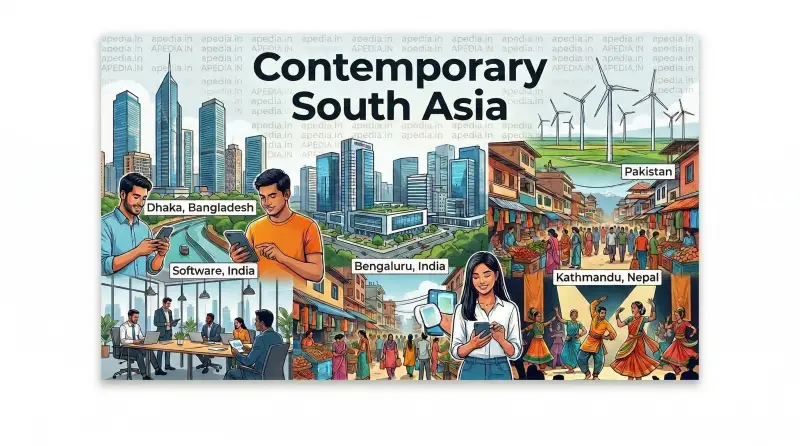
🌏 Contemporary South Asia
⚔️ Module 1: The Military and Democracy in Pakistan & Bangladesh
South Asia is a diverse region typically encompassing Bangladesh, Bhutan, India, the Maldives, Nepal, Pakistan, and Sri Lanka. While the region shares a geographical space, the political systems vary greatly, with some nations struggling to maintain democratic governance.
Pakistan's Democratic Struggles
- Military Dominance: Pakistan has experienced frequent military coups. Following its first constitution, General Ayub Khan took over, later followed by General Yahya Khan. Despite brief periods of elected governments under leaders like Zulfikar Ali Bhutto, Benazir Bhutto, and Nawaz Sharif, military leaders like General Zia-ul-Haq and General Pervez Musharraf often seized control.
- Reasons for Instability: The social dominance of the military, clergy, and landowning aristocracy severely hampers democratic stability. Furthermore, the ongoing conflict with India is frequently used by the military to justify its hold on power. Western nations, particularly the US, have also supported military regimes in the past due to fears of "global Islamic terrorism" and the need to secure Pakistan's nuclear arsenal.
The Birth and Politics of Bangladesh
- The 1971 Crisis: Originally "East Pakistan," the region suffered cultural and economic domination by West Pakistan, including the forced imposition of the Urdu language. Sheikh Mujibur Rahman led the Awami League in demanding autonomy. When the Pakistani military cracked down on the East, India intervened, leading to the 1971 war and the creation of independent Bangladesh.
- Post-Independence: Bangladesh drafted a secular, democratic constitution but soon slipped into military rule following the assassination of Sheikh Mujibur Rahman. Military rulers like Ziaur Rahman and H.M. Ershad governed until massive pro-democracy protests in 1990 restored representative democracy.
📝 Concept Check 1
1. Which groups dominate society and politics in Pakistan, hindering democracy?
The military, clergy, and landowning aristocracy.
2. Who led the Awami League's struggle for autonomy in East Pakistan?
Sheikh Mujibur Rahman.
3. Why did Western powers historically support military rule in Pakistan?
Due to fears of Islamic terrorism and concerns over nuclear security.
4. What language did West Pakistan attempt to force upon East Pakistan?
Urdu.
👑 Module 2: Monarchy, Democracy, and Ethnic Conflict
While India and Sri Lanka have successfully maintained democratic systems since independence, other nations like Nepal transitioned from a monarchy, and Sri Lanka itself was deeply scarred by ethnic violence.
Nepal: From Kingdom to Republic
- The Triangular Conflict: For years, Nepal was a Hindu kingdom where the king retained absolute control. In the 1990s and 2000s, a violent triangular conflict erupted between the monarchist forces, democratic political parties, and armed Maoist insurgents.
- The 2006 Uprising: After King Gyanendra dismissed the government in 2002, a massive, countrywide pro-democracy protest in 2006 forced the king to restore the House of Representatives. Nepal subsequently abolished the monarchy, becoming a democratic republic, and finally adopted a new constitution in 2015.
Sri Lanka: Ethnic Conflict and Growth
- Sinhala vs. Tamil: Post-independence politics in Sri Lanka (formerly Ceylon) were dominated by the majority Sinhala community, who were hostile to the minority Tamils (who had migrated from India).
- Rise of the LTTE: Frustrated by discrimination, Tamil nationalism grew, leading to the formation of the Liberation Tigers of Tamil Eelam (LTTE) in 1983. The LTTE engaged in an armed struggle demanding a separate country, "Tamil Eelam".
- Indian Intervention: In 1987, India sent the Indian Peace Keeping Force (IPKF) to stabilize the situation, but it ended up fighting the LTTE and was withdrawn in 1989 without achieving its goal. The Sri Lankan military finally defeated the LTTE in 2009.
- Economic Resilience: Despite the devastating civil war, Sri Lanka achieved remarkable economic growth, high human development, and became the first developing nation to successfully control its population growth and liberalize its economy.
🤝 Module 3: India-Pakistan Conflicts & Regional Cooperation
The geopolitical landscape of South Asia is heavily defined by the enduring rivalry between its two largest nations, India and Pakistan, as well as attempts to foster regional integration through SAARC.
India and Pakistan
- The Core Dispute: Immediately after partition, India and Pakistan clashed over the fate of Kashmir, resulting in wars in 1947-48 and 1965. The region remains divided by the Line of Control. They also fought a decisive war in 1971 (which liberated Bangladesh) and a limited conflict in Kargil in 1999.
- Nuclear Tension: The rivalry gained a dangerous global dimension when both nations acquired nuclear weapons in 1998 (India tested at Pokhran, Pakistan at Chagai Hills).
- Other Disputes: Beyond Kashmir, the nations disagree over the Siachen Glacier, the demarcation line in Sir Creek (Rann of Kutch), and cross-border terrorism. However, they have cooperated on issues like river waters, signing the World Bank-brokered Indus Waters Treaty in 1960.
SAARC and External Powers
- SAARC & SAFTA: Established in 1985, the South Asian Association for Regional Cooperation (SAARC) is the region's primary multilateral forum. To boost trade, member states signed the South Asian Free Trade Agreement (SAFTA) in 2004 to lower tariffs, though trust issues often hinder its full potential.
- Global Influence: South Asia is heavily influenced by outside powers. China maintains a strategic partnership with Pakistan, while the United States acts as a major mediator and maintains strong ties with both India and Pakistan since the Cold War ended.
📝 Concept Check 2
1. Which king of Nepal dismissed the government and dissolved parliament in 2002?
King Gyanendra.
2. What did the LTTE demand in Sri Lanka?
A separate state for Tamils called "Tamil Eelam".
3. Which treaty resolved the river water sharing dispute between India and Pakistan in 1960?
The Indus Waters Treaty.
4. What agreement was signed in 2004 to create a free trade zone in South Asia?
The South Asian Free Trade Agreement (SAFTA).