🌊 Movements of Ocean Water: Waves, Tides, and Currents
🌬️ Module 1: Ocean Waves
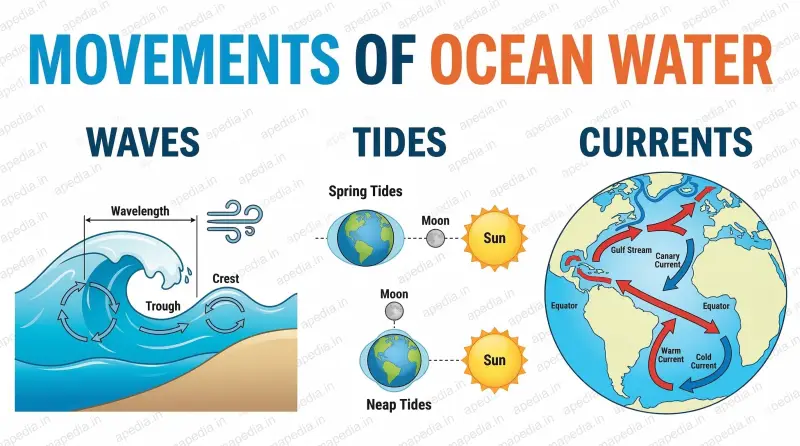
Ocean water is in constant motion, experiencing both horizontal and vertical dynamics. Waves represent a horizontal transfer of energy across the ocean's surface, rather than the physical transport of water itself. As a wave travels, the actual water molecules move in continuous circular patterns.
Wave Terminology
- Crest and Trough: The elevated peak of a wave is the crest, while the lowest depression is the trough.
- Wave Height and Amplitude: Wave height measures the total vertical span from the trough to the crest. The amplitude represents exactly half of this wave height.
- Wavelength and Period: Wavelength is the horizontal distance stretching between two consecutive crests. The wave period refers to the time it takes for two crests to pass a specific stationary point.
Wind acts as the primary engine for wave creation. The ultimate height and power of a wave depend heavily on the wind's speed, how long it blows, and the expanse of open water it travels across.
📝 Concept Check 1
1. What is actually transferred across the sea surface during a wave?
Energy
2. What element supplies the main energy for wave formation?
Wind
3. What term is used for the lowest point of a wave?
Trough
4. In what path do water particles move as a wave travels through?
A circular path
🌖 Module 2: Understanding Tides
Tides are the rhythmic, vertical rising and lowering of the ocean surface, typically occurring once or twice daily. This phenomenon is predominantly driven by the gravitational pulls exerted by the Moon and the Sun, coupled with the outward centrifugal force of the rotating Earth.
Categories of Tides
- By Daily Frequency: Semi-diurnal (two highs and two lows per day), Diurnal (one high and one low daily), and Mixed (successive tides with varying heights).
- Spring Tides: Triggered when the Earth, Moon, and Sun align straight. This combined gravitational force creates exceptionally high tides, occurring twice monthly during full and new moons.
- Neap Tides: When the Sun and Moon form a right angle relative to Earth, their gravitational pulls partially cancel each other out, resulting in noticeably lower tides.
The receding phase between high and low tide is termed the ebb, while the incoming phase is the flow or flood. Tides are indispensable for marine navigation, clearing out river estuaries, and generating renewable tidal energy.
📝 Concept Check 2
1. Which celestial body exerts the strongest gravitational influence on our tides?
The Moon
2. Which tidal pattern consists of two highs and two lows daily?
Semi-diurnal
3. What specific alignment generates Spring Tides?
The Sun, Moon, and Earth in a straight line
4. Where can the world's highest tides be observed?
Bay of Fundy, Canada
🔄 Module 3: Ocean Currents
Ocean currents are comparable to massive, continuous rivers flowing within the sea along defined routes. They are essential for redistributing global heat and heavily dictate the climatic conditions of coastal lands.
Mechanisms and Types
- Initiating Forces: Currents are set in motion by solar heating (causing water to expand), wind friction, gravity, and the Coriolis force, which bends the water into vast circular systems known as Gyres.
- By Depth: Surface currents account for the top 400 meters (about 10% of ocean volume), whereas Deep water currents constitute the remaining 90%, circulating slowly due to density and temperature differences.
- By Temperature: Cold currents normally trace the western margins of continents in lower latitudes, generating arid environments. Warm currents generally run along eastern margins, delivering warmth and moisture.
Regions where warm and cold ocean currents intersect foster rich plankton growth, making them the most productive fishing grounds on the planet.