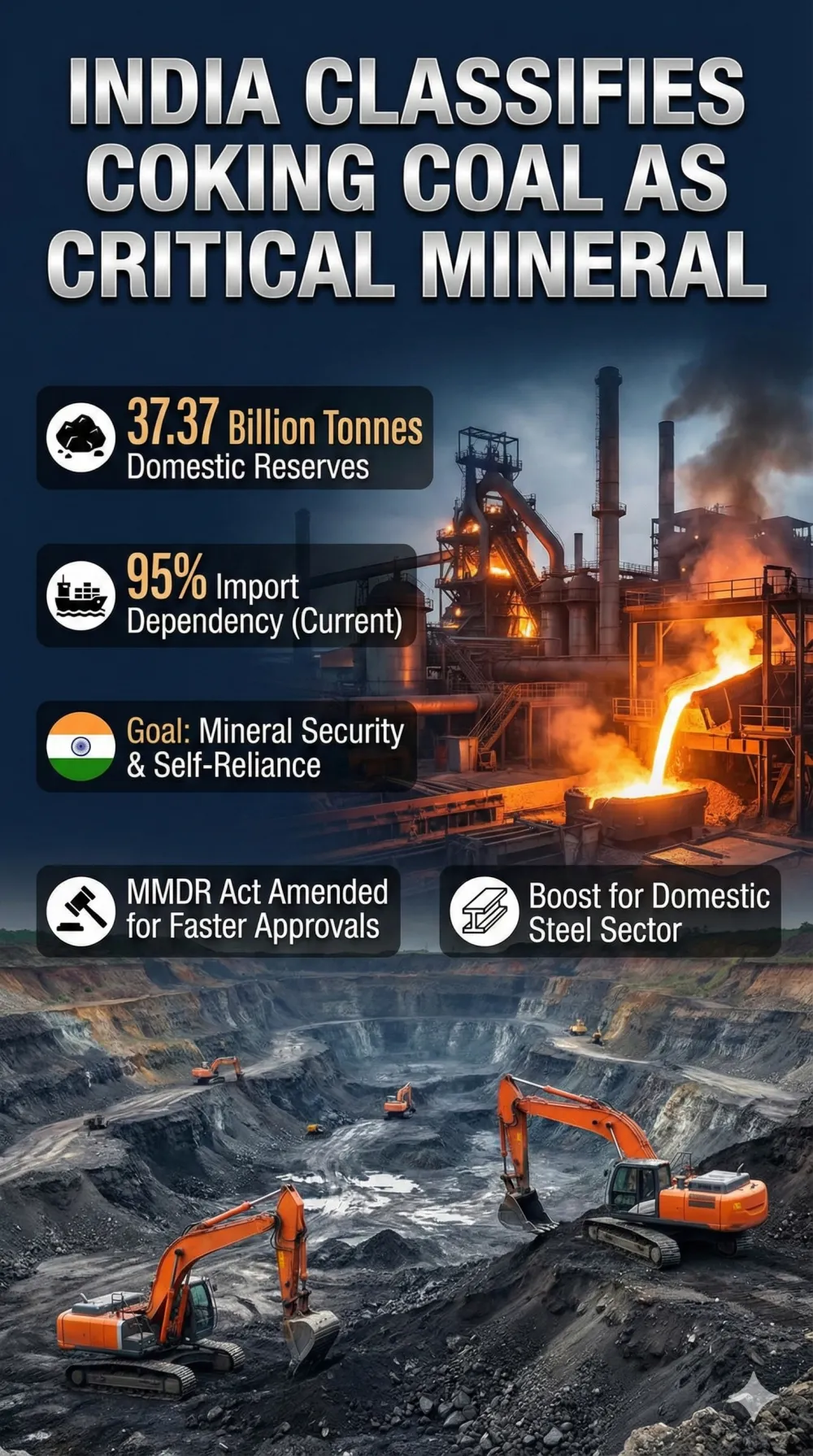

In a decisive move to strengthen India's industrial resilience, the Central Government has officially designated Coking Coal as a "Critical and Strategic Mineral." This notification, issued under the Mines and Minerals (Development and Regulation) Act, 1957, aligns with the nation's ambitious Viksit Bharat 2047 goals. The policy shift aims to aggressively reduce the steel industry's heavy reliance on foreign imports by unlocking domestic mining potential through expedited approvals and regulatory reforms.
37.37 Billion Tonnes
Jharkhand (Major), MP, WB, Chhattisgarh
~95% of Steel Sector Requirements
51.20 MT (2020-21) to 57.58 MT (2024-25)
Listed in Part D (Critical & Strategic Minerals) of MMDR Act
The Strategic Rationale
Following recommendations from the High-Level Committee on Viksit Bharat Goals and NITI Aayog, the Ministry of Coal identified a critical gap in national mineral security. Despite vast reserves, India faces a significant foreign exchange drain due to rising imports.
Amendment to MMDR Act
Using powers under Section 11C of the MMDR Act, 1957, the First Schedule has been amended:
- Part A: The definition has been broadened to "Coal, including Coking Coal."
- Part D: "Coking Coal" is now explicitly listed as a Critical and Strategic Mineral.
Accelerating Operations
This classification allows for faster regulatory clearances. Notably, mining for critical minerals is exempt from mandatory public consultation requirements, streamlining the path from auction to extraction.
Land Use Reforms
To encourage private participation, the policy permits the utilization of degraded forest land for compensatory afforestation, resolving a common bottleneck in mining projects.
Economic Ripple Effect
The move is projected to catalyze private investment in advanced mining technologies and beneficiation (processing), creating employment across the logistics and steel value chains.
The Ministry has issued a crucial clarification regarding revenue sharing. Despite the Central Government managing the auctions for critical minerals, all statutory payments—including royalties and auction premiums—will continue to accrue to the respective State Governments. This ensures that resource-rich states like Jharkhand and West Bengal retain their economic benefits.
Original Notification: Ministry of Coal via PIB
Frequently Asked Questions