🏢 Tertiary and Quaternary Activities
💼 Module 1: The Service Sector (Tertiary Activities)
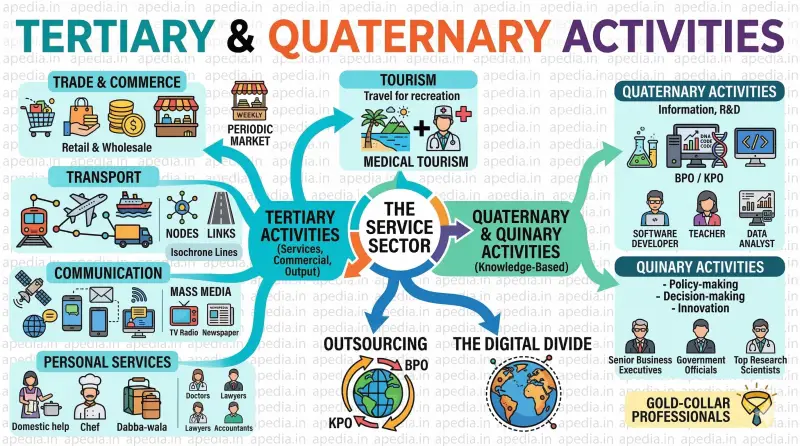
Unlike primary and secondary sectors that produce tangible goods, the tertiary sector involves the commercial output of services. The expertise provided by services relies heavily on specialized skills, experience, and knowledge of the workers rather than machinery and factory processes. It includes both production (measured in wages and salaries) and exchange (trade, transport, and communication).
Key Tertiary Activities
- Trade and Commerce: Intended for profit. Includes wholesale and retail trading. Rural marketing centers cater to local needs and often feature periodic markets (weekly/bi-weekly), while urban centers offer highly specialized goods and professional services.
- Transport: A facility carrying people and goods. Transport networks consist of nodes (meeting points) and links (roads joining nodes). Distance can be measured in km, time, or cost. Lines joining places equal in travel time are called isochrone lines.
- Communication: Transmission of words, facts, and ideas. While early communication relied heavily on transport, modern telecommunications (mobile telephony, internet, satellites) have revolutionized instantaneous global contact.
- Services: Range from low-order (grocery shops, domestic help like Mumbai's dabbawala service) to high-order specialized services (physicians, lawyers, consultants).
📝 Concept Check 1
1. Tertiary activities primarily involve the production of what?
Services (intangible goods)
2. What are markets that are held on specified dates and move from place to place in rural areas called?
Periodic markets
3. In a transport network, what is the meeting point of two or more routes called?
A node
4. What lines on a map join places equal in terms of the time taken to reach them?
Isochrone lines
✈️ Module 2: Tourism and Medical Tourism
Tourism is travel undertaken for recreation rather than business. It has become the world's single largest tertiary activity in terms of total registered jobs (around 250 million) and total revenue (about 40% of the total GDP).
Tourism Dynamics
- Tourist Attractions: Climate (Mediterranean warmth or snowy mountains for skiing), picturesque landscapes, historical/archaeological sites, and unique local cultures all drive tourism.
- Medical Tourism: When medical treatment is combined with international tourism, it is known as medical tourism. Countries like India, Thailand, Singapore, and Malaysia have emerged as leading destinations, offering world-class healthcare at a comparative advantage. Beyond physical travel, the outsourcing of medical services (like reading MRIs overseas) is rapidly growing.
🧠 Module 3: Quaternary, Quinary Activities & The Digital Divide
In advanced economies, the knowledge sector has replaced most primary and secondary employment. This sector is sub-divided into highly specialized categories.
The Knowledge Sector
- Quaternary Activities: Involve the collection, production, and dissemination of information. It centers around R&D, software developers, mutual fund managers, and teachers. These activities are not tied to resources or localized markets and are often outsourced.
- Quinary Activities: The highest level of decision-makers and policy-makers. These "gold-collar" professionals focus on creating, rearranging, and interpreting new ideas and technologies (e.g., senior business executives, government officials, top research scientists).
- Outsourcing (BPO vs. KPO): Transferring work to outside agencies to reduce costs and improve efficiency. When moved overseas, it's called off-shoring. While BPO deals with standard business processes, Knowledge Process Outsourcing (KPO) involves highly skilled workers focusing on R&D, legal research, and data interpretation.
- The Digital Divide: The uneven global distribution of opportunities emerging from Information and Communication Technology (ICT). Developed countries have generally surged forward, while developing countries, or peripheral rural areas within large countries, lag behind.
📝 Concept Check 2
1. Which sector involves the collection and production of information, and research and development?
Quaternary Sector
2. Senior business executives and top policy-makers belong to which activity tier?
Quinary Activities
3. What color collar is associated with quinary professionals?
Gold-collar
4. The unequal access to Information and Communication Technology across different regions is called what?
The Digital Divide