🌌 The Origin and Evolution of the Earth
🔭 Module 1: Theories of Origin
For centuries, philosophers and scientists have pondered how our planet and the vast universe came to be. Early theories focused specifically on the Earth and planets, while modern science shifted its focus to the origin of the entire universe.
Early vs. Modern Theories
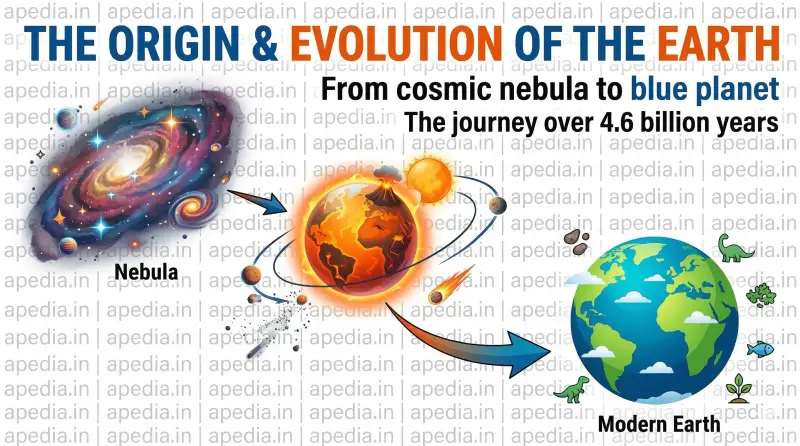
- Nebular Hypothesis (Early): Proposed by Immanuel Kant and revised by Laplace (1796). It suggested that planets formed from a rotating cloud of material (nebula) associated with a young sun. Later, scientists like Otto Schmidt and Carl Weizascar added that this solar nebula consisted mostly of hydrogen, helium, and dust, which formed planets through friction and accretion.
- The Big Bang Theory (Modern): Also known as the expanding universe hypothesis. In 1920, Edwin Hubble provided evidence that the universe is actively expanding. According to this theory, all matter initially existed as a singular "tiny ball" with infinite density and temperature. About 13.7 billion years ago, this ball violently exploded, leading to a massive expansion that continues today. As the universe expanded and cooled, energy converted into matter.
📝 Concept Check 1
1. Who provided evidence in 1920 that the universe is expanding?
Edwin Hubble
2. What was the singular "tiny ball" in the Big Bang theory characterized by?
Infinite temperature and density
3. How long ago did the Big Bang occur?
13.7 billion years ago
4. Which theory involves planets forming from a rotating cloud of dust and gas?
The Nebular Hypothesis
⭐ Module 2: Formation of Stars and Planets
The early universe was not perfectly uniform. Slight differences in matter density led to variations in gravitational forces, drawing matter together to form galaxies.
From Gas Clouds to Planets
- Star Formation: A galaxy begins by accumulating massive clouds of hydrogen gas called nebulas. Localized, dense clumps within these nebulas eventually ignited into stars about 5 to 6 billion years ago. Note: Huge cosmic distances are measured in light-years (the distance light travels in one year).
- Planetesimals to Planets: Gas lumps within a nebula formed a dense core surrounded by a rotating disc of gas and dust. This matter condensed into small rounded objects called planetesimals through cohesion. These planetesimals collided and stuck together due to gravity (accretion) to eventually form large planets.
🌍 Module 3: Evolution of the Earth and Life
Initially, the Earth was a barren, hot, and rocky body with a thin atmosphere of hydrogen and helium. Over millions of years, profound internal and external changes transformed it into a habitable world.
Stages of Planetary Evolution
- Lithosphere (Differentiation): As the young, volatile Earth heated up, materials inside separated based on density. Heavy materials like iron sank to the core, while lighter materials floated to the surface to cool and solidify into the crust. This sorting process is called differentiation.
- Atmosphere & Hydrosphere (Degassing): The Earth's primordial atmosphere was stripped away by solar winds. As the interior cooled, gases and water vapor were released from within through a process called degassing. Frequent volcanic eruptions added more water vapor, which eventually condensed into rain, filling vast depressions to form the first oceans roughly 4,000 million years ago.
- Origin of Life: Around 3,800 million years ago, complex chemical reactions generated the first living organic molecules in the oceans. By 2,500-3,000 million years ago, photosynthesis evolved, slowly saturating the oceans with oxygen, which eventually flooded into the atmosphere.
📝 Concept Check 2
1. What process caused heavier materials to sink to the Earth's core?
Differentiation
2. What stripped away the Earth's primordial atmosphere?
Solar winds
3. What is the outpouring of gases from the Earth's interior called?
Degassing
4. Approximately when did life first begin to evolve on Earth?
3,800 million years ago