🌍 World Climate and Climate Change
📊 Module 1: Koeppen's Scheme of Classification
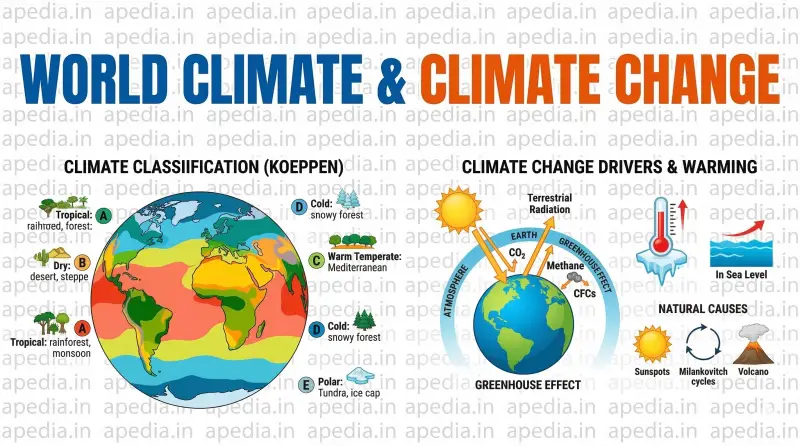
To make sense of global weather patterns, V. Koeppen developed an empirical climate classification scheme based on the close relationship between climate and vegetation. He used mean annual and monthly data of temperature and precipitation to delineate different climatic zones.
The Five Major Climatic Groups
- Group A (Tropical): Found near the equator; the average temperature of the coldest month is 18°C or higher. Includes Tropical Wet (Af), Monsoon (Am), and Wet & Dry (Aw) types.
- Group B (Dry): Regions where potential evaporation exceeds precipitation. Divided into Subtropical Steppe/Desert and Mid-latitude Steppe/Desert.
- Group C (Warm Temperate): Mid-latitude climates with the coldest month averaging between -3°C and 18°C. Notable for the Mediterranean climate (Cs) with dry summers and mild, rainy winters.
- Group D (Cold Snow Forest): Found mainly in the northern hemisphere; the coldest month is -3°C or below. Features severe, snowy winters.
- Group E (Cold): Polar regions where the average temperature for all months is below 10°C. Includes Tundra (ET) and Ice Cap (EF) climates.
📝 Concept Check 1
1. Which climatic group designates dry climates in Koeppen's scheme?
Group B
2. What do the small letters 'f' and 'w' indicate?
'f' is no dry season; 'w' is winter dry season
3. Which type of climate dominates the Indian sub-continent?
Tropical Monsoon (Am)
4. What is the defining feature of a Mediterranean climate (Cs)?
Hot, dry summer and mild, rainy winter
📈 Module 2: Climate Change and Global Warming
Climate change is a natural and continuous process. Geological records show traces of glacial advances, and historical evidence highlights events like the "Little Ice Age" in Europe (1550-1850). However, modern changes are heavily influenced by human activity.
Drivers of Climate Change
- Natural Causes: Include astronomical factors like sunspot activities and Milankovitch oscillations (changes in Earth's orbit and axial tilt). Volcanic eruptions also release aerosols that can cool the planet temporarily by blocking solar radiation.
- The Greenhouse Effect: The atmosphere allows incoming short-wave solar radiation to pass but absorbs outgoing long-wave terrestrial radiation, warming the Earth.
- Greenhouse Gases (GHGs): Carbon dioxide (CO2) is the most abundant, primarily released by fossil fuel combustion. Other critical gases include Methane (CH4), Nitrous oxide (N2O), and Chlorofluorocarbons (CFCs), which also cause ozone depletion.
Global Action: The Kyoto Protocol (1997) was a major international effort where industrialized nations committed to reducing their GHG emissions. Continued global warming threatens to raise sea levels by melting glaciers, potentially inundating coastal areas.
📝 Concept Check 2
1. What are Milankovitch oscillations?
Cycles in Earth's orbital characteristics and axial tilt
2. Which greenhouse gas is primarily responsible for the ozone hole?
Chlorofluorocarbons (CFCs)
3. What is the primary source of increased carbon dioxide emissions?
Fossil fuel combustion
4. Which international agreement aims to reduce GHG emissions?
Kyoto Protocol