🌍 Foreign Perspectives: Through the Eyes of Travellers
📖 Module 1: Al-Biruni and the Kitab-ul-Hind
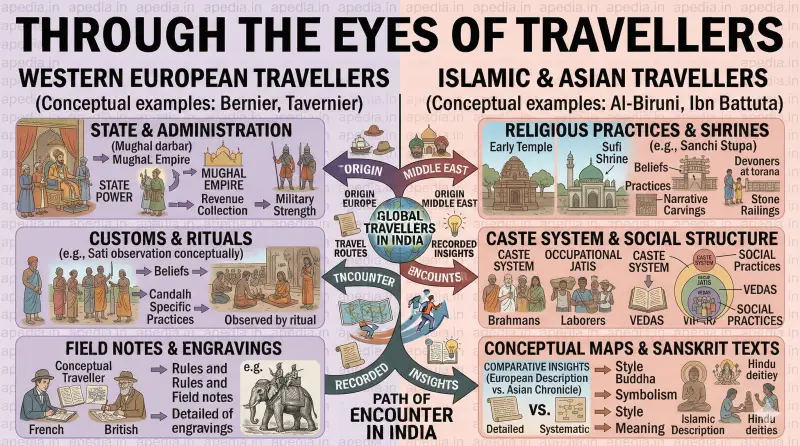
Between the 10th and 17th centuries, international visitors to the Indian subcontinent documented daily life, cultural habits, and social systems in ways that local scholars—who often found these everyday practices mundane—did not.
Bridging Cultural Divides
- The Scholar from Khwarizm: Born in modern-day Uzbekistan (Khwarizm) in 973 CE, Al-Biruni was relocated to Ghazni as a captive intellectual following Sultan Mahmud's invasion in 1017. During his time in Ghazni, he cultivated a profound fascination with Indian culture and dedicated himself to mastering the Sanskrit language.
- Structuring the Kitab-ul-Hind: He authored his encyclopedic masterpiece, the Kitab-ul-Hind, in Arabic. The text spans 80 chapters detailing Indian astronomy, philosophy, and religion. Al-Biruni employed a highly systematic, almost mathematical writing structure: introducing a clear question, exploring it through classical Sanskrit frameworks, and concluding with a comparative analysis of other cultures.
- The Three Obstacles: Al-Biruni explicitly identified three major barriers to fully comprehending the subcontinent: the daunting complexity of Sanskrit grammar, fundamental differences in theological beliefs, and the deeply insular, self-absorbed nature of the local population.
- Analyzing the Caste System: To make sense of India's social hierarchy, he drew comparative parallels with the ancient Persian class system. While he acknowledged the Brahmanical framework of the four varnas, he fiercely criticized the concept of social "pollution." He argued philosophically that anything deemed impure inherently strives to return to its original, unpolluted state—much like the sun constantly purifies the air.
📝 Concept Check 1
1. What region was Al-Biruni originally from?
Khwarizm (located in modern-day Uzbekistan).
2. Which conqueror forcibly brought Al-Biruni to his capital?
Sultan Mahmud of Ghazni.
3. What language did Al-Biruni use to compose the 'Kitab-ul-Hind'?
Arabic.
4. Which specific aspect of the Brahmanical caste system did Al-Biruni reject as contrary to the laws of nature?
The concept of inherent social impurity or "pollution."
🐪 Module 2: Ibn Battuta’s Rihla and the Marvel of the Unfamiliar
Hailing from Tangier, Morocco, the legendary globetrotter Ibn Battuta was a firm believer that practical, firsthand travel experience was far superior to traditional, book-based learning.
Navigating the Subcontinent
- Arrival in the Capital: Drawn by the sweeping reputation of Sultan Muhammad bin Tughlaq, Ibn Battuta crossed into Sind in 1333 and made his way to Delhi. The Sultan was highly impressed by his scholarly pedigree and appointed him as the city's qazi (chief magistrate), a role he fulfilled for years before being dispatched as an ambassador to China.
- Writing the Rihla: His exhaustive travelogue, the Rihla, was composed in Arabic. He purposefully highlighted bizarre and wondrous novelties to astound his North African audience, famously dedicating detailed descriptions to unfamiliar botanicals like the betel leaf (paan) and the coconut, which he amusingly likened to a human head.
- Bustling Mega-Cities: He portrayed major Indian urban centers, particularly Delhi and Daulatabad, as densely packed, wealthy mega-cities ripe with economic opportunity. Their bazaars were vibrant social arenas—most notably Tarababad, an entire market district dedicated to vocalists and musicians.
- The Marvel of the Mail: The medieval Indian postal network left Ibn Battuta entirely astounded. It allowed merchants to swiftly transport goods and the Sultan to receive rapid intelligence. The network was split into the horse relay (uluq) and the pedestrian relay (dawa). Remarkably, he noted that the foot-couriers were even faster than the riders.
📝 Concept Check 2
1. Who appointed Ibn Battuta to the prestigious position of qazi in Delhi?
Sultan Muhammad bin Tughlaq.
2. Which two common Indian agricultural products did Ibn Battuta vividly describe for his amazed foreign readers?
The coconut and the betel leaf (paan).
3. According to Ibn Battuta, which city rivaled the grandeur and massive population of Delhi?
Daulatabad.
4. What was the specific term for the highly efficient foot-courier postal system?
Dawa.
⚖️ Module 3: François Bernier and the "Degenerate" East
François Bernier, a prominent French physician and political thinker, resided within the Mughal Empire for a dozen years (1656–1668), securing an intimate view of its royal court.
A Harsh European Critique
- A Prejudiced Lens: Unlike Ibn Battuta’s sense of wonder, Bernier’s accounts were sharply critical, consistently portraying India as inferior to Western Europe. He strategically dedicated his masterwork, Travels in the Mughal Empire, to King Louis XIV of France in an effort to shape European economic statecraft.
- The Property Fallacy: Bernier posited that the root difference between the East and West was India's supposed lack of private land ownership. He wrongly asserted that the Mughal emperor personally owned all territory in the empire, concluding that this completely destroyed any incentive for aristocrats or farmers to invest in agricultural modernization.
- A Doomed Empire: He aggressively painted a picture of a nation ruined by its own land policies, dismissing the emperor as a sovereign ruling over "beggars and barbarians." He infamously argued that Indian society possessed "no middle state"—asserting it was comprised exclusively of the ultra-wealthy elite and the desperately poor masses.
- Philosophical Legacy: Despite being a massive oversimplification, Bernier’s writings had a profound ripple effect on Western political theory. His accounts directly inspired Montesquieu's idea of "oriental despotism" and subsequently provided the foundation for Karl Marx's theory of the "Asiatic mode of production."
📝 Concept Check 3
1. To whom did François Bernier deliberately dedicate his writings to influence state policy?
King Louis XIV of France.
2. What did Bernier identify as the primary reason for the Mughal Empire's alleged economic stagnation?
The state ownership of all land and the total absence of private property.
3. How did Bernier inaccurately characterize India's socioeconomic structure?
He claimed there was "no middle state," just a stark divide between the excessively rich and the absolute poor.
4. Which renowned political theorist utilized Bernier's accounts to formulate the "Asiatic mode of production"?
Karl Marx.
🔥 Module 4: A Complex Reality: Trade, Artisans, and Society
Even through the lens of their inherent biases, these foreign chroniclers accidentally preserved evidence of a deeply complex civilization featuring massive commercial networks, intricate manufacturing systems, and harsh societal norms.
The True Engine of the Empire
- The Karkhana System: Although Bernier argued that Indian artisans lacked ambition, he contradicted himself by documenting the existence of karkhanas—massive, highly structured imperial factories bustling with silk weavers, goldsmiths, and embroiderers. He also conceded that global trade aggressively funneled the world’s precious metals into India to purchase these high-quality exports.
- Thriving Merchant Hubs: Bernier dismissively categorized Mughal urban centers as mere "camp towns" that survived only because of the royal court's geographic presence. This completely overlooked the reality of thriving, independent commercial hubs heavily dominated by powerful indigenous merchant classes, such as the mahajans.
- The Reality of Slavery: The institution of slavery was openly integrated into daily medieval life. Ibn Battuta observed bustling public slave markets, noting that female slaves fulfilled various roles ranging from domestic chores and musical entertainment to carrying palanquins and acting as covert spies reporting directly to the Sultan.
- The Status of Women: The societal treatment of women deeply disturbed many European observers. Bernier provided a particularly harrowing, eyewitness account of sati, detailing his horror at witnessing the forced, tragic self-immolation of a twelve-year-old child widow in the city of Lahore.
📝 Concept Check 4
1. What specific term was used for the large, highly organized imperial workshops documented by foreign travelers?
Karkhanas.
2. How did Bernier incorrectly classify thriving Mughal cities to downplay their economic independence?
By labeling them mere "camp towns" dependent entirely on the royal court.
3. According to Ibn Battuta, what covert administrative role did certain female slaves perform?
They functioned as secret spies for the Sultan.
4. Which deeply disturbing social custom did Bernier witness and document regarding a young widow in Lahore?
Sati (the ritual self-immolation of widows).