🏛️ An Empire Across Three Continents
⚔️ Module 1: The Early Empire and Political Structure
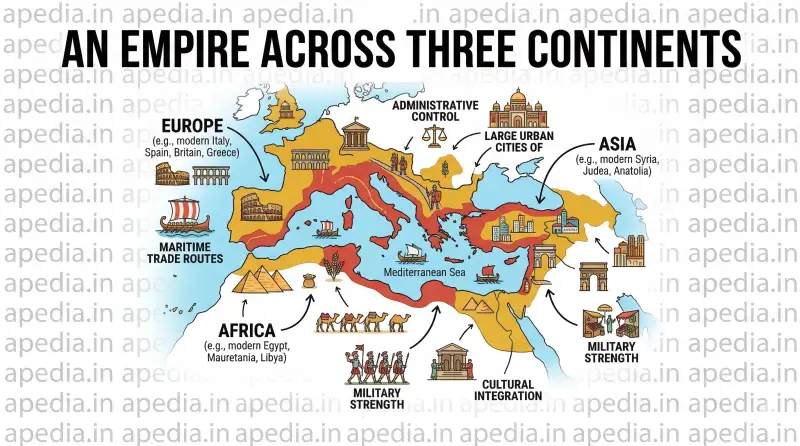
The Roman Empire covered a vast stretch of territory including most of Europe, a large part of the Fertile Crescent, and North Africa. Its boundaries were defined by the Rhine and Danube rivers in the north, and the Sahara desert in the south. It stood as a superpower alongside its eastern rival, Iran, separated largely by the Euphrates river.
Political Players and the Principate
- The Principate: After the Republic (dominated by the Senate) was overthrown, Augustus established the 'Principate' in 27 BCE. He was the absolute ruler but maintained the fiction of being the "leading citizen" (Princeps) out of respect for the Senate.
- The Senate and the Army: The political history of the empire was dominated by three players: the Emperor, the Senate (representing the wealthy aristocracy), and the Army. Unlike the Persian conscripted army, the Roman army was a paid, professional force where soldiers served a minimum of 25 years.
- Cultural Diversity: The Roman Empire was a mosaic of cultures bound by a common government. Latin was spoken in the West, while Greek was the language of the upper classes in the East.
- The Third-Century Crisis: After two centuries of relative peace, the empire faced severe strain in the third century due to rapid successions of emperors (25 in 47 years), aggressive expansion by the new Sasanian dynasty in Iran, and repeated invasions by Germanic tribes (like the Alamanni, Franks, and Goths) along the Rhine and Danube.
📝 Concept Check 1
1. Which river separated the Roman and Iranian empires?
The Euphrates.
2. What was the regime established by Augustus in 27 BCE called?
The Principate.
3. What was a distinctive feature of the Roman military compared to the Persian army?
It was a paid, professional army rather than a conscripted one.
⚖️ Module 2: Society, Gender, and Economy
The Roman Empire boasted a sophisticated economy and a social structure that gave surprising legal rights to women while still relying heavily on bound and slave labor.
Family, Women, and Literacy
- The Nuclear Family: The nuclear family was prevalent; adult sons rarely lived with their parents, though slaves were considered part of the family.
- Women's Legal Rights: Roman women enjoyed considerable legal independence. A married woman retained full rights in the property of her natal family, becoming an independent property owner upon her father's death, rather than transferring entirely to her husband's authority.
- Literacy: Casual literacy varied by region. It was widespread in Pompeii (as seen by graffiti and street advertisements) but less so in Egypt, where professional scribes handled formal documents.
Economic Infrastructure and Labour
- Trade and Amphorae: Wheat, wine, and olive oil were traded in huge quantities. Liquids were transported in clay containers called 'amphorae'. For instance, 'Dressel 20' was widely used for transporting high-quality Spanish olive oil.
- Slavery and Labour: Slavery was deeply rooted. Slaves were viewed as an investment, and landowners calculated their use carefully. To ensure productivity, workers (both free and slave) were strictly supervised and often organized into gangs or squads, sometimes even working in chains or debt bondage.
📝 Concept Check 2
1. What kind of family structure was typical in the Roman Empire?
The nuclear family.
2. Did a Roman wife transfer all her property to her husband upon marriage?
No, she retained full rights in the property of her natal family.
3. What is a 'Dressel 20'?
An amphora container used primarily to transport Spanish olive oil.
👑 Module 3: Late Antiquity and Transformation
'Late Antiquity' (4th to 7th centuries) was a period of momentous cultural and economic change, leading to the division and eventual fragmentation of the Roman world.
Reforms and the Rise of Christianity
- Diocletian's Consolidation: Emperor Diocletian (284-305) abandoned overexpanded territories, fortified frontiers, and separated military from civilian functions to stabilize the empire.
- Constantine's Innovations: Emperor Constantine introduced the solidus (a pure gold coin of 4.5 gm) to replace the exhausted silver currency, stimulating economic growth. He also built a second capital at Constantinople (modern Istanbul) and decided to make Christianity the official religion.
- The Fall of the West: In the West, the empire fragmented politically as Germanic groups (Goths, Vandals, Lombards) established 'post-Roman' kingdoms.
- The Arab Conquests: In the East, the Byzantine (Roman) and Sasanian empires exhausted themselves with war. In the 7th century, the expansion of Islam from Arabia led to the rapid Arab conquest of large parts of both empires by 642.