🌪️ Atmospheric Circulation and Weather Systems
🌡️ Module 1: Pressure and Wind Dynamics
Atmospheric pressure is essentially the weight of the air column above a unit area. Differences in this pressure, caused by temperature variations, trigger the movement of air from high-pressure zones to low-pressure zones, creating wind.
Core Forces Influencing Wind
- Pressure Gradient Force: This is the primary driver of wind. The closer the isobars (lines of equal pressure), the steeper the gradient and the faster the wind.
- Coriolis Force: Caused by Earth's rotation, it deflects winds to the right in the Northern Hemisphere and to the left in the Southern Hemisphere. It is zero at the equator and maximum at the poles.
- Frictional Force: Resistance offered by the Earth's surface, which slows down winds in the lower atmosphere (up to 1-3 km).
📝 Concept Check 1
1. What is the standard atmospheric pressure at sea level?
1,013.2 millibars
2. Which force is absent at the equator?
Coriolis Force
3. What do we call lines joining places of equal pressure?
Isobars
4. In which direction does a cyclone rotate in the Northern Hemisphere?
Anticlockwise
🌍 Module 2: Global Atmospheric Circulation
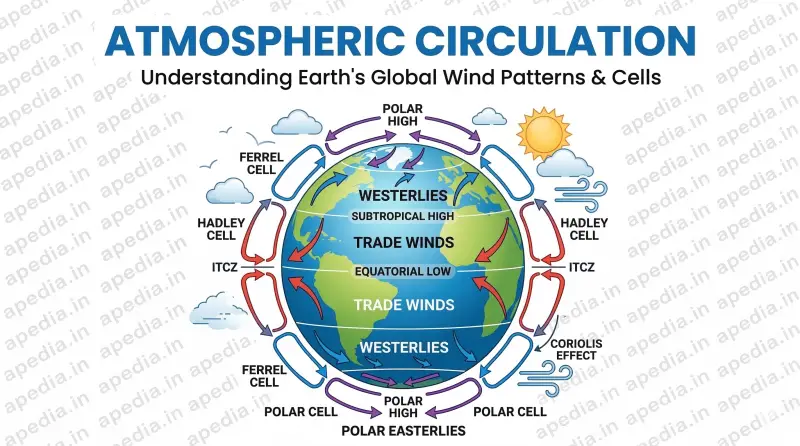
The general circulation of the atmosphere is a planetary-scale movement of air that redistributes heat. It is structured into three distinct cells in each hemisphere: Hadley, Ferrel, and Polar cells.
Planetary Wind Belts
- Trade Winds: Tropical easterlies that blow towards the Intertropical Convergence Zone (ITCZ).
- Westerlies: Strong winds blowing from the subtropical high-pressure belts towards the subpolar lows.
- Polar Easterlies: Cold air blowing from the polar highs towards lower latitudes.
- ITCZ: A low-pressure zone near the equator where trade winds converge and air rises.
📝 Concept Check 2
1. Which cell is located in the tropical region?
Hadley Cell
2. What does ENSO stand for?
El Nino Southern Oscillation
3. What is the name of the warm current that replaces the cool Peru current?
El Nino
4. What is the boundary between two different air masses called?
Front
🌀 Module 3: Violent Weather Systems
Tropical cyclones are low-pressure systems with violent winds, originating over warm oceans (temp > 27°C). They dissipate upon reaching land as the moisture supply is cut off.
Storm Classifications
- Extra Tropical Cyclones: Form in middle latitudes along fronts; they can form over both land and sea.
- Thunderstorms: Short-lived, intense storms caused by strong convection and cumulonimbus clouds.
- Tornadoes: Violent spiraling winds descending from severe thunderstorms, common in middle latitudes.