🧱 Bricks, Beads and Bones: The Harappan Civilisation
🏙️ Module 1: Urban Centres and Subsistence
Renowned globally for its extraordinary urban design, the Indus Valley (or Harappan) Civilisation reached its cultural and structural zenith during the "Mature" period, spanning approximately from 2600 to 1900 BCE.
Agriculture and the City of Mohenjodaro
- Dietary Habits: The Harappan diet was remarkably diverse, relying heavily on cultivated crops like chickpeas, sesame, wheat, and lentils. Pastoral activities included raising sheep, pigs, and cattle, which they supplemented by hunting wild game such as boar and deer.
- Farming Technology: Early agricultural mastery is demonstrated by terracotta plow models recovered from Banawali and Cholistan, alongside the discovery of an ancient furrowed field in Kalibangan. They also mastered water engineering, building irrigation canals in Afghanistan (Shortughai) and massive stone reservoirs in Gujarat (Dholavira).
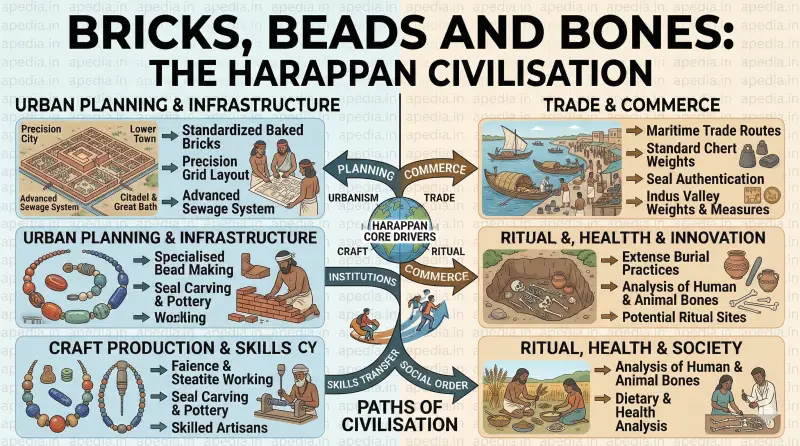
- Urban Layout: Harappan cities are famous for their calculated urban blueprints. Mohenjodaro, for example, was distinctly split into two zones: an elevated "Citadel" resting on mud-brick foundations, and a sprawling, residential "Lower Town".
- Drainage and Infrastructure: Urban spaces featured a strict grid system with roads meeting at perfect right angles. Residential homes were seamlessly integrated into a highly advanced street-level drainage network. The Citadel itself was reserved for monumental civic structures, including a massive storage Warehouse and the Great Bath—a large rectangular pool likely intended for ritual purification.
📝 Concept Check 1
1. What is the generally accepted timeline for the "Mature" phase of the Harappan Civilisation?
Between 2600 BCE and 1900 BCE.
2. Which archaeological site yielded evidence of an ancient plowed agricultural field?
Kalibangan.
3. What were the two primary architectural divisions of the city of Mohenjodaro?
The elevated Citadel and the larger Lower Town.
🏺 Module 2: Crafts, Trade, and the Enigmatic Script
Beyond their architectural prowess, Harappan society boasted highly skilled artisans and maintained expansive domestic and international trade routes, governed by a uniform weight system and a writing system that still baffles modern linguists.
Production and Exchange
- Industrial Hubs: The tiny outpost of Chanhudaro operated almost entirely as a manufacturing center. Artisans there specialized in metallurgy, carving seals, and fashioning intricate beads from valuable materials like steatite, crystal, and carnelian.
- Sourcing Materials: To secure raw materials, the civilization established strategic outposts. Nageshwar and Balakot were coastal hubs for shell extraction, while Shortughai provided access to brilliant blue lapis lazuli. Expeditions were also dispatched to the Khetri region of Rajasthan to mine copper ore.
- International Commerce: Chemical signatures confirm long-distance maritime trade. Both Harappan and Omani copper share distinct traces of nickel. Furthermore, standardized Harappan weights and iconic seals have been excavated in ancient Mesopotamia, whose texts referred to the Oman region as "Magan".
Seals, Script, and Weights
- The Language Mystery: The Harappan writing system remains an unsolved linguistic puzzle. Written predominantly from right to left, it is logographic rather than alphabetical, comprising roughly 375 to 400 unique symbols.
- Standardized Commerce: Economic transactions were strictly regulated using unmarked, cubical chert stones. These weights featured a binary progression for smaller amounts (1, 2, 4, 8, etc.) and transitioned to a decimal basis for heavier measurements.
📝 Concept Check 2
1. Which tiny Harappan settlement was almost entirely dedicated to specialized craft production?
Chanhudaro.
2. Where did the Harappans source their copper from?
The Khetri region of Rajasthan and Oman.
3. In what direction was the enigmatic Harappan script written?
From right to left.
👑 Module 3: Society, Authority, and Decline
While the exact governance model of the Harappan people remains a subject of intense archaeological debate, the sheer scale of their public works implies a highly coordinated society capable of massive collective action.
Social Differences and Leadership
- Funerary Practices: Deceased individuals were typically interred in earthen pits, occasionally accompanied by modest pottery or jewelry. Unlike the contemporary pharaohs of Egypt, Harappans did not practice burying immense hoards of wealth with their dead.
- Artifact Classification: Social stratification is often gauged by categorizing excavated objects. Commonplace items shaped from local clay or stone are considered utilitarian, whereas rare artifacts crafted from complex, non-local materials—like faience—are classified as luxury goods.
- The Mystery of Rulers: Monumental art depicting specific rulers is conspicuously absent. One famous stone bust was dubbed the "Priest-King" by early archaeologists drawing parallels to Mesopotamia, but there is no concrete proof such figures held actual political sway. Leadership theories range from a completely egalitarian society to a tightly controlled, centralized empire.
The End of the Civilisation
- Urban Abandonment: By approximately 1800 BCE, the mature phase began to fracture. Major population centers in regions like Cholistan were abandoned, and the standardized systems of writing, weights, and inter-regional trade disintegrated.
- Theories of Demise: The myth of a sudden, violent Aryan invasion has been largely discarded by modern scholars. Instead, evidence points to a combination of severe environmental shifts—such as prolonged droughts, tectonic events altering river courses, extensive deforestation, and catastrophic flooding.
🔍 Module 4: Discovering the Harappan Past
The eventual excavation of Harappan sites revolutionized our understanding of the Indian subcontinent, revealing an urban heritage far older than previously imagined.
The Pioneers of Archaeology
- Early Misinterpretations: Alexander Cunningham, the foundational head of the Archaeological Survey of India (ASI), initially failed to grasp Harappa's immense antiquity. Guided heavily by the travel accounts of Chinese Buddhist pilgrims, he mistakenly assumed the subcontinent's history originated in the Ganges valley, completely misinterpreting the unique ancient seals presented to him.
- A Historic Announcement: The true breakthrough occurred decades later when Daya Ram Sahni and Rakhal Das Banerji unearthed identical, distinctly ancient seals at Harappa and Mohenjodaro. Recognizing the undeniable pattern, ASI Director-General John Marshall officially announced the discovery of the Indus Valley Civilisation to the globe in 1924.
- Methodological Shifts: When R.E.M. Wheeler assumed control of the ASI in 1944, he revolutionized excavation methodology. He abandoned the flawed practice of digging in arbitrary horizontal layers (which jumbled artifacts from different eras) and instead applied rigorous, military-style precision to excavate along the earth's natural stratigraphy.
📝 Concept Check 3
1. Why did researchers initially name a specific Mohenjodaro statue the "Priest-King"?
Because they were drawing historical parallels from ancient Mesopotamia.
2. Who formally announced the discovery of this new ancient civilisation to the world in 1924?
John Marshall, Director-General of the ASI.
3. Which archaeologist improved excavation accuracy by strictly following the earth's natural stratigraphy?
R.E.M. Wheeler.