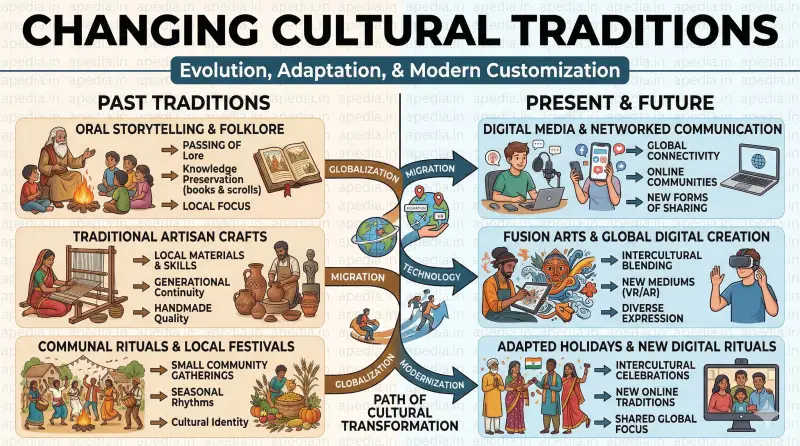
🎨 Changing Cultural Traditions
🏛️ Module 1: The Revival of Italian Cities and Humanism
From the fourteenth to the seventeenth century, a distinct 'urban culture' emerged in Europe, particularly in Italian cities like Florence, Venice, and Rome. Townspeople began to view themselves as more 'civilised' than rural populations, and these cities became vibrant centres of art, learning, and trade.
The Birth of the 'Renaissance'
- A New Era: In the nineteenth century, historians like the Swiss scholar Jacob Burckhardt popularized the term 'Renaissance' (meaning 'rebirth') to describe the cultural changes of this period. Burckhardt argued that a new, independent 'modern' man emerged in Italy during this time.
- Universities and Law: The earliest universities in Europe were established in Italian towns like Padua and Bologna in the 11th century. Since commerce was the main activity, the study of law was highly demanded to draft trade contracts.
- The Rise of Humanism: By the early 14th century, scholars like Petrarch began to emphasize the study of ancient Greek and Roman literature. This intellectual movement, known as 'humanism', stressed that there was much more to learn than what religious teachings offered, focusing instead on human life, emotions, and skills.
- A New View of History: Humanists divided history into distinct periods: the 'Ancient' period (Greece and Rome), the 'Middle Ages' or 'Dark Ages' (the period after the fall of Rome, which they saw as a time of ignorance), and the 'Modern' period (their own time, starting in the 15th century).
📝 Concept Check 1
1. What does the term 'Renaissance' literally mean?
Rebirth.
2. Which Swiss historian wrote 'The Civilisation of the Renaissance in Italy'?
Jacob Burckhardt.
3. What was the primary subject taught at the early universities of Padua and Bologna?
Law, due to the needs of commerce and trade.
🖌️ Module 2: Art, Architecture, and the Printed Word
The humanistic focus on the natural world dramatically transformed art, science, and the dissemination of knowledge across Europe.
Realism and the Classical Revival
- Art and Anatomy: Artists began observing nature closely. Andreas Vesalius, a Belgian professor at the University of Padua, was the first to accurately dissect the human body, changing how artists painted and sculpted human figures. This infusion of anatomy, geometry, and light created 'realism' in art.
- Great Masters: Figures like Leonardo da Vinci (who painted the Mona Lisa and The Last Supper) and Michelangelo (famous for painting the Sistine Chapel ceiling) exemplified the era's multi-talented 'Renaissance men'.
- Architecture: The city of Rome revived the classical architectural styles of imperial Rome. Architects like Filippo Brunelleschi designed spectacular structures like the dome of the Florence cathedral.
The Printing Revolution
- Johannes Gutenberg: In 1455, the German inventor Johannes Gutenberg created the first printing press with movable type.
- Impact: Previously, books were rare manuscripts written by hand. The printing press allowed books to be mass-produced, making ideas, humanist texts, and religious debates accessible to a much wider audience, rapidly spreading the Renaissance across Europe.
📝 Concept Check 2
1. Who was the first to dissect the human body, profoundly influencing Renaissance artists?
Andreas Vesalius.
2. Who painted the ceiling of the Sistine Chapel in Rome?
Michelangelo.
3. In what year did Johannes Gutenberg print the first Bible on his press?
1455.
⛪ Module 3: Debates within Christianity
The printing press and humanist philosophy led many to question the practices and authority of the Catholic Church, sparking major religious upheavals.
The Protestant and Catholic Reformations
- Early Critiques: Northern humanists like Erasmus (Holland) and Thomas More (England) criticized the Church for its greed and the extortion of money from ordinary people, specifically the sale of 'indulgences' (documents promising forgiveness of sins).
- Martin Luther: In 1517, a German monk named Martin Luther launched a campaign against the Catholic Church. He argued that salvation came through faith alone and that believers did not need priests to connect with God. This movement became known as the Protestant Reformation.
- The Radical Reformation: Reformers like Ulrich Zwingli and Jean Calvin furthered the movement. Some radical groups, like the Anabaptists, even suggested that salvation meant ending all forms of social oppression.
- The Catholic Response: In response to the Protestant challenge, the Catholic Church initiated its own internal reforms. In 1540, Ignatius Loyola founded the Society of Jesus (the Jesuits), whose followers aimed to serve the poor and widen their knowledge of other cultures.
🔭 Module 4: The Copernican Revolution
The Renaissance completely changed how human beings understood their place in the universe, marking the beginning of modern science.
From Earth-Centric to Sun-Centric
- The Old Belief: For centuries, the Christian notion was that the Earth was a sinful place and therefore stationary at the centre of the universe, with all other planets revolving around it.
- Nicolaus Copernicus: A contemporary of Martin Luther, Copernicus asserted that the Earth and other planets revolve around the sun. Fearing backlash from church traditionalists, he kept his manuscript, De revolutionibus, unpublished until he was on his deathbed in 1543.
- Proof and Acceptance: It took over half a century for this idea to be accepted. Johannes Kepler formulated the laws of planetary motion, showing that orbits are elliptical, not circular. Galileo Galilei used the telescope to confirm the dynamic nature of the heavens.
- Isaac Newton: The scientific revolution culminated in the late 17th century with Isaac Newton's theory of universal gravitation, definitively explaining the physics of the solar system.
📝 Concept Check 3
1. Who launched the Protestant Reformation in 1517?
Martin Luther.
2. What did Copernicus argue in his book 'De revolutionibus'?
That the planets, including the Earth, revolve around the sun.
3. Who founded the Society of Jesus (Jesuits) to reform the Catholic Church?
Ignatius Loyola.