☁️ Earth's Atmosphere: Composition and Structure
🌬️ Module 1: Composition of the Atmosphere
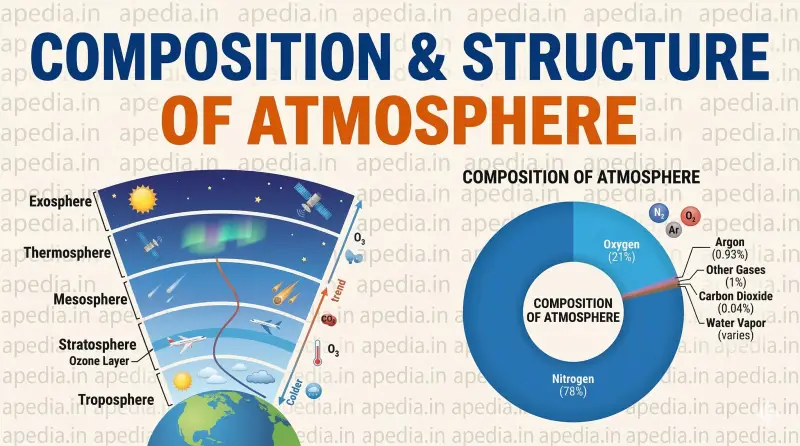
The atmosphere is a critical envelope composed of various gases that surrounds our planet. Remarkably, 99 per cent of its total mass is concentrated within just 32 km of the Earth's surface. The atmosphere is composed primarily of gases, water vapour, and dust particles.
Key Components
- Important Gases: Oxygen is vital for breathing, but its quantity becomes nearly negligible at an altitude of 120 km. Carbon dioxide, which absorbs outgoing terrestrial radiation, plays a significant role in the greenhouse effect and is found up to 90 km. Ozone acts as a protective filter between 10 and 50 km, absorbing harmful ultra-violet solar rays.
- Water Vapour: This is a variable gas that acts like a temperature-regulating blanket. Its concentration decreases as altitude increases and also drops when moving from the equator toward the poles.
- Dust Particles: Concentrated mainly in the lower layers, these include sea salts, fine soil, pollen, and meteoric debris. They serve as hygroscopic nuclei, which are essential for water vapour condensation and cloud formation.
📝 Concept Check 1
1. At what height does 99% of the atmospheric mass end?
32 km
2. Which gas is largely responsible for the greenhouse effect?
Carbon dioxide
3. What acts as hygroscopic nuclei to help produce clouds?
Dust and salt particles
4. In which layer is the protective ozone filter located?
Between 10 and 50 km
📊 Module 2: Structure of the Atmosphere
The atmosphere is divided into five distinct structural layers based on temperature and density variations.
The Five Atmospheric Layers
- 1. Troposphere: The lowermost layer where all weather changes occur. Its average height is 13 km (greatest at the equator at 18 km). Temperature decreases at a rate of 1°C for every 165m of altitude.
- 2. Stratosphere: Found above the tropopause, extending up to 50 km. It houses the crucial ozone layer that shields life from intense ultraviolet radiation.
- 3. Mesosphere: Reaches up to 80 km. Here, temperature drops significantly, reaching minus 100°C at its upper limit, the mesopause.
- 4. Thermosphere (Ionosphere): Located between 80 and 400 km above the mesopause. It contains electrically charged ions that reflect transmitted radio waves back to Earth. Temperature increases with height here.
- 5. Exosphere: The highest and least known layer, featuring extremely rarefied contents that eventually merge into outer space.
📝 Concept Check 2
1. Which layer contains dust particles, water vapour, and is where all climate changes occur?
Troposphere
2. What is the boundary separating the troposphere from the stratosphere?
Tropopause
3. Which layer reflects radio waves back to the Earth?
Ionosphere
4. What is the temperature at the top of the mesosphere (80 km height)?
Minus 100°C