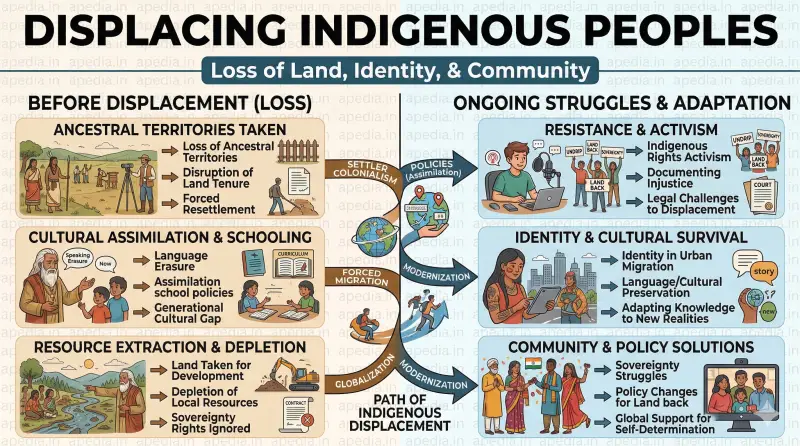
🌍 Displacing Indigenous Peoples
🏕️ Module 1: Native Peoples of North America
Centuries before European contact, the North American landscape was rich with complex, self-sustaining indigenous societies, each possessing unique cultural and linguistic traditions.
Origins and Lifestyle
- Migration and Settlement: Human history in North America stretches back over 30,000 years, beginning when nomadic populations crossed the Bering Strait land bridge from Asia and gradually expanded southward as global temperatures shifted.
- Ecological Balance: Unlike the massive agrarian empires of South America, northern tribes generally organized into smaller, sustainable communities. They practiced localized farming and hunted local game—most notably the wild bison—harvesting only what was necessary for survival, without the concept of private land ownership.
- Cultural Clashes: Initial interactions with 17th-century European explorers were largely cooperative. Indigenous groups traded local furs for European metals, firearms, and eventually alcohol. However, a fundamental misunderstanding existed: natives viewed these exchanges as relationship-building gifts, while Europeans viewed them strictly as market commodities meant for profit.
📝 Concept Check 1
1. How did the earliest human populations reach the North American continent?
By migrating from Asia across a land bridge spanning the Bering Strait.
2. Which major animal was a crucial food source for indigenous groups on the open grasslands?
The wild bison.
3. What difference in mindset characterized the early trading between natives and Europeans?
Natives treated trade as a mutual exchange of gifts, whereas Europeans viewed it as buying and selling commodities for profit.
🚂 Module 2: The Push Westward and Dispossession
As the United States pursued aggressive territorial expansion, the boundary of European settlement constantly moved west, resulting in the systemic uprooting of native communities.
Relocation and Resource Rushes
- Territorial Aggression: Through a combination of massive land purchases and military victories, the US rapidly expanded its borders. Indigenous inhabitants were routinely coerced into signing away their ancestral territories.
- The Cherokee Tragedy: The displacement was often violently enforced. When Chief Justice John Marshall ruled that the Cherokee Nation held sovereign rights over their land, President Andrew Jackson openly defied the Supreme Court. He mobilized the military to forcibly march the Cherokee westward—a devastating journey known as the "Trail of Tears," which claimed thousands of lives.
- Industrial Booms: The discovery of gold in California during the 1840s triggered a massive influx of prospectors. This wealth boom accelerated the construction of transcontinental railroads, largely built by Chinese immigrants.
- Confinement: Stripped of their hunting grounds, native populations were relegated to shrinking, resource-poor zones known as 'reservations'. Resistance to this confinement was met with overwhelming military force by the US army between 1865 and 1890.
📝 Concept Check 2
1. Which executive leader defied a Supreme Court ruling to authorize the forced removal of the Cherokee Nation?
President Andrew Jackson.
2. What 1840s economic boom rapidly accelerated westward migration and railway development?
The California Gold Rush.
3. What term is used to describe the restricted territories where displaced indigenous groups were forced to relocate?
Reservations.
🦘 Module 3: Australia and the Path to Recognition
The colonization of Australia mirrors the North American experience, characterized by the violent dispossession of ancient cultures, followed by a modern legal battle for civil rights and historical truth.
Colonization and the Legal Fiction
- Ancient Connections: Indigenous Australians have maintained a continuous presence on the continent for more than 40,000 years. They navigate their deep historical and spiritual connections through a concept known as the 'Dreamtime'.
- A Prison Colony: British colonization began in the late 18th century when the continent was utilized as a massive penal colony. Once convicts served their sentences, they frequently seized land from the native inhabitants.
- The Doctrine of Terra Nullius: To legitimize taking the continent, the British government classified Australia as terra nullius—a legal term meaning the land belonged to no one.
The Shift Towards Justice
- Legislative Reforms in the Americas: Global attitudes began to shift in the 20th century. In the US, the Meriam report exposed severe poverty on reservations, ultimately paving the way for the Indian Reorganisation Act of 1934, which reinstated certain land purchasing rights. Later, Canada formally codified indigenous treaty rights in its 1982 Constitution Act.
- Reckoning in Australia: Activism in the late 20th century forced a national reckoning. In a landmark 1992 decision, the High Court struck down the concept of terra nullius. By 1999, the country established a 'National Sorry Day' to formally apologize for historic human rights abuses, including the traumatic forced assimilation of mixed-race indigenous children.
📝 Concept Check 3
1. What legal concept did colonizers use to claim that the Australian continent was "empty" and free for the taking?
Terra nullius.
2. What was the primary demographic of the earliest British European settlers in Australia?
Deported convicts serving out their sentences.
3. Which critical 1934 piece of US legislation sought to improve indigenous conditions by restoring land purchase rights?
The Indian Reorganisation Act.