⚖️ Equality
🌍 Module 1: The Paradox and Meaning of Equality
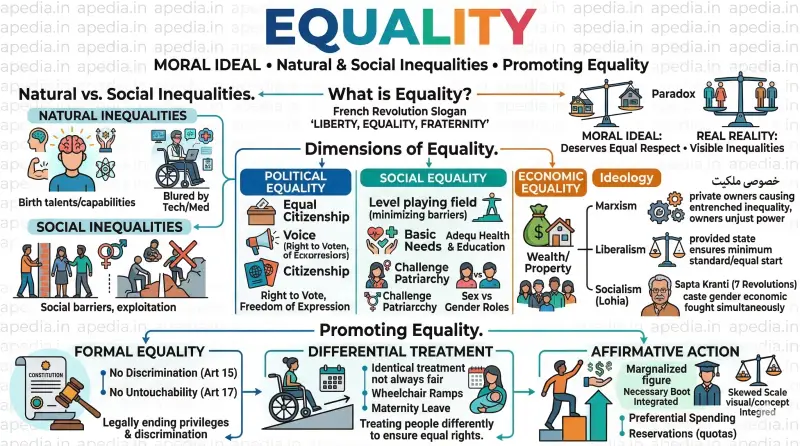
Equality is a powerful moral and political ideal rooted in the belief that all human beings share a common humanity and deserve equal consideration and respect, regardless of their color, gender, race, or nationality. Throughout history, this ideal inspired movements like the French Revolution (with the slogan 'Liberty, Equality and Fraternity') and anti-colonial struggles in Asia and Africa.
However, we face a paradox: while equality is a universally accepted ideal, inequality is the most visible reality around us. We see luxury housing alongside slums, and massive global disparities where the richest 50 individuals own more than the poorest 40 crore people combined.
However, we face a paradox: while equality is a universally accepted ideal, inequality is the most visible reality around us. We see luxury housing alongside slums, and massive global disparities where the richest 50 individuals own more than the poorest 40 crore people combined.
Natural vs. Social Inequalities
- Natural Inequalities: Historically considered to be differences in abilities and talents people are born with. However, medical and technological advances (like wheelchairs or computers used by physicist Stephen Hawking) have blurred this line, making many "natural" limitations alterable.
- Social Inequalities: Inequalities created by society through unequal opportunities or exploitation, such as discrimination based on caste, race, or gender. Today, political theorists focus heavily on eliminating inequalities that arise from the circumstances of one's birth.
- Equality of Opportunity: Equality does not mean treating everyone identically or eliminating all differences; it means people should not be restricted by birth or social circumstances and must have equal rights and opportunities to develop their talents.
📝 Concept Check 1
1. What slogan was used during the French Revolution to revolt against the monarchy?
Liberty, Equality and Fraternity
2. What is the paradox of equality?
Almost everyone accepts the ideal of equality, yet inequality is highly visible everywhere
3. Inequalities emerging from different inborn capabilities and talents are traditionally called what?
Natural inequalities
4. Which famous physicist's life shows that "natural" physical disabilities can be overcome with support?
Stephen Hawking
📐 Module 2: The Three Dimensions of Equality
To build a just society, thinkers highlight three primary dimensions of equality that must be addressed simultaneously.
Political, Social, and Economic Equality
- Political Equality: Involves granting equal citizenship to all members of the state, ensuring rights like the right to vote, freedom of expression, and freedom of belief. While essential, it is often not enough on its own.
- Social Equality: Focuses on providing a level playing field by minimizing social barriers. It demands minimum conditions of life like adequate healthcare, education, and nourishment for everyone. Feminism strongly advocates for social equality, identifying patriarchy as the system that values men over women. Feminists distinguish between biological "sex" and societal "gender" roles, arguing that society, not nature, unfairly burdens women with the "double burden" of public work and domestic chores.
- Economic Equality: Examines differences in wealth and property.
- Marxism: Karl Marx argued that the root of entrenched inequality is the private ownership of key economic resources, which gives owners unjust political power.
- Liberalism: Liberals argue that free and fair competition is the most just and efficient way to distribute resources, provided the state ensures a minimum standard of living and equal starting opportunities.
- Socialism (Lohia's view): Indian thinker Rammanohar Lohia argued for Sapta Kranti (Seven Revolutions), stating that economic, caste, gender, color, and colonial inequalities have independent roots and must be fought simultaneously.
🛠️ Module 3: How Can We Promote Equality?
Promoting equality involves targeted state policies and societal shifts.
Strategies to Achieve Equality
- Establishing Formal Equality: The first step is legally ending privileges and discrimination. For example, the Indian Constitution prohibits discrimination on grounds of religion, race, caste, sex, or place of birth, and formally abolishes untouchability.
- Equality Through Differential Treatment: Identical treatment is not always fair. Sometimes, treating people differently is required to ensure they enjoy equal rights (e.g., providing wheelchair ramps for the disabled, or maternity leave and crèches for working women). This is an enhancement of equality, not an infringement.
- Affirmative Action: Designed to correct the cumulative effect of past inequalities and deep-rooted prejudices. This can range from preferential spending (like scholarships) to the policy of reservations (quotas) in education and jobs. While supporters argue it provides a necessary boost for marginalized groups to compete fairly, critics argue it is "reverse discrimination" that violates the principle of identical treatment.
📝 Concept Check 2
1. Which ideology identifies private ownership of economic resources as the root cause of inequality?
Marxism
2. Which Indian thinker proposed the 'Sapta Kranti' or seven revolutions?
Rammanohar Lohia
3. What term do feminists use for the social system that values men more than women?
Patriarchy
4. Providing wheelchair ramps in public buildings is an example of what kind of treatment?
Differential treatment to enhance equality