🌍 Earth's Amazing Landforms
Discovering Nature's Ultimate Sculptors
🌊 Module 1: Running Water - The Master Sculptor
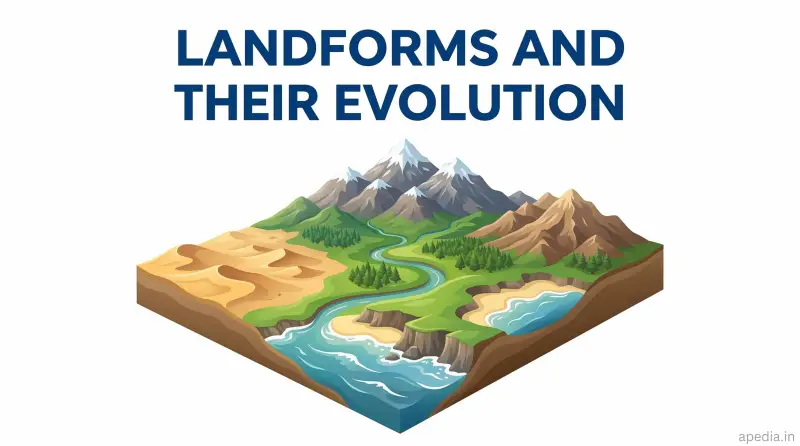
In humid regions where rainfall is heavy, running water is the most powerful agent breaking down the land surface. Rivers act like busy artists, carving out the earth in stages just like human life: Youth, Mature, and Old Age.
Key Features of River Work
- Valleys & Canyons: Rivers start by cutting deep V-shaped valleys. A deep valley with extremely steep, straight sides is called a gorge. When it has step-like slopes, it’s known as a canyon.
- Plunge Pools: At the bottom of beautiful waterfalls, the sheer impact of water creates massive, deep holes called plunge pools.
- Depositional Forms: When rivers reach gentler slopes, they lose their speed and drop their materials. This creates alluvial fans at the foot of mountains and vast deltas when they meet the sea.
📝 Concept Check 1
1. Which geomorphic agent is the most powerful in heavy rainfall regions?
Running water
2. What do we call a deep valley with step-like side slopes?
Canyon
3. What is the large hole created at the base of a waterfall called?
Plunge pool
4. What cone-shaped deposit forms when a steep mountain stream hits a flat plain?
Alluvial fan
🕳️ Module 2: Groundwater - The Hidden Artist
Not all water flows on the surface! When water trickles down into rocks like limestone or dolomite, it slowly dissolves them through a chemical process, creating magical underground landscapes known as Karst Topography.
Underground Wonders
- Sinkholes: These are funnel-shaped depressions on the surface created when limestone dissolves. Sometimes, the roof of an underground cave collapses, creating a sudden, deep hole.
- Caves: Over time, water moving horizontally through cracks creates long, empty gaps underground called caves.
- Stalactites & Stalagmites: Inside caves, dripping water leaves behind calcium carbonate. Stalactites hang like beautiful icicles from the ceiling, while Stalagmites slowly rise up from the cave floor. When they eventually meet, they form a solid pillar.
📝 Concept Check 2
1. What kind of topography is formed by groundwater in limestone areas?
Karst topography
2. What funnel-shaped surface depressions form from dissolving limestone?
Sinkholes
3. What do you call the icicle-like rock formations hanging from cave ceilings?
Stalactites
4. What forms when a stalactite and stalagmite fuse together?
A pillar or column
🧊 Module 3: Glaciers - The Icy Giants
Imagine massive rivers of ice slowly creeping down a mountain—these are Glaciers. Even though they move very slowly, their sheer weight causes unbelievable friction, giving them the power to carve through solid rock and drastically reshape mountains.
Glacial Signatures
- Cirques & Horns: Cirques are deep, bowl-shaped troughs carved into mountain tops. When multiple cirques cut back into each other, they create a sharp, pointed peak called a Horn (like the famous Mount Everest!).
- U-Shaped Valleys: Unlike rivers that carve V-shapes, glaciers carve broad, smooth U-shaped valleys as they bulldoze their way down.
- Moraines & Eskers: As glaciers melt, they drop all the rocky debris they were carrying. These long ridges of dropped debris are called Moraines. Winding ridges of gravel left by streams flowing *under* the ice are called Eskers.
📝 Concept Check 3
1. What do we call large masses of ice moving slowly over land?
Glaciers
2. What deep, bowl-shaped troughs are commonly found at glacial valley heads?
Cirques
3. What shape of valley does a glacier typically carve out?
U-shaped
4. What are the long ridges of unsorted glacial debris called?
Moraines
💨 Module 4: Waves & Winds - Coastal and Desert Carvers
Finally, let's look at the edges of the land and the driest places on Earth. Coastal processes are incredibly dynamic, powered by the constant smashing of Waves. Meanwhile, in hot, dry deserts, Winds become the master builders.
Coastal and Desert Formations
- Cliffs & Beaches: Powerful waves cut steep cliffs into high rocky coasts. Over time, eroded materials are ground down and deposited to form soft, sandy beaches.
- Mushroom Rocks: In deserts, wind blasts sand against rocks, wearing away their bases faster than their tops, creating rocks that look like giant mushrooms.
- Sand Dunes: Winds are excellent at sorting sand. When the wind slows down, it drops sand to create dunes. Crescent-shaped dunes are called Barchans, and those with only one wing are called Seifs.
📝 Concept Check 4
1. Which agent is mostly responsible for creating sea cliffs and beaches?
Waves
2. What desert feature is created when wind erodes the base of a rock faster than the top?
Mushroom rock
3. What is the name of a crescent-shaped sand dune?
Barchan
4. What type of sand dune is similar to a Barchan but has only one wing?
Seif