🕊️ Freedom
🌟 Module 1: The Ideal of Freedom
Freedom is a powerful ideal for which individuals and societies have historically sacrificed everything. In its essence, freedom represents the desire of people to control their own destinies and express themselves without unjust domination.
Inspiring Figures
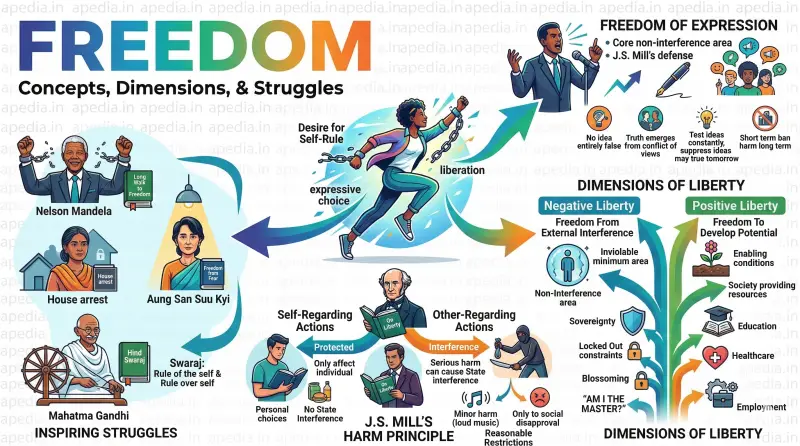
- Nelson Mandela: In his autobiography, Long Walk to Freedom, Mandela details his 27-year struggle against the racist apartheid regime in South Africa. For him, freedom meant removing unjust constraints that discriminated against people based on their race.
- Aung San Suu Kyi: Inspired by Mahatma Gandhi, she fought for her people in Myanmar while enduring strict house arrest. In her book, Freedom from Fear, she asserts that real freedom is living a dignified life without fear of authority or societal ridicule.
- Swaraj: In Indian political thought, freedom is analogous to Swaraj (Swa = Self, Raj = Rule). Mahatma Gandhi in Hind Swaraj emphasized it as both the rule of the self and rule over the self—a liberation that redeems self-respect.
📝 Concept Check 1
1. Who wrote the autobiography "Long Walk to Freedom"?
Nelson Mandela
2. According to Aung San Suu Kyi, what is real freedom?
Freedom from fear
3. What does the term 'Swaraj' translate to?
Rule of the self and rule over self
4. Which regime did Nelson Mandela struggle against in South Africa?
The apartheid regime
⚖️ Module 2: Defining Freedom and the Harm Principle
A simple definition of freedom is the absence of external constraints. However, total absence of constraints leads to chaos. We need mechanisms to settle disputes and prevent violence.
John Stuart Mill's Harm Principle
In his essay On Liberty, J.S. Mill provided a framework for deciding when society or the state can interfere with an individual's freedom.
- Self-Regarding Actions: Actions that only affect the individual performing them. The state has no business interfering here (e.g., what clothes you wear at home).
- Other-Regarding Actions: Actions that have consequences for others. If an action causes serious harm to others, the state can forcefully interfere.
- Minor Harm vs. Serious Harm: Mill argued that "minor harm" (like a neighbor playing loud music) should only provoke social disapproval, not police action. The force of law should only be used to prevent serious harm. In India, justifiable constraints are legally referred to as reasonable restrictions.
🔄 Module 3: Negative Liberty, Positive Liberty, and Expression
Political theory divides freedom into two major dimensions.
Dimensions of Liberty
- Negative Liberty: Focuses on the "freedom from" external interference. It carves out an inviolable minimum area where the individual is completely sovereign.
- Positive Liberty: Focuses on "freedom to" develop one's potential. It argues that an individual is like a flower that needs fertile soil; therefore, society must provide enabling conditions like education, employment, and resources.
Freedom of Expression
Considered a core part of the minimum area of non-interference, freedom of expression is heavily defended by J.S. Mill. Mill provided four reasons why even "false" ideas should not be banned:
1) No idea is entirely false.
2) Truth emerges from the conflict of opposing views.
3) Truth risks becoming an unthinking cliché if not constantly tested.
4) Ideas considered false today might be proven true tomorrow. Banning books or films is a short-term fix that harms society in the long run.
📝 Concept Check 2
1. What kind of actions, according to Mill, have consequences only for the actor?
Self-regarding actions
2. Which concept asks the question, "Over what area am I the master?"
Negative Liberty
3. How should society react to "minor harm" like loud music, according to Mill?
With social disapproval, not legal force
4. What term does the Indian Constitution use for justifiable constraints?
Reasonable restrictions